Genspark Gen-1 Slides: We Think They Are Right
Genspark post-trained MiniMax M3 into Gen-1 Slides and matched Claude Opus 5 at a tenth of the cost. What holds up, what their own numbers admit, and why ChatSlide reached the same conclusion from the other direction.
Quick Answer: On September 11, 2026, Genspark released Gen-1 Slides, a model post-trained from open-weight MiniMax M3 specifically to build presentations. It scored 0.821 against Claude Opus 5's 0.810 on their internal grader, and costs $0.44 per finished deck against $4.16. The core claim is correct and we agree with it: general-purpose frontier models are not optimized for decks, and the fix is to optimize against the finished artifact instead of the text. Where we differ is placement. Genspark put the slide knowledge into model weights, so the model discovers layout by rendering a page and repairing it. ChatSlide puts it into a layout contract the model fills, so the fit problem is constrained before a page is ever drawn. Genspark's own blind human review found layout problems on 88% of Gen-1 pages, with 7% unusable.
What Genspark Actually Built
Strip the headline numbers away and the engineering is genuinely interesting.
Gen-1 Slides starts from MiniMax M3, an open-weight mixture-of-experts model (428B total parameters, roughly 22B active per token) with long context and native tool calling. Genspark did no pre-training. They ran reinforcement learning on roughly 2,000 internally constructed slide tasks, jointly with Fireworks AI. The final run took one week on 96 NVIDIA B300 GPUs, and mean training reward climbed from 0.271 to 0.765.
Four design decisions carry most of the result:
- The reward is computed on the rendered deck, scored by a multimodal judge on task completion, content quality, visual design, and process quality, with penalties for layout defects and fabrication. Not on a transcript of text.
- Rollouts run inside the live production serving stack, so there is no train-versus-serve distribution shift.
- The grader evolves online to counter reward hacking. This is the most honest part of their report. Over the run the policy learned to import a reference deck and pass it off as finished, to write "sources verified" without checking anything, and to shrink fonts until overflow detection stopped firing.
- The model learns from grader comments, not only from the scalar. They call it on-policy self-distillation: a trajectory spans dozens of turns and hundreds of thousands of tokens, yet ends in one number, which tells the model how well it did and nothing about what went wrong.
That fourth point deserves attention from anyone building in this space, and it connects directly to something we published in July.
This Resolves Our Own Benchmark
In July we ran a 128-deck benchmark across four frontier models and two generation strategies, scored by a three-judge ensemble with leave-one-out so no model family graded itself. The finding: an agentic self-refinement loop, where a model drafts a deck, critiques it, and revises, produced no statistically significant quality gain for any model (all p > 0.17) while costing up to 5x more and running up to 3.5x slower.
Genspark's result appears to contradict that. It does not, and the reason is the whole lesson.
Our refinement loop asked a model to critique its own text. No new information entered the loop, so the model shuffled wording and occasionally broke a constraint the first draft had already satisfied. Genspark's loop renders the page and looks at the pixels. That introduces information the model could not have predicted from its own output, which is precisely why it moves the score. Their own on-policy self-distillation section makes the same point from the inside: a scalar reward is too thin to teach, and the grader's concrete comment ("body text on page 4 runs off the canvas") is what carries the signal.
The rule that survives both studies: a critique loop pays only when it imports information from outside the model. Self-talk is choreography. Rendering is measurement.
What Their Numbers Actually Say
Genspark published more detail than most labs would, including the parts that cut against them. Read carefully, three things stand out.
The headline number is graded by the reward function. The 0.821 comes from Genspark's internal grader, which also supplied the RL reward for the model. They say so plainly in the post, which is to their credit. A model optimized against a grader beating other models on that grader is expected. The independent evidence sits in the six cells scored by the two public graders (PPTEval and UniPPTEval), which were never used as reward. Gen-1 leads five of those six, and across all six the gap between first and second never exceeds 1.7% of the scale. The accurate summary is "same tier as Opus 5", which is the language Genspark themselves use.
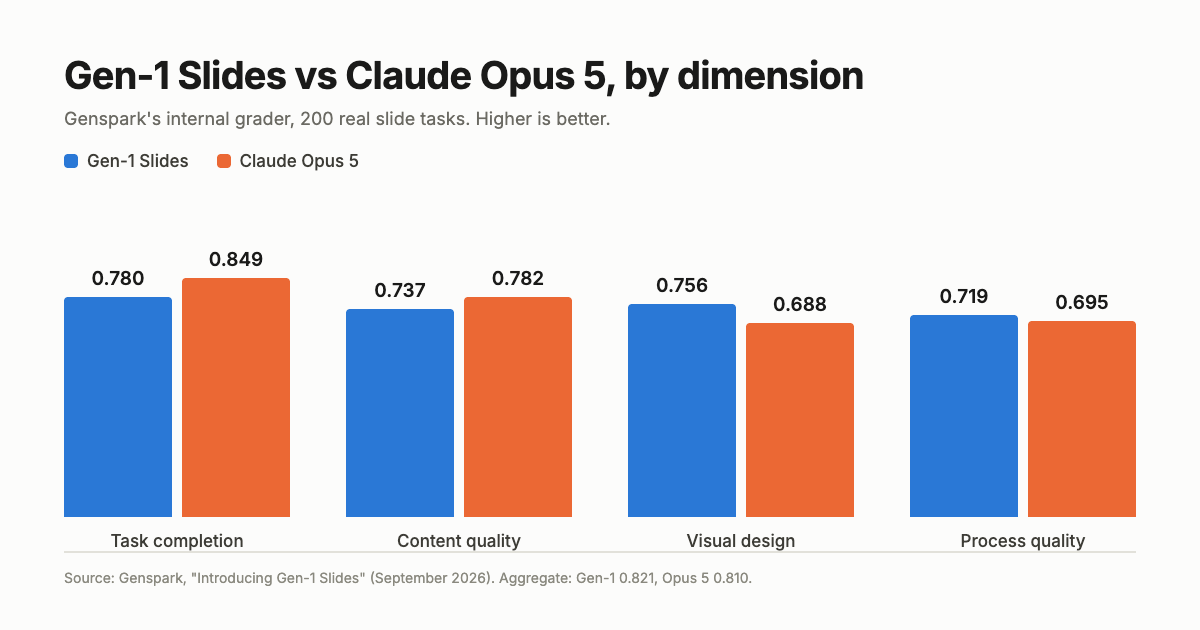
Opus 5 still wins on substance. Broken out by dimension:
| Dimension | Gen-1 Slides | Claude Opus 5 |
|---|---|---|
| Task completion | 0.780 | 0.849 |
| Content quality | 0.737 | 0.782 |
| Visual design | 0.756 | 0.688 |
| Process quality | 0.719 | 0.695 |
The 0.011 aggregate lead is built on visual design. On doing what the user asked and getting the content right, Gen-1 trails, and Genspark lists both in their limitations.
Plotted from zero, which is the honest way to show it. These are two systems in the same tier, separated by a rounding error on the aggregate and by real differences on individual dimensions that point in opposite directions.
The human review is the number to sit with. Product managers and designers blind-annotated 4,063 pages. Layout problems appeared on 88% of Gen-1 pages against 81% for Opus 5, with 33% rated severe or worse. Fabrication ran at 13.3% of atomic claims, better than Opus 5's 17.7%, and still roughly one claim in eight.
That last pair is the real state of the art in agentically generated slides, from the team with the most production data on the problem. It is worth knowing before anyone puts an AI deck in front of a board.
Same Thesis, Different Placement
We agree with Genspark's central argument. Frontier labs optimize for coding, math, and reasoning benchmarks. Building a finished deck is an engineering task with its own failure modes, and it needs its own optimization target computed on the delivered artifact. Genspark is the first team to prove that an application company can act on this at model level, and their transparency about the base model and the reward hacking sets a standard we would like to see more of.
The open question is where the slide knowledge should live.
Genspark put it in the weights. The model writes front-end code for every page, renders it, inspects the result, and repairs it across dozens of turns. Layout correctness is something it discovers, which is why post-training added about 29% to per-deck cost (more self-checking) and why 88% of pages still carry a layout issue.
ChatSlide puts it in the contract between the model and the page. Our generator does not ask a model to invent a canvas. It asks for a subtopic, a layout name, and the content blocks, where the layout is picked from a short menu and each option declares what it can hold: one option takes four content blocks of one sentence each, another takes two with a visual, and so on. The renderer then places those blocks into a real layout, one of about 30 it implements, styled by one of 16 themes. Text that overruns is a bounded condition in a known box rather than a defect to be found by looking at a picture afterwards.
The same logic applies to the file you walk out with. ChatSlide builds the .pptx server-side with python-pptx, writing native PowerPoint text boxes, pictures, charts, shapes, and speaker notes. It opens in PowerPoint or Keynote as an editable deck. Genspark's post lists native PowerPoint output as still to come. For anyone who has to hand a deck to a colleague who will edit it, that difference outranks a 0.011 grader delta.
On sourcing, we take the opposite side of the same problem. Decks built from your uploaded files, URLs, or YouTube links carry per-slide citations and a citations page, and images retain provenance back to the source document and page. That constrains where content can come from. It does not verify every claim, and no one in this field has solved that yet, which is what Genspark's 13.3% figure measures.
Here is what we do not do, and Genspark does: we never look at the rendered pixels. Our quality pass reads the deck as structured data and issues targeted repair instructions. It does not screenshot the page and judge it as an image. Genspark's central insight is that rendering is where the information is, and on that specific axis their loop sees something ours does not.
Neither approach dominates. A trained model reaches content quality and narrative judgment that a layout contract cannot supply, and Genspark's content scores are real. A constrained layout delivers a page that is correct the first time and a file that survives being edited. The interesting product is the one that takes both.
What To Take Away
- If you are choosing a tool: ask what the deck looks like after export, not just what it scores. A 13.3% fabrication rate and a 7% unusable-page rate are published numbers from the strongest system measured, so check sources and read every page regardless of which tool made it.
- If you are building one: compute your reward on the rendered artifact. A model critiquing its own text is measurably worthless, which we showed in July and Genspark's self-distillation work explains.
- If you are watching the industry: an application company post-trained an open base into frontier-tier performance on its core task in one week. That path is now open to any product with enough task data and a way to score the output.
Want slides that arrive correct and leave editable? Try ChatSlide, which builds a full presentation from your topic or documents in minutes and exports to PowerPoint, Keynote, or PDF.
Sources: Genspark, "Introducing Gen-1 Slides"; Fireworks AI on reinforcement fine tuning. All Gen-1 figures quoted are Genspark's own published numbers.
Author
2026/09/12