Quick Answer: In a controlled 2026 benchmark of 128 AI-generated decks, GPT-5.6 (4.64/5) and Claude Opus 4.8 (4.59/5) tied for the best single-shot slide quality, ahead of Gemini 3.1 Pro (4.18) and GPT-4o (3.96). The surprise: adding an "agentic" self-refinement loop (generate → self-critique → revise) produced no statistically significant quality gain for any model (all p > 0.17), while costing up to 5x more and 3.5x slower, and it occasionally broke the requested slide count. The takeaway for building an AI slide tool: pick a stronger base model, don't bolt on a self-critique agent. ChatSlide uses a GPT-5-class model for exactly this reason.
Why This Question Matters
If you are choosing an AI tool to build presentations, or building one yourself, the obvious instinct in 2026 is to reach for the most "agentic" setup you can: let the model draft a deck, critique its own work, and revise until it is happy. More steps, better slides. Right?
We put that assumption to a real test. This guide summarizes a controlled benchmark comparing four frontier models across two generation strategies on sixteen diverse slide topics. The result is useful and slightly counterintuitive.
The Setup
We generated 128 slide decks: four models, two strategies each, across sixteen topics (business analysis, science explainers, startup planning, consumer education, technology surveys, history, health, operations, and engineering). Each deck was an eight-slide presentation for a stated audience.
The two strategies:
- Single-shot: one generation call. Prompt in, deck out.
- Agentic self-refinement: the model generates a deck, critiques it against a quality rubric, and revises, up to two rounds.
Every deck was scored 0 to 5 on five dimensions (content, structure, density, design fit, coverage) by a three-judge ensemble of frontier models, using leave-one-out scoring so no model graded its own family.
Which AI Model Makes the Best Slides?
| Model | Single-shot quality (0–5) | Notes |
|---|---|---|
GPT-5.6 | 4.64 | Top content and structure scores |
Claude Opus 4.8 | 4.59 | Statistically tied for first (p = 0.44) |
Gemini 3.1 Pro | 4.18 | Strong, slightly behind the top two |
GPT-4o | 3.96 | Weaker on content and coverage |
GPT-5.6 and Claude Opus 4.8 are effectively tied at the top; the difference between them is not statistically significant. Both clearly outperform the older GPT-4o, which trails mainly because its content is thinner and its topic coverage less complete.

The Surprise: Self-Refinement Doesn't Help
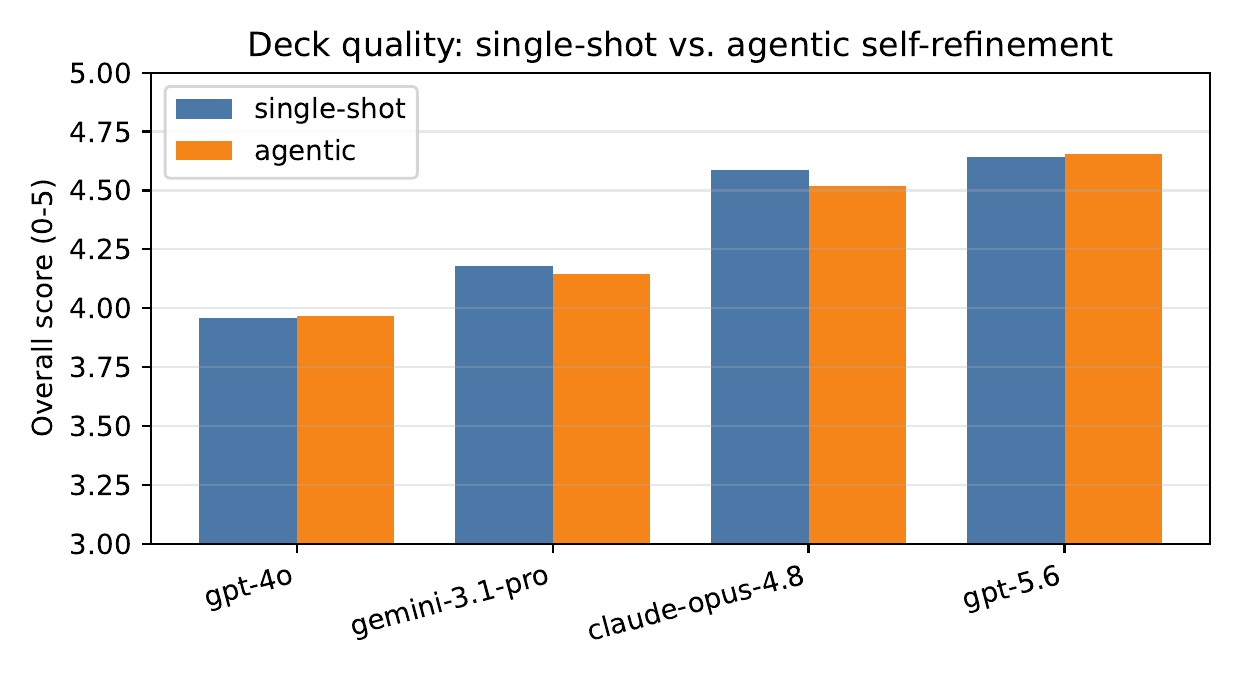
Here is the finding that matters most if you are building or choosing an AI slide generator. Letting the model critique and rewrite its own deck did not reliably improve quality for any model:
| Model | Single-shot | With self-refinement | Change |
|---|---|---|---|
GPT-4o | 3.96 | 3.97 | +0.01 (not significant) |
Gemini 3.1 Pro | 4.18 | 4.14 | −0.03 (not significant) |
Claude Opus 4.8 | 4.59 | 4.52 | −0.07 (not significant) |
GPT-5.6 | 4.64 | 4.66 | +0.01 (not significant) |
Every change is within statistical noise (paired t-tests, all p > 0.17). Meanwhile the self-refinement loop:
- Cost up to 5x more and ran up to 3.5x slower for the OpenAI models.
- Occasionally broke hard constraints. The only decks that came back with the wrong number of slides were mostly in the self-refinement condition, because a revision step can reopen a requirement the first draft had already satisfied.
In plain terms: on frontier models, the first draft is already near the quality ceiling, and asking the model to "improve" it mostly shuffles wording, sometimes for the worse.
What This Means For You
- Choosing an AI presentation tool? Prioritize one built on a current frontier model (a GPT-5-class model or Claude Opus 4.8). That single choice moves quality far more than any clever multi-step pipeline.
- Building one? A well-prompted single generation call from a strong model beats a same-model self-critique loop, at a fraction of the cost and latency. Spend your engineering budget on the base model and the prompt, not on a refinement agent.
- Already using GPT-4o? Upgrading the generation model is worth roughly a 0.6-point jump in measured deck quality, a bigger gain than any refinement trick we tested.
This is exactly how ChatSlide is built. It generates decks in a single strong pass from a GPT-5-class model rather than an expensive self-critique loop, so you get high-quality slides quickly. Drop in a topic, an outline, or a document, and it produces a full deck (and can add AI-narrated avatar videos for async sharing).
A Note on Method (and Honesty)
A few caveats, because benchmarks are easy to overstate:
- Scores come from AI judges, not a large human study, though we used a three-judge ensemble and leave-one-out to reduce bias.
- This is sixteen tasks with one deck format and one refinement design. It is a solid signal, not the final word.
- An earlier six-task pilot had suggested self-refinement helps weaker models. That effect disappeared once we ran more tasks with stricter judging, a reminder that small tests mislead.
The full benchmark, including the harness and raw scores, is available for anyone who wants to re-run it as models evolve.
Bottom Line
For making slides with AI in 2026, capability beats choreography. The best single-shot model (GPT-5.6 or Claude Opus 4.8) produces excellent decks in one pass, and a self-critique loop adds cost without adding quality. Choose the strongest base model, prompt it well, and skip the agent.
Want great slides without the guesswork? Try ChatSlide — it builds professional presentations from your topic or documents in minutes.