
Why Your Opening Matters More Than Anything Else
The first 60 seconds of any presentation determine whether your audience leans in or checks their phone. Before you have shown a single data point, before you have made a single argument, your audience has already formed an impression of you and decided how much attention to give.
This is not pressure — it is an opportunity. A strong opening does not require dramatic flair or years of public speaking experience. It requires a deliberate choice about how to start, and this guide walks you through ten proven approaches with real examples you can adapt immediately.
The 3 Goals of a Strong Presentation Opening
Before choosing an opening strategy, understand what any good opening needs to accomplish:
-
Capture attention. Break through distraction. Your audience is thinking about other things when you start. You need to interrupt that mental activity with something compelling.
-
Establish relevance. Answer the unspoken question every audience member asks: "Why should I care about this?" If you do not answer that in the first minute, many people have already mentally moved on.
-
Set the tone. Your opening signals whether this will be a formal, data-driven presentation or a conversational, story-led one. Match the tone to your context.
Everything below serves one or more of these three goals.
10 Ways to Start a Presentation
1. Open with a Striking Statistic
A single, unexpected number can stop an audience in their tracks — but only if the number is genuinely surprising and relevant to your topic.
Example: "One in four adults will develop a sleep disorder at some point in their life. That means, statistically, at least a quarter of the people in this room already have one or soon will. Today I want to talk about what that costs us — in productivity, in health, and in ways most people never think about."
Why it works: Numbers are concrete. They give the audience something specific to react to, and a well-chosen statistic immediately frames the scale of your topic.
Avoid: Generic statistics that do not surprise anyone. "Social media usage has increased" is not a striking statistic. "The average person now spends 2 hours and 27 minutes per day on social media — the equivalent of 7 years over a lifetime" is.
2. Tell a Short Story
Stories activate the brain differently from abstract arguments. A brief narrative that connects to your topic gives your audience something to follow emotionally before you shift to evidence.
Example: "Three years ago, I got a call from a client at 11pm. She had just lost her biggest account — not because the product was wrong, but because the presentation they gave the board was unclear. The board members could not explain it to each other. That call changed how I think about presenting data. And it is why I am here today."
Why it works: Personal stories build credibility. They show you have real experience, not just theoretical knowledge. Stories also give the audience a reason to pay attention — they want to see how the narrative resolves.
Keep it under 90 seconds. A story that runs too long before getting to the point loses people. Get in, establish the emotional hook, and move to your main topic.
3. Ask a Question (Rhetorical or Real)
Questions engage the audience immediately because they require a response — even if the response is only internal. Rhetorical questions prompt thinking. Direct questions get hands or voices in the room.
Rhetorical example: "What would you do if you had to explain your entire business strategy to someone with no industry knowledge in under five minutes?"
Direct question example: "Quick show of hands — how many of you have sat through a presentation in the last month that you felt was a complete waste of your time?"
Why it works: Questions transfer ownership. Instead of watching you present, the audience is now participating, even if silently. This shift from passive to active listening changes the dynamic of the entire presentation.
Caution: Do not ask a question if you cannot handle an unexpected answer. If you ask the room something and get a response that derails your opening, it is hard to recover.
4. Start with a Bold Claim or Counterintuitive Statement
Opening with something your audience does not expect — or even disagrees with — forces them to pay attention to hear you make your case.
Example: "Networking events are mostly a waste of time. I know that sounds odd coming from someone who runs a professional networking platform. But hear me out — because the research on how professional relationships actually form changed everything about how we built this company."
Why it works: Cognitive dissonance is a powerful attention tool. When you say something that contradicts what people assume to be true, their brains want to resolve the contradiction. They will keep listening to see if you can justify the claim.
5. Use a Prop or Visual Demonstration
A physical object, a surprising image, or an unexpected demonstration can grab attention more effectively than any words — especially if your presentation is visually static.
Example openings:
- Hold up a printed page covered in red marks: "This is what our last investor report looked like after our CFO reviewed it. Today I want to talk about how we fixed the problem that made it look this way."
- Show a before-and-after image without explaining it yet: "I am going to tell you what changed between these two photos by the end of today's session."
Why it works: Visual information is processed faster than text or speech. A prop or striking image establishes your topic instantly and gives audiences a tangible reference point to return to throughout the presentation.
6. Reference Something Specific to Your Audience or Context
Nothing signals "I prepared for this specifically" like referencing something personal to the room — a recent event, a shared challenge, or something that happened at the conference earlier.
Example: "I heard Jamie mention this morning that your team's biggest challenge this quarter is customer retention. Everything I am going to cover in the next 30 minutes addresses exactly that — and I am going to give you three things you can implement this week."
Why it works: It shows you did your homework. It also immediately answers the relevance question — the audience knows this is for them, not a generic presentation you give to everyone.
How to prepare: Ask your contact before the event what the audience's top concern is. Look at the event program. Read recent news about the company or industry. Even one specific, accurate reference transforms how the audience perceives you.
7. Open with a Quote
A carefully chosen quote can frame your entire presentation in a single sentence — as long as it is genuinely relevant and not overused.
Example: "Winston Churchill once said: 'A good speech should be like a woman's skirt: long enough to cover the subject, and short enough to create interest.' I am going to try to do that today — cover everything you need without overstaying my welcome."
Why it works: Quotes borrow credibility from recognized authorities and give you a memorable anchor to return to at the end. They also signal that you have thought carefully about your topic.
Avoid: Overused quotes ("Albert Einstein said insanity is doing the same thing...") and quotes that are only vaguely connected to your topic. A tangential quote tells the audience you ran out of ideas.
8. State a Problem Your Audience Faces
Frame your opening around a specific, painful problem your audience experiences. This works especially well for sales presentations, training sessions, and pitches.
Example: "You spend four hours building a quarterly report. You email it to twelve stakeholders. Three of them actually read it. Two of them ask questions that are answered in the report. And the decisions that depend on that report get delayed by another two weeks. That cycle is exactly what we built this product to fix."
Why it works: It shows empathy. It proves you understand your audience's reality before asking them to trust your solution. And it creates immediate emotional relevance — the audience is nodding because they recognize themselves in your description.
9. Begin with Silence or a Pause
Counterintuitively, not saying anything for 5–10 seconds at the start of a presentation can be one of the most powerful openings. The pause forces the audience to focus on you.
How to do it: Walk to the front. Make eye contact with several people in the room. Say nothing. Let the anticipation build. Then begin.
Why it works: Most speakers rush to fill silence because it is uncomfortable. By resisting that impulse, you signal confidence. The room also gets quiet — background conversations stop, phones go down. You have established control without saying a word.
Pair the pause with something. After the silence, show a provocative image on your first slide, ask a question, or make a bold claim. The pause primes the audience for whatever comes next.
10. Use the "Imagine if..." Framing
Inviting your audience to imagine a scenario pulls them mentally into your topic before you have presented any facts.
Example: "Imagine you are presenting to your company's board in 48 hours. You have the data. You know the story. But you do not have enough time to build a presentation that does justice to the work your team has done. What do you do?"
Why it works: It activates imagination, which makes the listening experience feel personal. The audience is not hearing about something abstract — they are mentally experiencing a situation, which primes them to care about your proposed solution.
What Not to Do in Your Opening
Just as important as what to do:
Do not start with "Today I am going to talk about..." This is the presentation equivalent of saying "This story I am about to tell is going to be very interesting." State your topic through your opening strategy, not by announcing it explicitly.
Do not apologize. "Sorry, I have a bit of a cold today" or "I know you have all been in sessions all day, so I will try to keep this brief" immediately lowers the audience's expectations and your credibility.
Do not start with a lengthy self-introduction. Unless you are the keynote speaker at a conference where nobody knows you, a long bio kills momentum. Your work will establish your credibility — do not spend the first three minutes telling people why they should listen to you.
Do not open with a joke unless you are confident it will land. A joke that falls flat in the first 30 seconds is almost impossible to recover from.
How to Structure the First 3 Minutes
A reliable structure for any presentation opening:
| Time | Content |
|---|---|
0–60 seconds | Opening hook (one of the 10 strategies above) |
60–90 seconds | Context: why this matters now |
90–120 seconds | Preview: what you will cover and what they will be able to do after |
120–180 seconds | Transition to your first main point |
The preview step is optional for shorter presentations (under 15 minutes), but essential for longer ones. Audiences pay closer attention when they know where they are going.
Using AI to Build Your Opening Slide
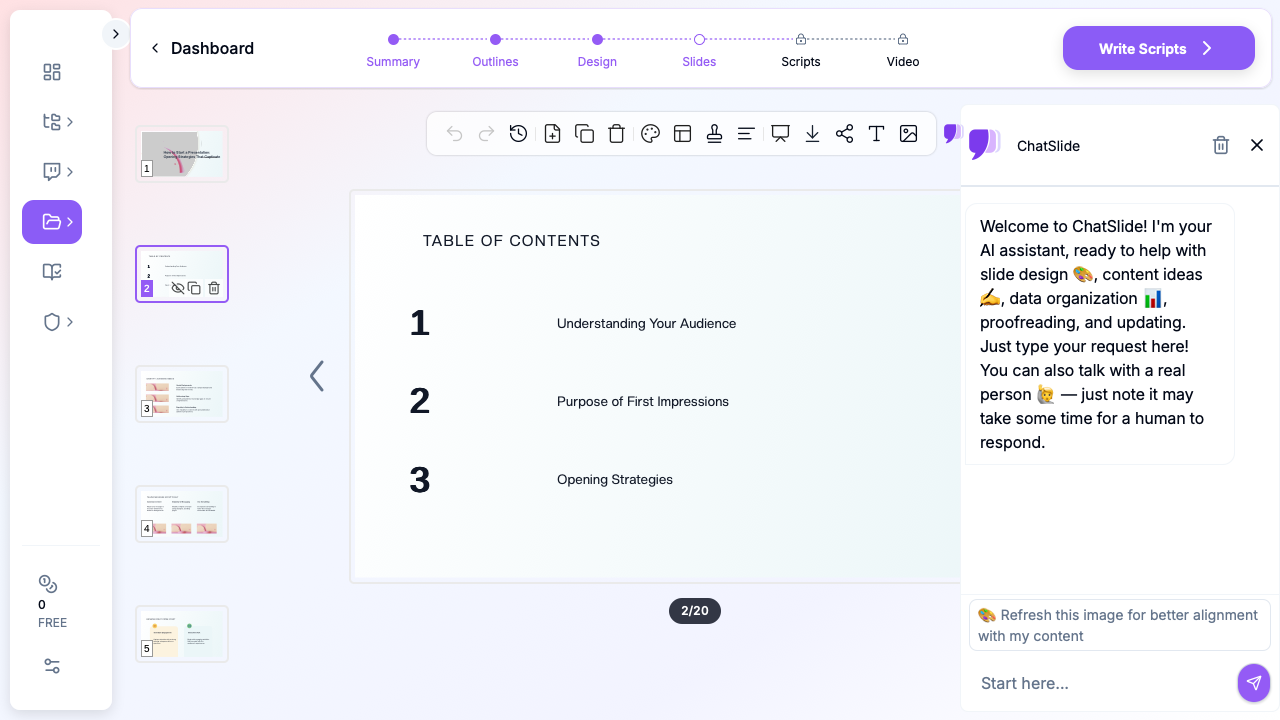
Your opening strategy requires a matching first slide. A compelling opening line paired with a cluttered, text-heavy first slide creates cognitive dissonance — the spoken experience and the visual experience do not match.
ChatSlide AI generates presentation slides from a topic or document, including a strong title slide and opening section designed to match the tone of your content. You can use the AI-generated structure as a starting point and adjust the opening slide to match whichever strategy you choose above.
This is particularly useful when you are building a presentation from scratch and want a clean visual foundation to work with, rather than spending time on layout before you have the content.
Adapting Your Opening to the Context
The right opening strategy depends on where you are presenting:
| Context | Best Strategies |
|---|---|
Job interview presentation | Specific problem you identified, bold claim |
Investor pitch | Striking statistic, "imagine if" scenario |
Sales presentation | Problem the audience faces, specific reference to them |
Academic lecture | Question, counterintuitive statement |
Conference keynote | Story, striking statistic, prop or visual |
Team meeting | Question, problem statement |
Training session | Story, bold claim |
Match the formality to the room. A story that works in a startup all-hands meeting may feel too casual in front of a hospital board.
Frequently Asked Questions
How long should a presentation introduction be?
For a 10-minute presentation, your introduction should be no more than 90 seconds. For a 30-minute presentation, 2–3 minutes is appropriate. For an hour-long session, 4–5 minutes is acceptable. The rule of thumb is roughly 10–15% of total time for the opening.
Should I introduce myself at the beginning?
Only if the audience does not know you. Even then, keep it to one or two sentences — your name, your role or institution, and optionally one credential directly relevant to the topic. Save the full bio for the end, when the audience has a reason to care.
What if I am nervous and forget my opening?
Have your opening written out in your speaker notes. Not as a script to read — as a safety net. Write the first sentence verbatim so you always have a clear starting point if your mind goes blank. Practice that first sentence until it is automatic.
How do I open a virtual presentation?
The same strategies apply, but virtual audiences have more distractions. Start with your camera on, maintain eye contact with the lens (not the screen), and open with something that creates immediate engagement — a question, a bold claim, or a striking statistic — before diving into any setup or logistics.
Can I use humor to open a presentation?
Yes, but use self-deprecating or situational humor rather than jokes that depend on timing or require setup. Self-deprecating humor builds rapport. Situational humor (referencing something that just happened in the room) shows you are present. Both are safer than prepared jokes.
Summary
The best presentation openings are deliberate, not default. Most people default to announcing their topic, which wastes the most valuable 60 seconds of any presentation. Instead, choose one of the ten strategies above: a striking statistic, a story, a question, a bold claim, a visual demonstration, a reference to your specific audience, a quote, a problem statement, a strategic pause, or an "imagine if" scenario.
Your opening sets the tone for everything that follows. Get it right, and the rest of the presentation has an easier job.