
Why Medical Billing Training Needs Better Presentations
Medical billing is one of the most detail-intensive functions in healthcare. From verifying patient eligibility to appealing denied claims, billing teams handle thousands of codes, rules, and payer-specific requirements every day. When training goes wrong, the consequences show up fast: higher denial rates, slower reimbursements, and frustrated staff.
Yet most billing training still relies on dense text documents, outdated slide decks copied from previous years, or informal walkthroughs that vary from trainer to trainer. The result is inconsistent knowledge across the team and preventable errors that cost real money.
The challenge is not a lack of information. Billing managers typically have deep expertise in CPT codes, ICD-10 mappings, payer policies, and appeal workflows. The problem is turning that expertise into clear, structured training materials without spending days on slide design.
What Makes Effective Medical Billing Training Slides
Strong billing training presentations share a few characteristics that set them apart from generic slide decks.
Structured around real scenarios. The best billing training walks through actual claim scenarios: a clean claim submission, a common denial reason, an appeal workflow. Abstract rules are hard to remember; concrete examples stick.
Visual workflow clarity. Billing processes involve multiple handoffs between registration, coding, submission, follow-up, and appeals. A well-designed slide can show the entire revenue cycle at a glance, helping new staff understand where their work fits in the bigger picture.
Code and payer specificity. Generic presentations that say "verify eligibility" without showing what that looks like in practice do not help. Effective training includes examples of specific denial codes, payer rejection reasons, and the exact steps to resolve them.
Consistent formatting for reference. Billing staff return to training materials regularly. Slides that follow a consistent structure — with clear headings, numbered steps, and highlighted key terms — work better as ongoing reference tools.
Building Medical Billing Slides with ChatSlide
Creating a comprehensive billing training deck traditionally takes days of work. Here is how AI changes that workflow.
Start with Your Topic and Audience
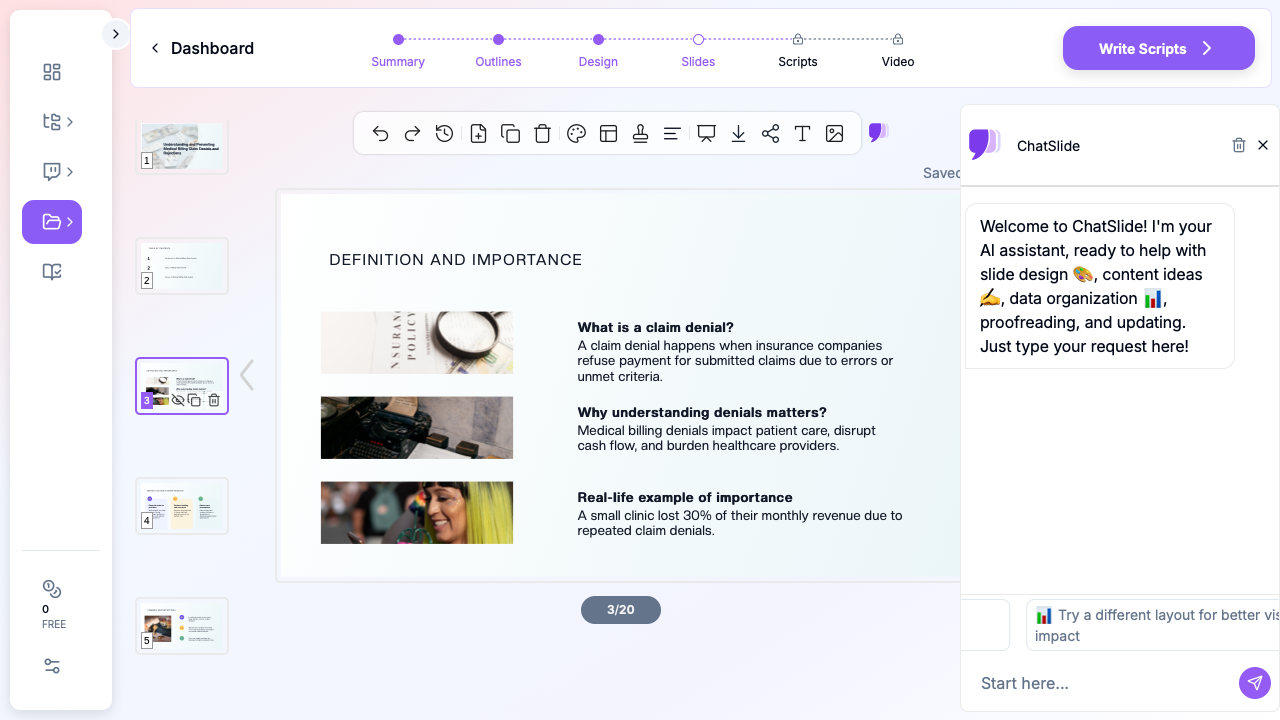
Open ChatSlide and describe your training topic. Be specific about the billing area you are covering. Instead of "medical billing training," try something like "Understanding and preventing claim denials for outpatient services" or "Revenue cycle management overview for new billing staff."
Specifying your audience matters. Training for newly hired billers needs different depth than a refresher for experienced coders or a compliance update for the entire department.
Let AI Structure Your Content
ChatSlide analyzes your topic and generates a logical outline covering the key sections a billing training should include. For a claim denial presentation, this might cover:
- Definition and types of claim denials vs. rejections
- Most common denial reason codes and their causes
- Prevention strategies at each stage of the revenue cycle
- The appeals process with timelines and documentation requirements
- Key performance metrics for tracking denial rates
You can adjust the outline before generating slides — adding sections specific to your organization's payer mix or removing topics your team already covers well.
Generate and Customize Slides
Once you approve the outline, ChatSlide creates a complete slide deck with formatted content, relevant images, and a professional layout. Each slide focuses on one concept, making it easy for your audience to follow along.
The generated slides are fully editable. You can add your organization's specific denial data, insert screenshots from your billing software, or adjust terminology to match your payer contracts.
Add Your Organization's Data
The AI gives you the structure and general content, but the most effective training includes your own numbers. Add slides showing:
- Your facility's top five denial reasons from the past quarter
- Before-and-after metrics from process improvements
- Payer-specific requirements that differ from the general guidelines
- Screenshots of your practice management system showing correct workflows
This combination of AI-generated structure and organization-specific data creates training materials that are both comprehensive and immediately relevant.
Common Medical Billing Training Topics
Here are specific billing topics that work well as AI-generated presentations:
Claim Denial Prevention. Cover the most frequent denial categories — eligibility issues, authorization failures, coding errors, and timely filing — with prevention checklists for each.
ICD-10 and CPT Coding Updates. Annual code changes require regular training. A structured presentation covering new codes, revised guidelines, and deleted codes helps coders stay current.
Payer-Specific Billing Rules. Different insurance companies have different requirements for prior authorization, modifier usage, and documentation. Create separate decks for your major payers.
Appeals and Follow-Up Workflows. Walk through the complete appeal process from initial denial review through external appeals, including documentation requirements and deadline tracking.
Compliance and Audit Preparation. Cover documentation standards, risk areas for audits, and best practices for maintaining clean records that withstand payer reviews.
New Staff Onboarding. Create a comprehensive onboarding deck that covers the revenue cycle end-to-end, from patient registration through final payment posting.
Research and Regulatory Reference Integration
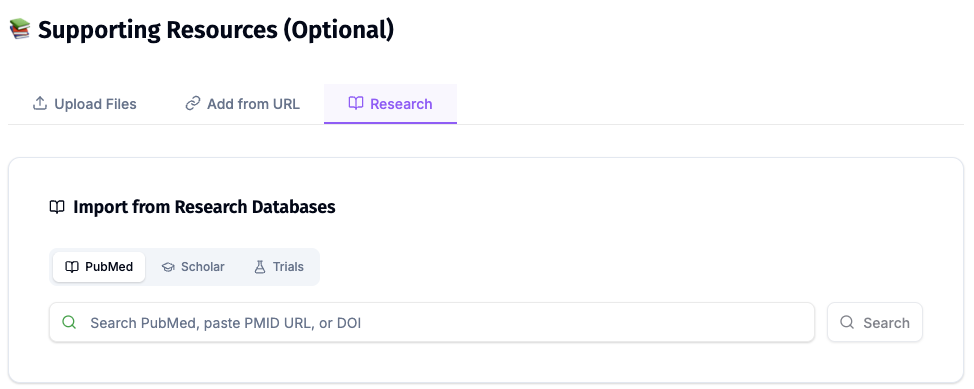
For billing training that references clinical coding guidelines, compliance studies, or healthcare policy research, ChatSlide includes built-in access to PubMed, Google Scholar, and ClinicalTrials.gov (NCT) through its Research tab. Search for published studies on denial rate reduction strategies, coding accuracy research, or revenue cycle management best practices and import them directly into your training materials.
Direct Research Database Access
ChatSlide's Research tab connects to the databases physicians use daily:
- PubMed: Search by keyword, PMID, or DOI. Find the landmark trials, recent publications, and clinical guidelines relevant to your case. The AI reads abstracts and incorporates key findings into your slides with citations.
- Google Scholar: When your topic spans disciplines — say, the intersection of genetics and oncology — Scholar captures the broader academic literature that PubMed alone might miss.
- Clinical Trials (NCT): Presenting on a treatment where pivotal trials are ongoing? Search by NCT number or condition to pull trial design, endpoints, and status into your slides.
Tips for Medical Billing Presentations
Use real denial code examples. Instead of saying "incorrect coding causes denials," show a specific scenario: "Claim denied with CO-4 (modifier required) because modifier 25 was missing on the E/M code billed with a procedure."
Include workflow diagrams. The revenue cycle has many steps. A single visual showing the flow from scheduling through payment posting helps staff understand how their role connects to the whole process.
Break complex topics into steps. When explaining an appeals process, number each step clearly. When covering coding guidelines, use decision trees rather than long paragraphs.
Keep regulatory references current. Medical billing rules change frequently. Include the effective date for any guidelines you reference, and plan to update your training materials at least annually.
Test knowledge along the way. Add scenario-based questions between sections. "A claim is denied with reason code CO-16. What is the most likely cause, and what is your first step?" This keeps the audience engaged and reinforces learning.
Get Started
Medical billing training does not need to take weeks to prepare. With ChatSlide, you can turn your billing expertise into structured, professional training slides in minutes. Upload your existing documentation or start from a topic description, and let AI handle the formatting while you focus on the content that matters.
Visit ChatSlide to create your first medical billing presentation today.
A note on patient data and HIPAA. ChatSlide's standard plans are not a HIPAA-covered service — keep PHI out of slide content, prompts, and uploads. For hospital systems, group practices, and clinics that need a Business Associate Agreement, our Enterprise plan offers HIPAA-compliant deployment options — contact us to discuss BAA terms, SSO, and private-cloud or on-prem hosting.