
Quick Answer: ChatSlide is an AI clinical case presentation maker designed for clinicians and researchers. It turns a de-identified case — history, labs, imaging reports, and the relevant literature — into a structured HPI → workup → differential → management → teaching-points deck in under 2 minutes, with built-in PubMed search, OCR for scanned records, and real charts from lab trends.
The Clinical Case Presentation Problem
Residents and attendings present cases constantly — morning report, noon conference, M&M, tumor board, case reports for publication. Each one means pulling a scattered story (admission note, labs over time, radiology reads, path, the guideline that applies) into a clean teaching narrative, usually the night before.
The hard part isn't the slides. It's that a good case presentation has requirements generic AI tools ignore:
- A clinical structure — chief complaint, HPI, exam, labs, imaging, differential, workup, management, outcome, teaching points — not a marketing story arc
- Data over time — trending a creatinine, a white count, or a tumor marker across a hospital course, from real values
- Evidence — the landmark trial or guideline that justifies the management, cited
- Mixed, messy sources — a scanned outside record, a PDF discharge summary, a photo of a chart
- Accuracy — clinical language preserved, not oversimplified into consumer copy
Generic tools like Gamma, Tome, or Beautiful.ai produce marketing-style slides. They often need more manual work to trend a lab from your values, search the literature, or read a scanned record.
What Makes ChatSlide Work for Clinical Cases
3 Input Modes for a Messy Case
Real cases live in different formats. ChatSlide takes all of them:
- File Upload — Upload the discharge summary (PDF), a labs export, a Word note, or images of scanned outside records. OCR extracts text from scans and photos automatically.
- Web and PubMed/URL — Paste a guideline URL or pull the supporting paper directly (see below).
- Text Prompt — Type the case in shorthand and let the AI structure it into the standard case format.
You can combine them — upload the chart and type the teaching point you want the case to land.
Keep it de-identified. ChatSlide's standard plans are not a HIPAA-covered service. Do not upload PHI, and follow your institution's de-identification policy before sharing any case. For a Business Associate Agreement, see the Enterprise note at the end.
Built-In PubMed, Google Scholar, and Trials Search
A case presentation is only as strong as the evidence behind the plan. ChatSlide's Research tab searches PubMed, Google Scholar, and ClinicalTrials.gov (NCT) from inside the editor — find the landmark trial or the current guideline, import it, and the AI weaves the finding into your management slide with a citation.
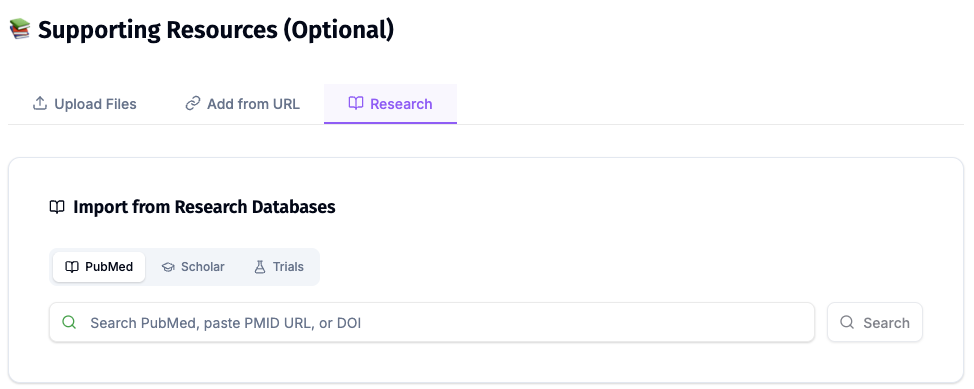
Presenting a resistant-hypertension case at morning report? Search PubMed for the relevant trial, import it, and the differential and management slides come back evidence-backed.
Real Charts from the Hospital Course
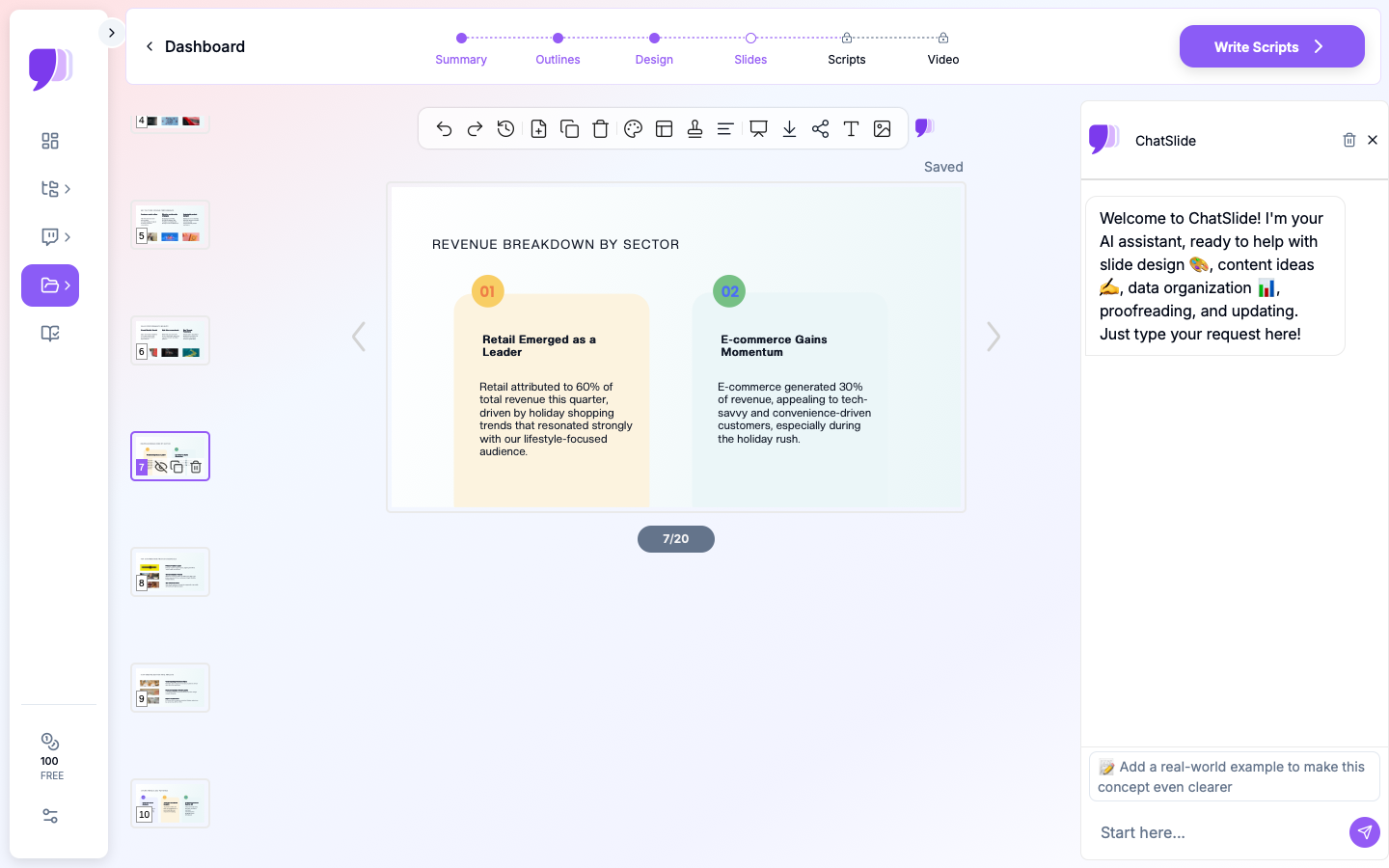
ChatSlide renders charts from actual values with Chart.js and D3 — trend the creatinine across admission, overlay the antibiotic timeline, plot the tumor marker response. These are real data visualizations from the numbers you provide, not decorative stock graphics.
19 AI Editing Tools
After generation, refine with natural-language commands: "Add a differential table ranked by likelihood," "Turn the hospital course into a timeline," "Tighten the teaching points to three." Four editing modes and batch editing give you slide-level control where accuracy matters.
Persistent Knowledge Base
Every paper and record you upload is stored, so the trials you imported for one case are searchable for the next. Build a library that makes every future case faster.
How ChatSlide Builds a Case Presentation
Step 1: Gather the (De-identified) Case
Upload the discharge summary, labs, and imaging reads; search PubMed for the supporting evidence; or type the case in shorthand.
Step 2: AI Structures It
The AI organizes content into the standard case flow — HPI, exam, labs, imaging, differential, workup, management, outcome, teaching points — extracts citations, and builds charts from any values you provide.
Step 3: Edit with 19 AI Tools
"Add an imaging-findings slide," "Create a differential table," "Rewrite speaker notes for a 5-minute morning-report slot."
Step 4: Export and Present
Download as PowerPoint or PDF, present from the browser, or generate a narrated video with an AI avatar for asynchronous teaching.
Frequently Asked Questions
What case formats does it handle?
Any teaching format — morning report, noon conference, M&M, tumor board, grand rounds, and written case reports for submission. Describe the format and the AI structures the deck to fit.
Can it use scanned outside records?
Yes. Built-in OCR extracts text from scanned PDFs, printed records, and photos of charts so legacy paper becomes usable source content.
Does it cite the literature?
Yes. Search PubMed, Scholar, and ClinicalTrials.gov inside ChatSlide, import the sources, and the AI incorporates findings with citations rather than unsupported claims.
How is the data visualization different?
ChatSlide charts your actual values with Chart.js and D3 — trend a lab, plot a response. Other tools insert template graphics.
Is my patient data safe?
Keep all cases de-identified. Standard plans are not HIPAA-covered; remove PHI before uploading. Enterprise offers a BAA (see below).
Can I collaborate with my team or co-residents?
Yes — Teams, Folders, Sharing, and Embed let you co-build and share within your program.
The Clinical Case Presentation: Slide-by-Slide Outline
A standard teaching case runs in this order. Adjust the depth for the format — morning report is tight, grand rounds and written case reports go deeper on discussion and literature.
- Title & one-line summary — age, sex, key presenting problem (de-identified)
- Chief complaint & HPI — the story, chronologically
- Past history, meds, allergies, social/family — the relevant background only
- Exam & vitals — pertinent positives and negatives
- Labs & imaging — trended values and key study findings
- Problem representation / summary statement — one crisp synthesizing sentence
- Differential diagnosis — ranked, with reasoning
- Workup & results — what you ordered and why
- Diagnosis & management — the plan, tied to guideline or trial evidence
- Hospital course & outcome — what happened
- Teaching points — 2–4 takeaways
- References — the literature you cited
Format variants: M&M adds a "what would you do differently" analysis; tumor board centers staging and treatment options; a written case report follows a structured case-report format (abstract, introduction, case description, discussion, conclusion, and references).
Getting Started
Try ChatSlide for Clinical Case Presentations — Upload a de-identified case, search PubMed, and get a structured teaching deck in minutes. Free to start, no credit card required.
ChatSlide is a general-purpose AI presentation platform. Features like PubMed/Scholar/Trials search, OCR, real data charts, and 19 AI editing tools make it well-suited to clinical teaching. All clinical content should be reviewed by qualified professionals before presentation.
A note on patient data and HIPAA. ChatSlide's standard plans are not a HIPAA-covered service — keep PHI out of prompts, uploads, and slides. For hospital systems and group practices that need a Business Associate Agreement, our Enterprise plan offers HIPAA-compliant deployment options — contact us to discuss BAA terms, SSO, and private-cloud or on-prem hosting.