Quick Answer: A board-review-quality echocardiography deck usually needs (1) physics primer — piezoelectric crystals, axial vs lateral resolution, harmonic imaging, (2) knobology — gain, TGC, depth, sector width, frame rate trade-offs, (3) Doppler hemodynamics — Bernoulli, continuity, PISA, with sample-volume placement, (4) chamber quantification — biplane Simpson's, GLS, LA volume index per ASE guidelines, (5) diastolic function — E/e′, septal vs lateral, TR jet, LA volume algorithm, (6) valvular disease — stenosis vs regurgitation grading rules, (7) TEE / focused / POCUS notes. Target 25–35 slides for a 60-minute lecture, 12–15 for a focused board-review session. ChatSlide accepts ASE guideline PDFs and produces the structured lecture format echo programs expect.
The Echo Lecture Tax
Echo is one of the most slide-heavy specialties in cardiology. A single grand rounds on diastolic function might pull from four ASE guidelines, six landmark trials, eight imaging plates, and a decade of accumulated teaching files. Cardiology fellows preparing for the NBE board exam, registered cardiac sonographers (RDCS) on the CCI track, and attendings building a CME workshop all face the same problem: most of the talk is established, well-codified material — the Nyquist limit, the simplified Bernoulli equation, the E/e′ cutoffs — but assembling the deck still eats the whole weekend.
Make the deck the old way and you spend most of Saturday hunting for a clean transducer diagram, redrawing the continuity equation, and copying valve area cutoffs out of the 2017 ASE Quantification document. By Sunday afternoon the talk is half-built and you're cropping screenshots in Preview because PowerPoint mangled the aspect ratio.
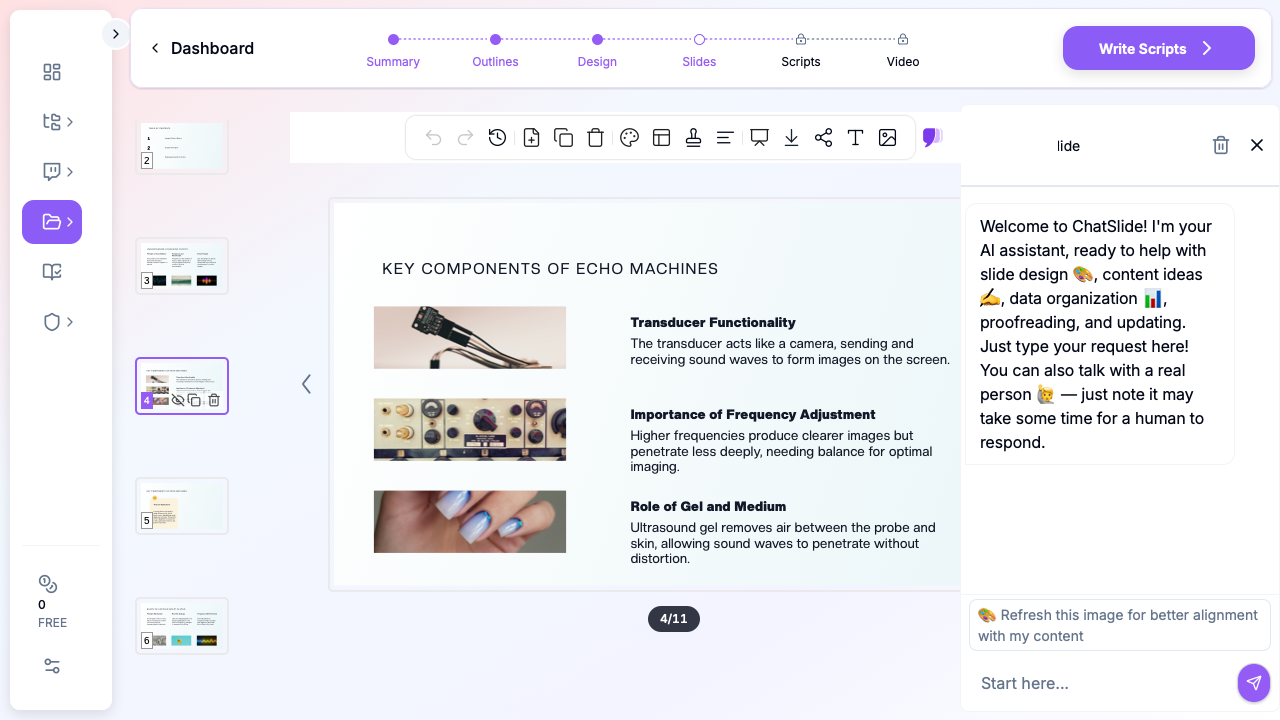
ChatSlide collapses the assembly step. Drop a topic — "Diastolic function assessment per ASE 2016 guidelines" or "Echo physics for the CCEXAM" — and you get a structured lecture deck with a clear pedagogical arc, anatomic and equipment visuals, side-by-side comparison tables, and speaker-ready talking points. You stay in charge of the clinical judgement and image curation; the tool stops eating your weekend.
What a Strong Echocardiography Lecture Actually Needs
Echo audiences are unusually demanding. A first-year fellow, a senior RDCS, and an attending echo lab director will all be in the room — and they all hate the same things. A board-quality echo deck has to hit a specific set of bars:
A physics primer that isn't insulting. The transducer slide gets reused in literally every echo lecture ever given. It still needs to be there for the trainees, but it has to load fast and not waste the senior sonographers' time. A clean diagram with frequency, wavelength, axial resolution, and harmonic imaging on a single plate beats four bullets that re-read a textbook.
Knobology with real trade-offs. Frame rate vs sector width vs depth is the unspoken backbone of half of all echo bench questions. Show the trade-off curve once, refer back to it later. Same with Nyquist limit and aliasing — the moment your slide says "aliasing happens when…" without showing a CW vs PW comparison, your fellows tune out.
Doppler hemodynamics that connect to clinical decisions. The simplified Bernoulli equation isn't interesting on its own. It's interesting when it explains why your AS patient with a calcified valve has a peak gradient of 64 mmHg, a mean of 38, and a continuity-derived AVA of 0.8 cm² — and how those three numbers should agree (and what to do when they don't).
ASE-guideline alignment for quantification. Biplane Simpson's for LVEF, GLS reference range (–18 to –22%), LA volume index ≤34 mL/m², RV S′, TAPSE, and the diastolic algorithm in the 2016 ASE/EACVI joint document. Echo board candidates know these cutoffs cold; your slides need to match them exactly.
Diastolic function delivered as an algorithm, not prose. The four-step algorithm — E/e′, TR jet, LA volume, septal e′ — has to fit on one slide. Senior sonographers will literally photograph that slide if it's clean enough.
Valvular grading rules that you can defend on rounds. Severe AS (Vmax ≥4 m/s, MG ≥40 mmHg, AVA ≤1.0 cm²), severe MR by integrated assessment with PISA where geometry allows, AR diastolic flow reversal in the descending aorta. These are exam-level facts, not opinion.
TEE, stress echo, and POCUS as parallel modalities. Comprehensive lectures need at least one TEE views slide (mid-esophageal 4-chamber, LAA, bicaval, TG short axis) and a stress echo protocol slide. POCUS / FoCUS gets brief treatment but should not be skipped — fellows now encounter it in the ICU and ED before they encounter formal TTE.
Real-world cases with annotated images. Pre-procedure echo, intra-procedure findings, post-procedure assessment. Three or four cases woven through the talk wakes the room up better than another data slide.
Step-by-Step: Building Your Echocardiography Lecture with ChatSlide
1. Pick the right scenario
In ChatSlide, choose Education > Lecture for fellowship didactics, RDCS prep classes, or CME workshops. This biases the outline generator toward pedagogical structure — primer, principles, application, cases, summary — rather than the conference-keynote shape you'd want for an ACC scientific session.
For an academic conference talk on a specific topic (say, "Strain imaging in cardiotoxicity surveillance"), switch to Conference > Keynote. For journal club on a TIMI substudy with echo endpoints, Education > Journal Club generates the critical-appraisal structure.
2. Write the topic the way you'd describe it to a colleague
Generic strings produce generic decks. Compare:
- Bad: "Echocardiography lecture"
- Better: "Echo physics and Doppler for first-year cardiology fellows"
- Best: "Echo physics, knobology, and Doppler hemodynamics with worked AS/MR examples — CCEXAM-aligned, 60-minute fellowship didactic"
The third version gives the AI enough to build a focused 28-slide deck with the exam alignment your fellows actually need.
3. Define the audience precisely
"Cardiology fellows" and "experienced sonographers" produce different decks. Be explicit:
- "First-year general cardiology fellows with no prior echo rotation"
- "Second-year fellows preparing for the NBE Adult Echocardiography board (ASCeXAM)"
- "Registered cardiac sonographers on the CCI Advanced Cardiac Sonographer (ACS) track"
- "Echo lab attendings — refresher on 2016 ASE diastolic function guidelines"
The audience description changes the assumed baseline. A fellow-track deck spends three minutes on the simplified Bernoulli; an attending-track deck spends 30 seconds on it.
4. Generate the outline first
Outline generation is fast and cheap. Read the section structure before generating slides. Common edits at this stage:
- Combine redundant primer sections (you don't need three slides on the piezoelectric effect)
- Add an "ASE guideline cutoffs cheat sheet" section if it didn't surface
- Reorder so the algorithm slide for diastolic function comes after the individual components, not before
- For a board-prep deck, add a "high-yield exam pearls" closing section — fellows will photograph it
5. Generate slides with images
This is where most generic AI presentation tools fall down. They produce text slides with stock-photo doctors holding clipboards. ChatSlide's image step pulls in transducer diagrams, anatomic illustrations, ultrasound-style cross-sections, and equipment visuals — the kind of imagery echo audiences expect.
For modality-specific imaging (parasternal long axis, apical 4-chamber, subcostal IVC, mid-esophageal TEE views), you'll want to swap in your own de-identified case images. The deck structure stays intact — drag your screenshots into the existing image slots. Patient identifiers should already be removed at the export step; ChatSlide does not see your raw DICOMs.
6. Refine for the room
A 45-minute board-review session for ten fellows reads differently than a 90-minute CME workshop for forty community-practice cardiologists. Tighten the deck for the room:
- Fellowship didactic: 25–35 slides, image-heavy, algorithm on a single page near the end
- ASCeXAM board prep: 15–20 high-density slides, exam-style multiple-choice slides every 10 minutes
- RDCS / CCEXAM bench review: 30–40 slides, knobology and physics over-represented vs clinical
- CME workshop: 20–25 slides, hands-on scanning station references, less text per slide
- POCUS for ICU/ED fellows: 12–15 slides, three focused views (subxiphoid, parasternal long, apical), IVC, B-lines
7. Export to PPTX or present from the browser
Exported PPTX preserves layout, bullets, and image positions — useful when the AV team in your lecture hall requires a local file. The browser preview also works well for small didactic groups where you want to skip the export step and edit live.
Specific Use Cases This Replaces
Echo physics modules. Transducer construction, frequency vs penetration, axial/lateral/elevation resolution, harmonic imaging — generate the primer deck once, reuse for every incoming class of fellows.
Doppler comparison plates. PW vs CW vs color Doppler, aliasing demonstration, Nyquist explanation — the AI builds the side-by-side comparison; you verify the example values.
ASE guideline reference decks. Quantification, diastolic function, valvular disease grading, pericardial disease — generate one structured deck per guideline document, link them as a series.
Case-based teaching. "62-year-old with new murmur — bicuspid AV, peak Vmax 4.2 m/s, AVA 0.9 cm², low-flow low-gradient pattern" — start a deck from the case and let the outline build the supporting teaching points.
Board review series. Build a 12-session series for the ASCeXAM by listing all topics, running each through ChatSlide, and linking the decks. Fellows get a consistent visual language across the whole curriculum.
TEE-focused lectures. TEE views (mid-esophageal 4-chamber, LAA, bicaval, TG short axis), peri-procedural TEE for structural heart, intra-op TEE — the AI builds the view-by-view structure; you add your case clips.
POCUS/FoCUS teaching for non-cardiology trainees. Three-view focused echo for ICU and ED — narrower deck, less physics, more "what does this view tell you in 10 seconds."
Strain imaging primers. GLS reference range, vendor differences, clinical applications in cardiotoxicity surveillance, amyloid screening, athlete's heart — generate the primer once, update annually.
Direct Research Database Access
ChatSlide's Research tab connects to the databases physicians use daily:
- PubMed: Search by keyword, PMID, or DOI. Find the landmark trials, recent publications, and clinical guidelines relevant to your case. The AI reads abstracts and incorporates key findings into your slides with citations.
- Google Scholar: When your topic spans disciplines — say, the intersection of genetics and oncology — Scholar captures the broader academic literature that PubMed alone might miss.
- Clinical Trials (NCT): Presenting on a treatment where pivotal trials are ongoing? Search by NCT number or condition to pull trial design, endpoints, and status into your slides.
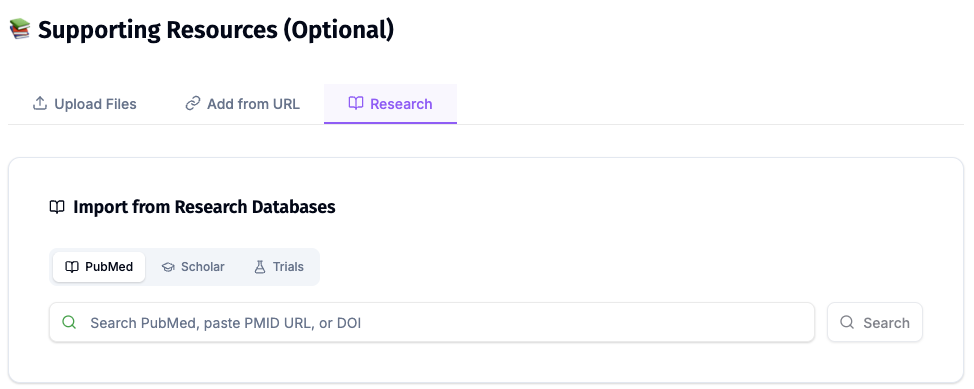
For echo specifically, the Research tab is most useful for pulling in the 2016 ASE/EACVI diastolic function paper, the 2017 valvular regurgitation quantification update, the EACVI strain consensus, and the major outcomes trials where echo is a co-primary endpoint (PARADIGM-HF, RELY, EMPEROR, etc.).
Tips Specific to Echo Lectures
Lead with knobology, not the piezoelectric effect. Trainees never struggle with the physics — they struggle with knowing which knob to turn. Open with a slide showing a poor-quality image and the three knob changes that fix it.
Show aliasing in motion, not in prose. A PW Doppler tracing with the velocity scale set too low does the teaching for you. Two screenshots, side-by-side, beat four bullets explaining the Nyquist limit.
One algorithm slide per deck. Diastolic function, valvular severity assessment, the systolic-vs-diastolic dysfunction sorting algorithm. Pick one canonical algorithm slide for your topic and refer back.
Be explicit about technique limitations. Continuity-derived AVA is great until the patient has a heavily calcified valve and you can't get a clean LVOT trace. Slides that acknowledge the limitations land harder than slides that don't.
End with high-yield pearls. Fellows will photograph the pearls slide. Make it clean, exam-aligned, and worth photographing.
Skip stock photos of doctors with clipboards. A deck full of staged photos signals you didn't put time into the talk. Transducer diagrams, real (de-identified) ultrasound clips, and ASE-style schematics only.
Why Generic AI Presentation Tools Underperform Here
Most AI deck generators were built for sales pitches and marketing decks. They optimize for visual flair and ignore the structural conventions of clinical didactics. For an echo audience, that produces:
- Physics slides with cartoon waves and no actual transducer cross-section
- Doppler slides that confuse PW and CW because the source didn't explain the difference
- Quantification slides that miss the ASE cutoffs by a digit
- Stock-photo "doctor reviewing chart" slides that have no place in an echo lecture
ChatSlide's clinical scenarios — Education, Conference, Research, Journal Club — bias the output toward the conventions an echo audience expects. You're still the clinical author; the tool just stops fighting your format.
Get Started
Building your next echocardiography lecture on ChatSlide takes about as long as scanning two patients. Drop a topic, refine the outline, generate the slides, swap in your own de-identified clips, and you have a fellowship-ready deck before morning report.
Try it free at chatslide.ai — most cardiology fellows and echo lab educators go from blank screen to first draft in under fifteen minutes.
Related guides:
- AI Medical Presentation Maker for Healthcare Professionals
- Medical Board Review Presentation AI Guide
- Medical Imaging and Radiology Presentation AI Guide
- Medical Grand Rounds Presentation AI Guide
- Journal Club Presentation AI Guide
A note on patient data and HIPAA. ChatSlide's standard plans are not a HIPAA-covered service — keep PHI out of slide content, prompts, and uploads. De-identify your echo clips and case data before you import. For hospital systems, academic medical centers, and echo labs that need a Business Associate Agreement, our Enterprise plan offers HIPAA-compliant deployment options — contact us to discuss BAA terms, SSO, and private-cloud or on-prem hosting.