The Challenge of Fertility Education
Reproductive endocrinologists, OB-GYNs, and fertility counselors face a recurring presentation problem. A single 30-minute patient talk on "optimizing the environment for conception" has to cover sleep, nutrition, exercise, supplements, ovulation timing, and red flags for when to seek help — all in language that lands with someone who may be anxious, overwhelmed, or entirely new to reproductive medicine. The clinical facts are well understood. The hard part is packaging them into clear, visually supportive slides for a general audience.
The same pattern shows up in egg freezing consultations, IVF orientation sessions, third-party reproduction briefings, and pre-conception counseling. Each topic has its own evidence base, its own decision points, and its own emotional stakes. Providers often end up reusing the same slide deck for years because rebuilding one is a weekend-long project.
Generic presentation templates do not solve this. A clinic PowerPoint from 2015 does not reflect current guidelines on AMH interpretation, updated PGT-A data, or evolving recommendations around ovarian reserve testing. Pamphlets from pharmaceutical companies focus on one product. Stock medical slide decks tend to be either too clinical for patients or too shallow for trainees.
AI presentation tools give fertility providers a way to build a new deck in minutes instead of a weekend, then spend the saved time refining the content for accuracy and tone. That shift — from design work to clinical judgment — is where AI earns its place in the reproductive health workflow.
What Makes a Strong Fertility Presentation
Fertility content sits at the intersection of three audiences that rarely overlap in other medical topics: anxious patients, curious partners, and skeptical family members. A good slide deck speaks to all three at the same time.
Frame the biology, then the choices. Patients cannot weigh treatment options without understanding what a follicle is, why AMH matters, or how implantation works. The first third of any fertility presentation should be biology — ovarian reserve, the menstrual cycle, fertilization — before any treatment protocol appears. Skipping this step leaves patients unable to engage with the decisions that follow.
Separate facts from probabilities. Fertility outcomes are probabilistic, and patients consistently misread single-cycle success rates as guarantees. Use explicit ranges ("live birth rates per egg retrieval at age 38 typically fall between X and Y%") and label them as age-dependent, clinic-dependent, and protocol-dependent. Charts work better than paragraphs here because they make the variance visible.
Pair each treatment with its timeline. Every fertility intervention has a calendar — stimulation days, trigger timing, retrieval, transfer, beta-hCG check, first ultrasound. Patients rank "knowing what happens when" above almost every other source of reassurance. A week-by-week slide for egg freezing or a cycle-map slide for IVF reduces the number of follow-up phone calls a clinic fields after every orientation.
Name the decision points. Patients need to know when the clinic will ask for a choice — fresh vs. frozen transfer, PGT-A yes or no, single vs. double embryo transfer, conventional IVF vs. ICSI. A slide that lists the choice points with a one-line explanation each lets patients arrive at the decision conversation already informed.
Acknowledge the emotional load. Fertility presentations that read like pharmacology lectures miss the mark. A short section on coping, community resources, and when to bring in a mental health professional signals that the clinic understands this is not just a medical process. One or two slides is enough — you are not replacing a counselor, just making it normal to ask for one.
Use Cases for a Fertility Slide Deck
The same presentation engine covers a surprisingly wide range of reproductive health talks:
- Pre-conception optimization — a 30-minute talk on sleep, nutrition, exercise, supplements, ovulation timing, and when to seek evaluation. Often delivered at community health events or early in a primary care visit.
- Egg freezing consultations — costs, success rates by age at freeze, storage logistics, and the decision framework for fertility preservation. Useful for both elective and medical indications (e.g., before gonadotoxic chemotherapy).
- IVF orientation — a walk-through of stimulation, retrieval, fertilization, embryo culture, transfer, and the two-week wait. Replaces much of the "where do I even start" anxiety that dominates the first real consult.
- Third-party reproduction briefings — donor egg, donor sperm, gestational carrier, reciprocal IVF. These talks need clear legal, psychological, and medical framing side by side.
- Male factor infertility — semen analysis interpretation, surgical options, lifestyle factors, and when to involve urology. Often skipped or rushed in female-focused fertility content.
- PCOS and endometriosis education — diagnosis criteria, the relationship to fertility, and management options across lifestyle, medication, and surgical interventions.
- Fertility preservation for oncology patients — urgent, time-sensitive counseling that pairs oncology context with reproductive options.
- Genetic counseling overviews — carrier screening, PGT-M, PGT-A, and how genetic testing fits into a fertility plan.
Each of these could be its own deck, and each can start from the same AI workflow.
Step-by-Step: Creating Fertility Presentations with ChatSlide
Here is how to build a patient-ready fertility presentation in ChatSlide.
Step 1: Write a Specific, Audience-Aware Prompt
Start at app.chatslide.ai and enter the topic with the audience baked in. Specificity drives quality — a generic prompt produces a generic deck.
Good examples:
- "Optimizing the Environment for Conception: A 30-Minute Patient Talk"
- "Egg Freezing Decision Guide: Costs, Timing, and Success Rates by Age"
- "IVF Orientation for First-Time Patients: Stimulation Through Transfer"
- "Fertility Preservation Before Chemotherapy: Options and Timeline"
- "PCOS and Fertility: What the Diagnosis Means for Getting Pregnant"
Avoid vague prompts like "Fertility Presentation" or "Reproductive Health Overview" — the output will be equally vague.
Step 2: Choose a Scenario Type That Matches the Setting
- Education → Lecture works for clinic orientation sessions, patient workshops, and resident teaching.
- Education → Tutorial works for step-by-step walk-throughs (e.g., "How to do your own injections").
- Research → General works for conference talks on fertility outcomes, guidelines updates, or meta-analyses.
Set the audience field to describe your actual audience: "Patients new to fertility evaluation and their partners" produces very different slides from "OB-GYN residents on their reproductive endocrinology rotation."
Step 3: Let ChatSlide Draft the Outline, Then Prune
ChatSlide generates a section-by-section outline before writing slides. For a fertility topic, review the outline with these questions:
- Does the biology section come before the treatment section?
- Are success rates framed as ranges, not single numbers?
- Is there a timeline slide for each procedure mentioned?
- Is the decision-point list explicit, not buried inside paragraphs?
- Is the emotional / support section present but not dominant?
Rename sections that do not match your clinic's flow. Delete sections that belong in a different talk — a single deck cannot be both an IVF orientation and a comprehensive PCOS workshop.
Step 4: Generate Slides and Let the AI Add Visuals
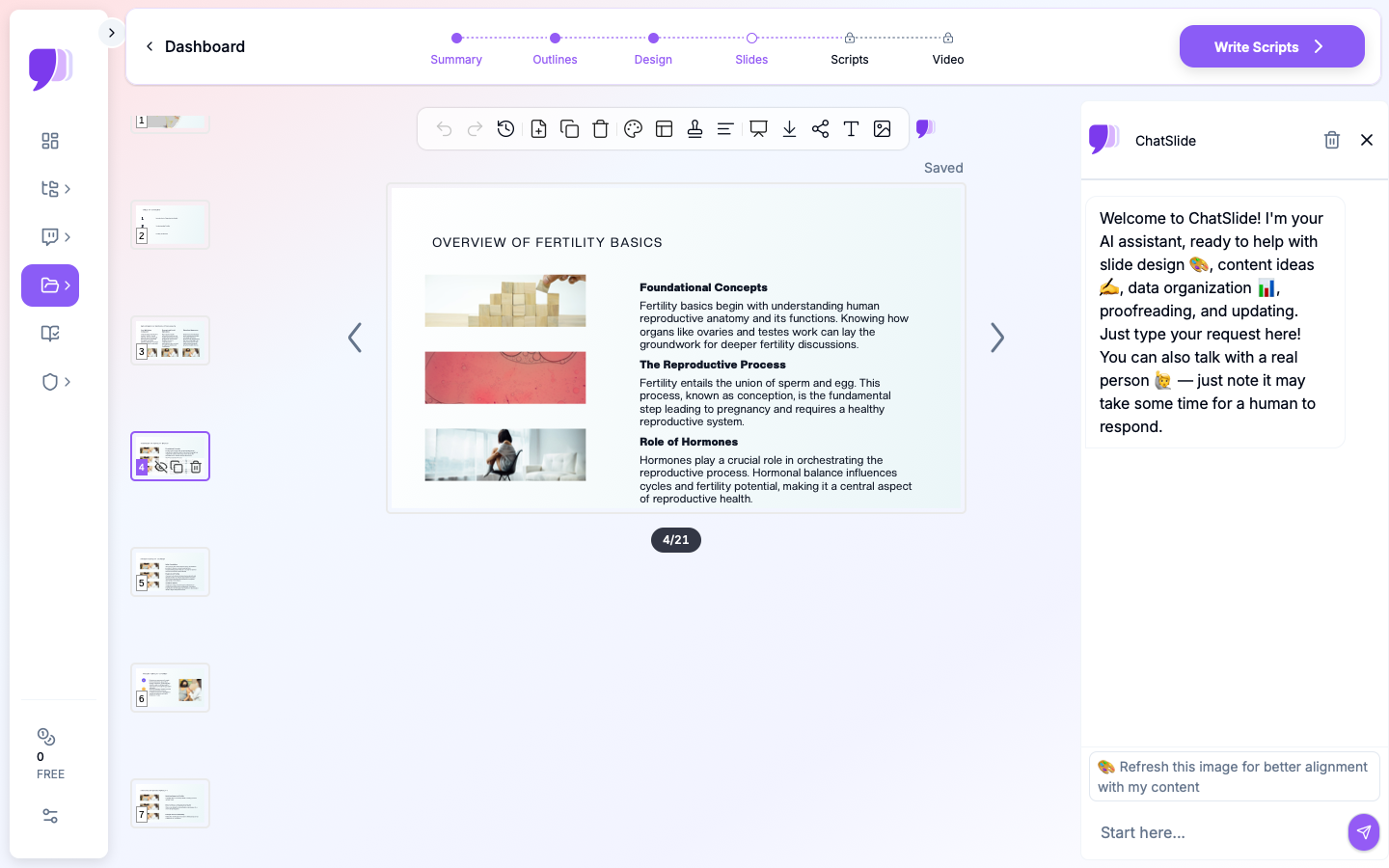
Once the outline is approved, ChatSlide generates the full deck with layouts and fetches stock imagery matched to each section. Fertility topics benefit from specific image categories:
- Anatomical diagrams for biology slides (ovaries, follicles, uterus)
- Cycle calendars and timeline visuals
- Bar and line charts for age-stratified outcome data
- Neutral lifestyle imagery (food, sleep, exercise) for optimization talks
- Clinical environment photos — but sparingly, since too many sterile medical images feel cold
You can swap the auto-selected images on any slide if you have clinic-approved diagrams or patient-consented photography you would rather use.
Step 5: Refine for Accuracy, Tone, and Legal Review
AI-generated fertility content needs a careful pass. Specific items to check on every deck:
- Numeric claims. Success rates, cycle statistics, and age-related probabilities should match your clinic's data or the current SART / CDC / ESHRE figures. Replace generic numbers with your clinic's verified range where possible.
- Medication names and protocols. Generic vs. brand names, dosing ranges, and protocol descriptions should be reviewed by a physician before the deck is shown to patients.
- Regulatory and legal framing. Third-party reproduction slides in particular need counsel review for jurisdiction-specific language.
- Health equity language. Fertility care has historically excluded LGBTQ+ patients, single parents by choice, and patients from lower-income backgrounds. Review the tone of every slide to make sure it reflects the full patient population you serve.
This is the part of the process AI cannot do. The saved drafting time should go here.
Step 6: Export to PowerPoint, PDF, or Video
ChatSlide exports to:
- PPTX — for clinic-owned templates and future editing
- PDF — for patient handouts and pre-visit reading
- MP4 — for embedding in patient portals or asynchronous education
The PDF export in particular is underused by fertility clinics. Patients arriving at a consult having already watched or read the orientation deck are measurably more engaged and ask better questions.
Direct Research Database Access
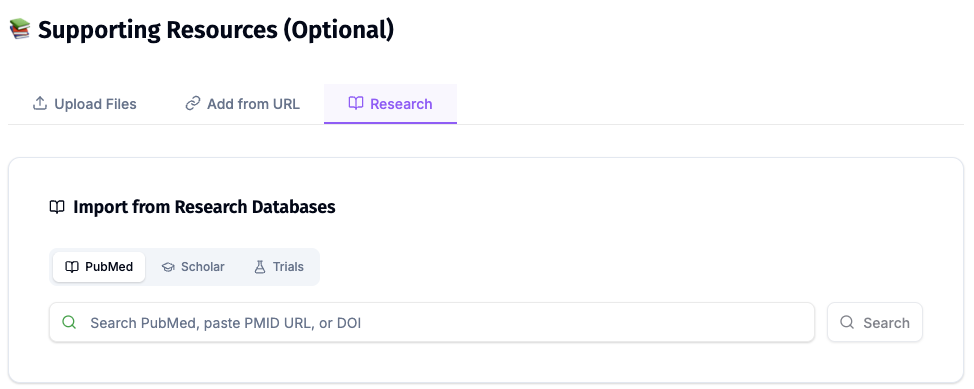
ChatSlide's Research tab connects to the databases physicians use daily:
- PubMed: Search by keyword, PMID, or DOI. Find the landmark trials, recent publications, and clinical guidelines relevant to your case. The AI reads abstracts and incorporates key findings into your slides with citations.
- Google Scholar: When your topic spans disciplines — say, the intersection of genetics and oncology — Scholar captures the broader academic literature that PubMed alone might miss.
- Clinical Trials (NCT): Presenting on a treatment where pivotal trials are ongoing? Search by NCT number or condition to pull trial design, endpoints, and status into your slides.
Tips for Fertility and Reproductive Health Presentations
A few patterns that consistently make fertility decks land better:
Use age bands, not birthdays. Age-stratified data (e.g., "under 35," "35–37," "38–40," "41–42," "43+") communicates the fertility cliff more honestly than a single number. Patients in their late 30s often underestimate how quickly probabilities shift.
Show what counts as "normal" early. Normal ranges for AMH, antral follicle count, and day-3 FSH reduce anxiety when patients recognize that one low number does not equal infertility. A single reference slide that patients can revisit saves hours of follow-up messaging.
Separate elective from medical preservation. Egg freezing decks should distinguish elective preservation from medical preservation (e.g., before chemotherapy) because the decision frameworks, timelines, and insurance coverage differ significantly.
Label every chart axis. "Cumulative live birth rate per retrieval" and "per-cycle clinical pregnancy rate" mean different things and are not interchangeable. Unlabeled charts consistently get misread by patients — and by some clinicians.
Include a "when to call us" slide. A short list of symptoms (e.g., severe pelvic pain, heavy bleeding, signs of OHSS) and the clinic's after-hours line belongs in every IVF or stimulation-related deck. Patients will screenshot this slide.
Keep one slide for resources. National support organizations, mental health referral options, financial assistance programs, and peer communities belong on a final slide. This is often the most photographed slide in the whole presentation.
Get Started with ChatSlide for Fertility Education
A fertility presentation that used to take a weekend now takes an afternoon — most of it spent refining clinical accuracy instead of wrestling with slide layouts. Reproductive endocrinologists, OB-GYNs, fertility counselors, and IVF nurse educators all benefit from the same shift.
Try ChatSlide and create your first fertility presentation today. Whether you are drafting a 30-minute pre-conception talk, an egg freezing decision guide, or an IVF orientation deck, the time you save on design is time you can spend with patients.
Related guides: AI Medical Presentation Maker, Patient Education Presentation AI, Nursing Education Presentation AI.
A note on patient data and HIPAA. ChatSlide's standard plans are not a HIPAA-covered service — keep PHI out of slide content, prompts, and uploads. For hospital systems, group practices, and clinics that need a Business Associate Agreement, our Enterprise plan offers HIPAA-compliant deployment options — contact us to discuss BAA terms, SSO, and private-cloud or on-prem hosting.