
Quick Answer: A nephrology/critical-care deck typically follows: (1) Clinical case or epidemiology (AKI affects up to 50% of ICU patients), (2) Pathophysiology with a labeled nephron/renal-tubule diagram, (3) Diagnostic criteria — KDIGO staging, RIFLE, AKIN side-by-side, (4) Management algorithm — flow chart for fluid resuscitation, RRT initiation, dialysis modality, (5) Outcomes data — Kaplan-Meier survival, dialysis-dependence rates, (6) Take-home pearls. Target 12–18 slides for a 15-minute talk. Upload your manuscript or NCT trial page to ChatSlide — it generates the KDIGO/RIFLE comparison tables and survival charts directly from the source data.
Presenting Renal Medicine in a Complex Clinical Landscape
Nephrology and critical care medicine are deeply intertwined. Acute kidney injury affects up to 50% of ICU patients, dialysis decisions carry life-altering consequences, and renal research generates a constant stream of new evidence that clinicians need to absorb. Presenting this complexity clearly — whether at a nephrology conference, during ICU rounds, or in a research meeting — requires well-structured slides that can handle dense clinical data.
The challenge for nephrologists and intensivists is familiar: balancing clinical responsibilities with the need to prepare high-quality presentations. A fellow validating an AKI risk score across a new patient population needs to present their findings compellingly. A nephrology attending preparing a dialysis outcomes talk for a national conference needs slides that visualize complex survival data. Building these presentations from scratch takes hours that could be spent at the bedside.
Nephrology Presentation Contexts
Research Conference Presentations
Nephrologists present original research at conferences like ASN Kidney Week, CRRT conferences, and critical care symposia. These presentations demand rigorous data visualization — Kaplan-Meier curves, forest plots, ROC analyses, and multivariable regression results — organized in a clear narrative that moves from clinical question to methodology to findings to implications.
Validating existing clinical tools in new populations — like applying an AKI risk score developed in one setting to ICU patients in a different healthcare system — is a common research presentation format that requires careful comparison of original and validation cohort characteristics.
Dialysis and Renal Replacement Therapy Education
Presentations on dialysis modalities, vascular access management, and renal replacement therapy protocols are frequent in nephrology training programs. These cover technical aspects (dialyzer selection, anticoagulation strategies, clearance calculations) alongside patient-centered topics (modality selection counseling, quality of life outcomes, and palliative care in advanced kidney disease).
Interpreting results from major dialysis trials — comparing outcomes across different modalities, intensities, or timing strategies — requires slides that can present trial design, patient flow, and outcome data clearly for journal club or clinical practice discussions.
ICU Rounds and Multidisciplinary Conferences
In the critical care setting, nephrology consultants present at multidisciplinary rounds, discussing fluid management strategies, electrolyte correction protocols, and indications for initiating or discontinuing renal replacement therapy. These presentations need to be concise, action-oriented, and accessible to non-nephrology ICU team members.
Quality Improvement and Outcomes Research
Nephrology departments track outcomes including AKI incidence rates, dialysis adequacy metrics, transplant referral patterns, and CKD progression rates. QI presentations require clear before-and-after comparisons, process mapping, and outcome trend visualizations that demonstrate improvement over time.
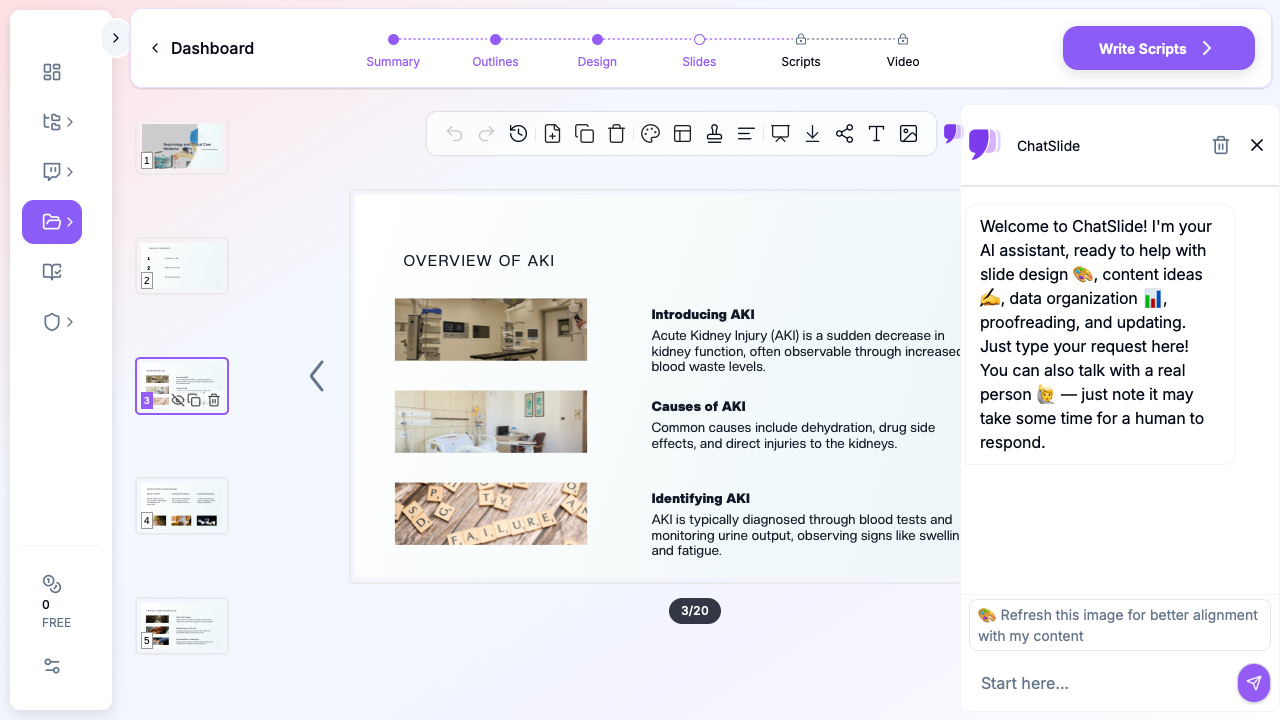
Creating Nephrology Presentations with ChatSlide
Step 1: Define Your Renal Topic Precisely
Specificity matters in nephrology presentations. Enter a focused topic like "Validating the Malhotra AKI Risk Score in Southeast Asian ICU Populations" rather than "AKI risk assessment." Include your target audience — nephrology fellows will need different depth than a general internal medicine audience.
Specify the presentation context: 10-minute oral abstract at ASN, 30-minute grand rounds, or a brief journal club presentation. This shapes the number of slides and level of detail the AI generates.
Step 2: Structure Your Clinical Argument
ChatSlide generates an outline following standard research presentation or clinical review formats. For a research presentation, expect: background and knowledge gap, study objectives, methods, results, discussion, and clinical implications.
Customize the outline based on your emphasis. For an AKI risk score validation study, you might want to expand the methods section to detail how you adapted the score for your population, or add a section comparing your validation cohort demographics with the original derivation cohort.
Step 3: Import Evidence with Built-In PubMed Search
ChatSlide includes integrated PubMed search — you can find and import nephrology papers directly inside the platform without switching between tools. Preparing a talk on STARRT-AKI trial outcomes? Search PubMed within ChatSlide, select the papers, and the AI extracts key findings, statistical results, and citations into your slides.
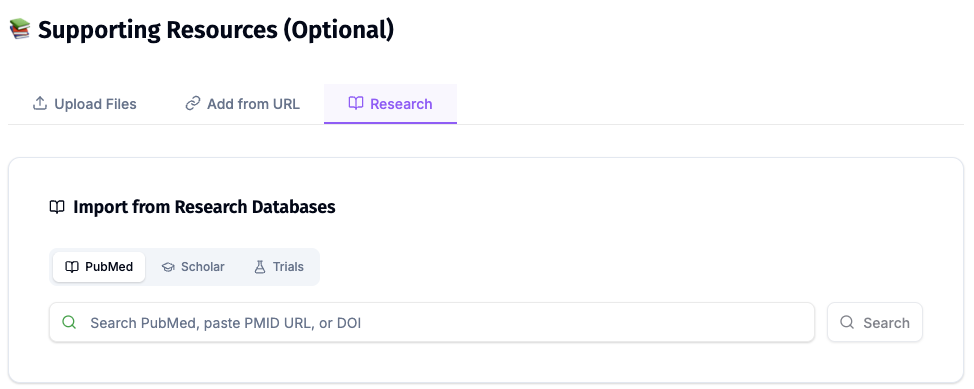
The platform also connects to Google Scholar and ClinicalTrials.gov, which is particularly valuable for nephrology — you can pull data from ongoing renal replacement therapy trials or recently completed AKI intervention studies directly into your presentation.
You can also upload PDFs of research papers, KDIGO guidelines, institutional protocols, or even scanned journal articles (OCR is built in). The AI preserves nephrology-specific terminology from your source materials — KDIGO staging, eGFR formulas, dialysis adequacy metrics — rather than oversimplifying the clinical language.
Step 4: Build Content-Rich Slides
The AI generates slides with structured clinical content for each section. For nephrology topics, this includes relevant pathophysiology, diagnostic criteria (KDIGO staging for AKI, CKD-EPI equations for GFR estimation), and treatment frameworks.
Review generated content carefully. Nephrology involves precise numerical thresholds — creatinine cutoffs, electrolyte targets, dialysis dose calculations — that you should verify against current KDIGO guidelines or your institution's protocols.
Step 5: Plan Your Data Slides
For research presentations, you'll want to replace placeholder slides with your actual data figures. ChatSlide creates the structural framework — title slides, methodology summaries, and discussion points — while you insert your specific Kaplan-Meier curves, forest plots, or regression tables.
For clinical review talks, the AI-generated content provides a comprehensive foundation. Add institutional data, case examples, or protocol-specific details to make the presentation relevant to your local practice.
Step 6: Export and Finalize
Export to PowerPoint format to add your research data figures, institutional branding, and any specific formatting required by conference organizers. Many nephrology conferences have strict slide templates and disclosure requirements — add these in the final PowerPoint edit.
Direct Research Database Access
ChatSlide's Research tab connects to the databases physicians use daily:
- PubMed: Search by keyword, PMID, or DOI. Find the landmark trials, recent publications, and clinical guidelines relevant to your case. The AI reads abstracts and incorporates key findings into your slides with citations.
- Google Scholar: When your topic spans disciplines — say, the intersection of genetics and oncology — Scholar captures the broader academic literature that PubMed alone might miss.
- Clinical Trials (NCT): Presenting on a treatment where pivotal trials are ongoing? Search by NCT number or condition to pull trial design, endpoints, and status into your slides.
Tips for Nephrology and Critical Care Presentations
Front-load the clinical relevance. Open with why this matters: "AKI affects 1 in 5 hospitalized adults and increases mortality by 4-fold. Early identification through validated risk scores could change outcomes." This immediately grounds your audience.
Visualize kidney physiology clearly. Nephron-level pathophysiology, glomerular filtration dynamics, and tubular transport mechanisms are best explained with diagrams rather than text. Use simple schematics that highlight the specific mechanism relevant to your talk.
Present trial data in context. When discussing major trials (STARRT-AKI, IDEAL, AKIKI), show the clinical question, key design features, and primary outcome on a single slide. Reserve detailed secondary outcomes for backup slides.
Use consistent staging systems. When discussing AKI severity, always reference KDIGO stages explicitly. When discussing CKD, include both GFR category and albuminuria category. Consistent nomenclature prevents confusion in multidisciplinary audiences.
Prepare for technical questions. Nephrology audiences ask detailed questions about dialysis prescription, drug dosing in renal impairment, and statistical methodology. Have backup slides ready with supplementary data tables and sensitivity analyses.
More Time for Patient Care
Nephrology and critical care presentations serve a vital purpose: they advance clinical knowledge, improve patient outcomes, and train the next generation of renal specialists. The time you spend building slides is time away from these goals.
ChatSlide helps nephrologists, intensivists, and renal researchers create structured, professional presentations faster — whether you're presenting AKI risk score validation at an international conference, leading a dialysis journal club, or preparing an ICU quality improvement report.
Start building your nephrology presentation with ChatSlide.
A note on patient data and HIPAA. ChatSlide's standard plans are not a HIPAA-covered service — keep PHI out of slide content, prompts, and uploads. For hospital systems, group practices, and clinics that need a Business Associate Agreement, our Enterprise plan offers HIPAA-compliant deployment options — contact us to discuss BAA terms, SSO, and private-cloud or on-prem hosting.