
Quick Answer: A job talk presents your research program — past work, current contribution, and future vision — to a faculty search committee in 45–60 minutes. With ChatSlide.ai you can turn your research statement, papers, or dissertation into a structured 40–50 slide job talk in about two minutes: an arc that opens with the big question, walks through your strongest results, and closes with a fundable future agenda. Free to start, exports to PowerPoint, Keynote, or PDF.
The Job Talk Is the Highest-Stakes Hour of Your Career
You made the shortlist. Now the department wants you to fly out and give a 45-to-60-minute job talk — the single presentation that the hiring committee, the faculty, and a room full of skeptical graduate students will use to decide whether you belong on their roster.
A job talk is not a thesis defense, and it is not a conference talk. It is its own genre with its own unwritten rules:
- A thesis defense proves you mastered one project. A job talk proves you have a research program — a coherent line of inquiry that will produce grants, papers, and students for the next decade.
- A conference talk shares one result with peers who already know the subfield. A job talk addresses a mixed audience — your subfield experts, adjacent-field faculty, and students — and must stay legible to all three.
That combination is exactly why job talks are so hard to build. Candidates routinely report spending 30 to 50 hours on a single talk:
- Deciding which papers and results make the cut (3–5 hours)
- Finding the narrative arc that connects past, present, and future work (4–6 hours)
- Rebuilding figures from publications into slide-legible visuals (6–10 hours)
- Calibrating depth so the talk lands for both experts and non-experts (3–5 hours)
- Designing 40–60 slides in PowerPoint, Keynote, or LaTeX Beamer (8–12 hours)
- Writing and rehearsing speaker notes for timing (4–6 hours)
- Revising after every practice talk with your lab and mentors (5–8 hours)
And it all happens during the most chaotic stretch of the academic year — while you are teaching, finishing manuscripts, and flying between campuses. AI presentation tools can compress the slide-building and narrative-drafting parts of that work to one or two hours, leaving you more time for the thing that actually wins offers: rehearsal.
What a Search Committee Is Really Listening For
Before you open a single slide, it helps to know what the room is evaluating. A strong academic job talk answers four questions, in this order:
- Is the problem important? Can this person convince a non-specialist why their work matters?
- Is the work rigorous and original? Does the candidate own a genuine contribution, not just a contribution to someone else's program?
- Is there a future here? Is this a fundable, multi-year agenda — or a finished dissertation with nowhere to go?
- Can this person teach and mentor? Forty minutes of clear, well-paced explanation is itself an audition for the classroom.
Every design choice in your talk should serve one of those four questions. If a slide does not, cut it.
The Job Talk Arc That Works in Most Fields
While disciplines differ, the most reliable job talk structure follows this sequence:
1. The Hook and the Big Question (2–3 slides)
Open with the motivating problem, framed so anyone in the room understands the stakes within ninety seconds. Resist the urge to start with your methods — start with why a smart outsider should care.
2. Your Research Program in One Slide (1 slide)
A single roadmap slide that names your two or three connected research threads. This is the slide the committee will photograph. It tells them you have a program, not just a project.
3. Background and Significance (3–5 slides)
The minimum context needed to understand your contribution — the key prior work, the gap, and where your research enters. Cite the landmark papers; do not attempt a full literature review.
4. Your Core Contribution (15–20 slides)
The heart of the talk: your strongest, most complete line of work. Walk through the question, the approach, the key results, and the figures that prove them. This is where depth lives — but every result must connect back to the big question from slide one.
5. A Second Thread, Briefly (4–6 slides)
A shorter treatment of a second project shows breadth and that your program is not a single lucky finding. Keep it tight; depth belongs to your flagship work.
6. Future Directions (3–5 slides)
The slide set that wins offers. Lay out a concrete, fundable agenda: the next questions, the methods you will use, the grants you will target, and the students you will train. Make it specific enough to be credible and broad enough to last a decade.
7. Contributions and Acknowledgments (1–2 slides)
Summarize your contribution in plain language and thank collaborators, funders, and mentors.
A well-built job talk runs 40–50 content slides for a 45–60 minute slot — roughly one slide per minute, with your flagship results getting the most airtime.
Step-by-Step: Building Your Job Talk with ChatSlide
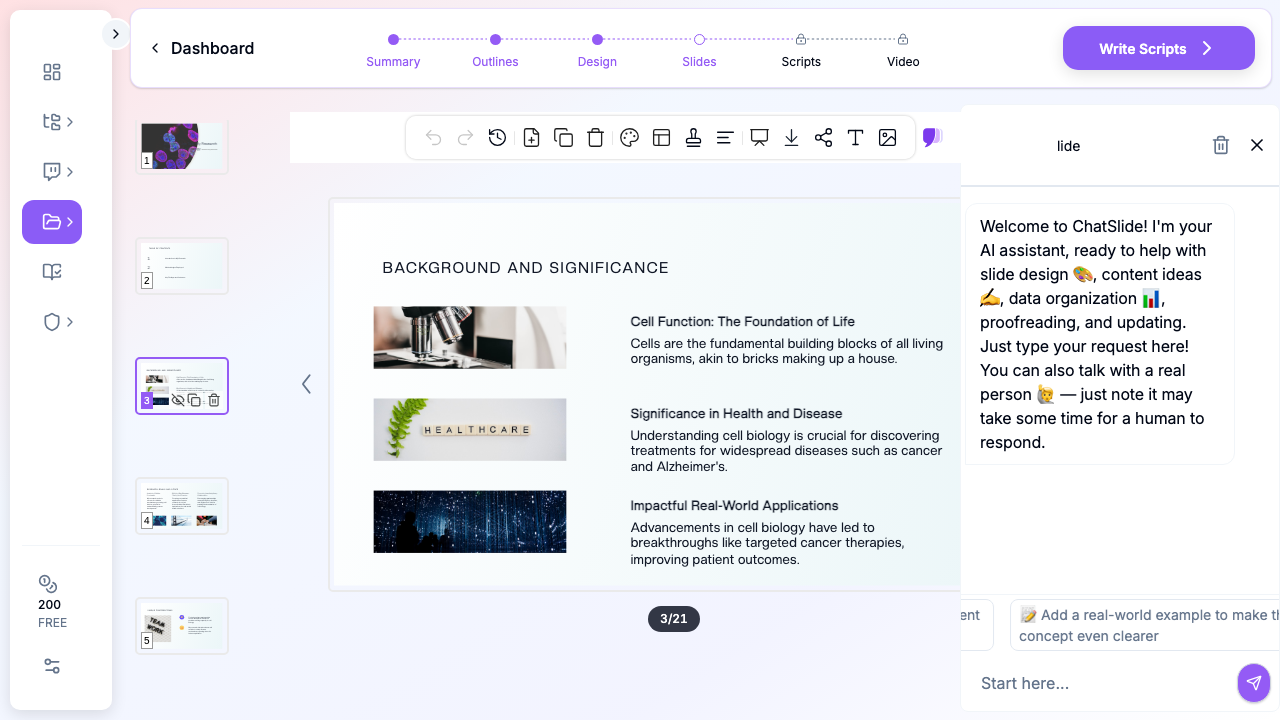

Step 1: Bring Your Existing Material
You have already written the hard part — your dissertation, your research statement, your published papers. Upload them, or paste your research statement directly. ChatSlide reads your source material instead of inventing generic content, so the slides reflect your program, not a template's idea of one.
Step 2: Set the Frame
Tell the AI your topic and audience — "faculty search committee and department members" — and choose a research or conference scenario. This calibrates the tone and depth: rigorous, but legible to adjacent-field faculty rather than only your three closest competitors.
Step 3: Generate and Refine the Outline
ChatSlide produces a structured outline first — sections, slide titles, and bullet points — before building any slides. Edit it here, where changes are cheap. This is the moment to enforce the arc above: make sure your hook leads, your flagship project gets the most slides, and your future directions are concrete. Reordering a section in the outline is far faster than rebuilding slides later.
Step 4: Generate the Slides
Approve the outline and the AI builds the full deck — title slide, roadmap, results pages, and closing slides — with a consistent visual theme. Relevant images and diagrams are placed automatically so your slides are not walls of text.
Step 5: Drop In Your Real Figures and Citations
Your published figures are your strongest evidence — swap the placeholder visuals for your own charts, micrographs, or models. If you want to ground a background section in the literature, ChatSlide's Research tab can pull references from PubMed, Google Scholar, and other databases so your significance slides cite the actual landmark papers rather than vague claims.
Step 6: Generate Speaker Notes and Rehearse
Because timing is everything in a job talk, generate speaker notes per slide and use them to rehearse to the clock. Run through it with your lab, mark where you ran long, and trim. Then export to PowerPoint or Keynote for the campus AV system — and keep a PDF backup, because something always goes wrong with the projector.
Tips That Separate Strong Job Talks from Forgettable Ones
- Make the first three minutes flawless. Committees form impressions fast. Your hook and big-question slides deserve more rehearsal than any others.
- One idea per slide. A job talk audience is processing your work in real time. Dense slides read as muddled thinking.
- Protect your flagship project's airtime. A common failure mode is spending twenty minutes on background and rushing your best results. Budget your slides so your strongest work gets the most minutes.
- Rehearse the future-directions section out loud. This is where nerves make candidates vague. Specific, confident future work is what turns a good talk into an offer.
- Anticipate the Q&A. Build three or four backup "appendix" slides — extra data, an alternative analysis, a limitations breakdown — to pull up when a faculty member presses. Having the slide ready signals depth.
- Keep the design consistent and quiet. Reviewers should remember your ideas, not your transitions. A clean, uniform template lets the science carry the talk.
Job Talk vs. Chalk Talk
Many search processes — especially in the life sciences — also ask for a separate chalk talk: an unslided, whiteboard-driven discussion of your future research plans. The two are complementary. Your job talk's future-directions slides are the perfect seed for your chalk talk outline; build the job talk first, then extract and expand that closing section into a research plan you can defend without slides.
Get Started on Your Job Talk
A campus interview is exhausting enough without losing a week to slide formatting. Let the AI handle the first draft of the deck so you can spend your energy on narrative and rehearsal — the parts that actually win the offer.
Build your academic job talk with ChatSlide — upload your research statement or papers, generate a structured 40–50 slide draft in minutes, refine the arc, and export to PowerPoint, Keynote, or PDF. Free to start.
Preparing other high-stakes academic presentations? See our guides on the PhD thesis defense presentation, the research conference presentation, and statistics and research methods lectures.