The Challenge of Teaching Agile Well
Agile methodology training sits in an awkward spot. The concepts themselves are not complicated — iterative delivery, cross-functional teams, continuous feedback. But teaching them effectively means making abstract principles feel concrete and actionable.
Project managers preparing PMP certification study groups face a particular challenge. The PMBOK Guide's agile content spans predictive, adaptive, and hybrid approaches. Condensing that into workshop slides that actually help people pass the exam requires careful structure and clear visual organization.
Whether you are an agile coach running a two-day scrum workshop, a PMO lead building internal training materials, or a study group organizer preparing PMP exam review sessions, the slide deck is where the rubber meets the road. And building one from scratch takes far more time than it should.
What Effective Agile Training Presentations Cover
The best agile training materials follow a progression that mirrors how practitioners actually learn the methodology:
Principles before practices. Start with the Agile Manifesto values and the twelve principles. Without this foundation, specific practices like daily standups or sprint reviews feel like arbitrary rituals rather than logical consequences of a coherent philosophy.
Framework comparisons. Most training needs to cover Scrum, Kanban, and at least one scaled framework like SAFe or LeSS. Side-by-side comparisons of roles, ceremonies, and artifacts help participants understand when each approach fits.
Visual process flows. Agile concepts are inherently visual — sprint cycles, Kanban boards, burndown charts, cumulative flow diagrams. Training slides that rely on bullet points instead of diagrams miss the point entirely.
Real-world scenarios. Every concept should connect to a practical situation. How does a product owner prioritize a backlog when stakeholders disagree? What does a scrum master do when the team consistently misses sprint goals? Scenarios make principles memorable.
Assessment preparation. For PMP-focused sessions, slides should map agile concepts to exam domains. Practice questions, key terminology, and common exam traps deserve dedicated sections.
Creating Agile Training Slides with ChatSlide
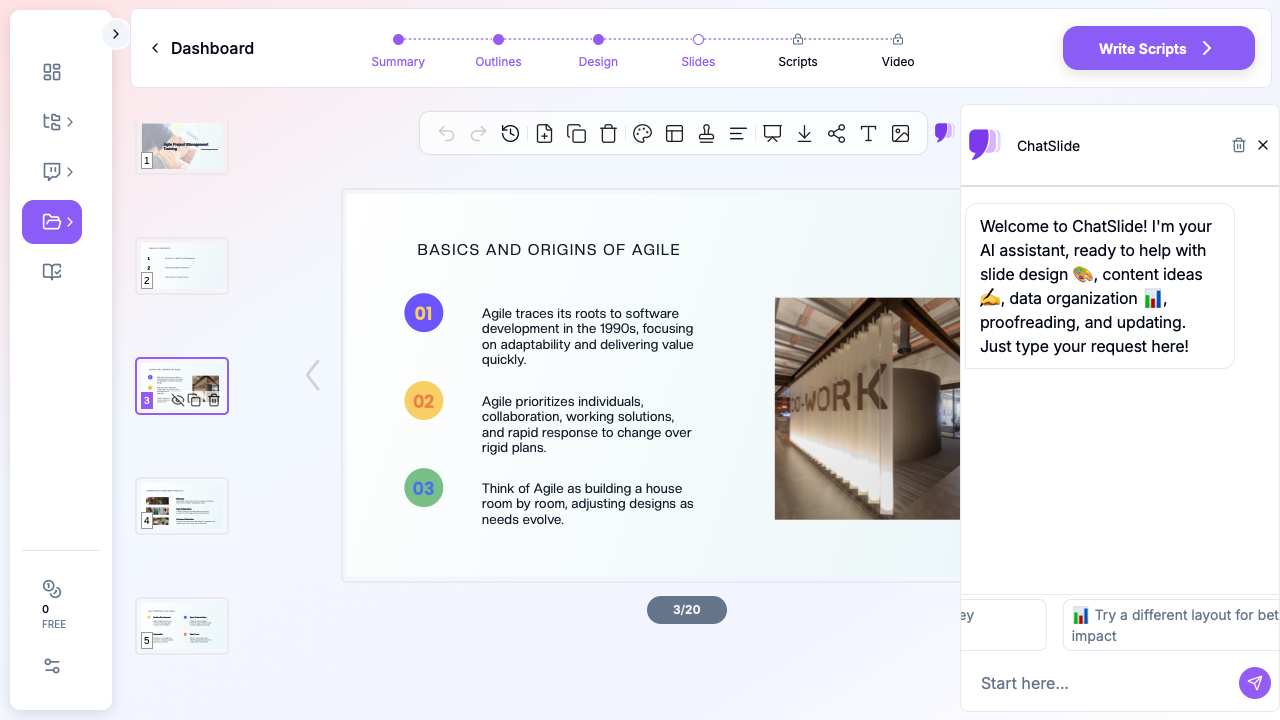

ChatSlide generates structured training content that follows established instructional design patterns. For agile methodology presentations, this means the AI organizes content around recognized frameworks rather than producing generic overviews.
Specify your training focus. Are you building a Scrum Master certification prep course, a Kanban fundamentals workshop, a PMP agile domain review, or an executive overview of agile transformation? The specificity of your input directly affects the quality of the output.
Set the right audience level. A session for developers new to scrum needs different depth than one for experienced project managers transitioning from waterfall. ChatSlide adjusts terminology, examples, and pacing based on your audience specification.
Review the generated structure. The outline typically progresses from foundational concepts through specific practices to implementation challenges. Rearrange sections if your training schedule requires a different flow — for example, leading with a hands-on exercise before covering theory.
Enhance with diagrams. The generated slides include relevant imagery, but agile training especially benefits from process diagrams. Add your own sprint cycle visuals, Kanban board layouts, or burndown chart examples to complement the AI-generated content.
Tailoring Content for PMP Certification Prep
If your primary goal is helping participants prepare for the PMP exam, the generated slides serve as a starting framework that you will want to customize:
Map to PMBOK domains. The current PMP exam covers three domains: People, Process, and Business Environment. Tag each slide or section with the relevant domain so participants can track their coverage.
Add practice questions. After each major concept section, insert two or three PMP-style situational questions. These help participants practice applying concepts rather than just memorizing definitions.
Highlight agile-predictive intersections. The PMP exam tests hybrid approaches — knowing when to apply agile practices within a predictive framework. Dedicate slides to scenarios where teams need to blend approaches.
Include key formulas and metrics. Velocity calculations, sprint burndown interpretation, and cumulative flow analysis all appear on the exam. Visual slides showing these calculations step-by-step are more effective than text descriptions.
Building a Multi-Module Training Program
Agile training works best as a progressive series. Here is a common structure you can build with ChatSlide:
Module 1: Agile Foundations. The manifesto, principles, and mindset shift from predictive to adaptive planning. This module focuses on understanding why agile works, not just what it prescribes.
Module 2: Scrum Deep Dive. Roles (Product Owner, Scrum Master, Developers), events (Sprint Planning, Daily Scrum, Sprint Review, Sprint Retrospective), and artifacts (Product Backlog, Sprint Backlog, Increment). Include a simulation exercise outline.
Module 3: Kanban and Flow. Visualizing work, limiting work in progress, managing flow, and making policies explicit. Compare Kanban's continuous flow with Scrum's time-boxed iterations.
Module 4: Scaling and Hybrid Approaches. When and how to scale agile (SAFe, LeSS, Nexus), and how to implement agile practices within organizations that also use predictive approaches.
Module 5: Exam Preparation. For PMP-track participants, a dedicated review module with practice questions, key terminology review, and exam strategy tips.
Each module can be generated as a separate presentation in ChatSlide, then customized with your organization's specific examples and exercises.
Tips for Delivering Agile Training
The best agile trainers practice what they preach. A few approaches that work:
Run the training itself using agile principles. Use time-boxed segments, collect feedback frequently, and adapt the agenda based on participant needs. This models the methodology while teaching it.
Emphasize simulation over slides. Use the presentation to introduce concepts, then immediately follow with hands-on exercises. A Lego Scrum simulation or a paper airplane Kanban exercise teaches more than twenty slides of theory.
Connect to participants' real projects. Ask participants to identify one concept from each session they can apply to their current work within the next week. This creates immediate accountability and relevance.
Provide reference materials. After the training, share the slide deck as a reference guide. Participants will refer back to framework comparisons, process flows, and terminology definitions long after the session ends.
Get Started
Whether you are preparing a PMP study group, running a scrum certification workshop, or building your organization's agile training curriculum, the slide deck is your foundation.
ChatSlide helps you generate a well-structured first draft in minutes, so you can focus your time on adding custom exercises, organization-specific examples, and interactive elements that make training stick.