
Quick Answer: Anthropic released Claude Opus 5.5 on September 22, 2026 at $4 per million input tokens and $20 per million output tokens — 20% below Opus 5, with output more than 30% faster. Claude support is on the ChatSlide roadmap and is not in the model picker yet. What is already live: ChatSlide's ULTIMATE tier runs GPT-6 Astra, which lands within 0.2 points of Opus 5.5 on the LLM Stats aggregate score (59.5 vs 59.7) — so the frontier tier you can use today is, on aggregate, an Opus 5.5-class model. On individual benchmarks the two split, and the detail is below. You can build full decks right now on GPT-5.6 Luna, free, and export to PowerPoint, PDF, and Keynote on a paid plan.
What Anthropic Actually Shipped
Opus 5.5 is the first Anthropic release since CEO Dario Amodei publicly called for a slowdown in AI development, and the headline is not raw capability — it is capability held roughly flat against Fable 5.1 while the price falls.
The published numbers:
| Claude Opus 5.5 | Claude Opus 5 | |
|---|---|---|
Input price | $4.00 / 1M tokens | $5.00 / 1M tokens |
Output price | $20.00 / 1M tokens | $25.00 / 1M tokens |
Cost on typical workloads | ~40% less than Opus 5 | baseline |
Output speed |
| baseline |
Anthropic also reports Opus 5.5 is 85% less likely than Opus 5 or Mythos 5.1 to attempt to bypass its prescribed boundaries, and that the model was evaluated pre-release by external groups including Frontier Design and METR. It is available across AWS, Google Cloud, and Microsoft Azure from day one. Sonnet 5.5 and Haiku 5.5 are slated for "the coming weeks."
Source: Anthropic's Introducing Claude Opus 5.5, with launch coverage from TechCrunch and MacRumors.
Opus 5.5 vs GPT-6 Astra: The Honest Comparison
This is the question that matters if you are choosing a presentation tool by the model underneath it, and the answer is genuinely close rather than a blowout in either direction.
On the aggregate score, they are a tie. LLM Stats puts Opus 5.5 at 59.7 and GPT-6 Astra at 59.5 — a 0.2-point gap, which is noise at this resolution.
On individual benchmarks, Opus 5.5 wins more of them. Of the nine benchmarks reported for both models, Opus 5.5 takes seven. From Anthropic's own published chart:
| Benchmark | Claude Opus 5.5 | GPT-6 Astra |
|---|---|---|
Terminal-Bench 4.0 (agentic coding) | 66.4% | 57.9% |
FrontierCode v1.1 | 54.4% | 53.3% |
GDPval-AA v2.1 (knowledge work, Elo) | 1846 | 1542 |
AutomationBench | 40.0% | 41.4% |
Terminal-Bench-Science 0.1 | 58.7% | 64.6% |
The GDPval gap is the one to take seriously if your work is document-and-deck shaped rather than code shaped: 1846 vs 1542 Elo on knowledge work is not a rounding error, and Anthropic positions GDPval as its closest proxy for real professional output.
Where Astra holds an edge that matters for slides: context window. Astra accepts 1,050,000 input tokens, which is the difference between summarizing a 400-page report and chunking it. If your deck starts from a pile of source documents rather than a prompt, that ceiling is the constraint you actually hit.
Where Opus 5.5 wins outright: price. At $4/$20 against Astra's $10/$50, Opus 5.5 is 2.5x cheaper on both input and output.
So: on par in aggregate, split on specifics, and priced very differently. Anyone telling you one of these models is categorically better than the other for slide generation is selling something — the benchmarks do not support that claim in either direction.
What This Means for ChatSlide Users
Claude support is on the roadmap. It is not shipped. The ChatSlide model picker today offers exactly three options, and none of them is a Claude model:
- GPT-5.6 Luna 🌙 — free tier, the default
- GPT-5.6 Terra 🌍 — any paid plan
- GPT-6 Astra ✨ — ULTIMATE
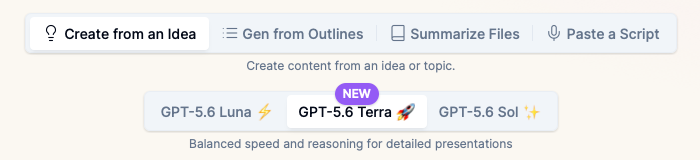
Astra entered the ULTIMATE slot on September 4, 2026. When Claude models are added, they will appear in this same picker — nothing about your decks, brand settings, uploads, or templates changes when a model joins the list. We are not publishing a date, because we have been asked for one before and a guessed date is worse than no date.
What you can do today, given the parity numbers: if you specifically wanted Opus 5.5 for its knowledge-work quality, the ULTIMATE tier's GPT-6 Astra is within noise of it on aggregate and ahead of it on context length. That is a real answer, not a consolation prize. If you specifically wanted Opus 5.5 because it is 2.5x cheaper per token, that pricing difference is an API-level concern and does not pass through to a flat-rate plan.
What Makes ChatSlide Powerful
The model is a per-deck choice, not an account setting. Generate on the fast model, and if one section needs more depth, regenerate that deck on a stronger one. Your brief, uploads, outline, and brand settings carry over.
Three input modes. Start from a prompt, from uploaded documents (PDF, Word, PowerPoint, Excel), or from a YouTube URL. The deck is built from your material, not from the model's general knowledge of your topic.
OCR on scanned material. Scanned PDFs and image-only slides get read rather than skipped, which is usually where "upload your document" tools quietly fail.
Real data charts. Numbers from your spreadsheet render as actual charts, not as a model's prose description of a trend.
Research import. Pull sources directly into the deck with citations attached, rather than pasting them in and losing provenance.
19 AI editing tools. Shorten, expand, rewrite for a different audience, fix tone — applied per slide, after generation, when you can actually see what is wrong.
Speaker notes and export. Every deck exports to PowerPoint, PDF, and Keynote on a paid plan, with speaker notes generated alongside the slides.
How ChatSlide Builds Your Deck
- Give it your material. Prompt, documents, or a YouTube link. Pick your model at the top of the Summary step.
- Review the outline. This is the highest-leverage moment — fixing structure here costs seconds; fixing it after generation costs a rebuild.
- Generate. Slides, layouts, charts, and speaker notes are produced together.
- Edit and export. Per-slide AI tools for the rough edges, then export to PowerPoint, PDF, or Keynote.
What a Stronger Model Does and Does Not Fix
Worth saying plainly, because every model launch produces a wave of posts implying otherwise.
A stronger model does help with structure under pressure. Give a weak model fourteen pages of source material and it flattens distinct ideas into one bullet, or produces twelve slides restating the same point. That failure mode — padding — is what frontier models genuinely improve.
A stronger model does not make better-looking slides. Layout, typography, chart rendering, and export fidelity are the presentation tool's job, not the language model's. If your slides look wrong, Opus 5.5 will not fix them and neither will Astra. The template will.
A stronger model does not fix a vague brief. "Make me a deck about Q3" produces a more elaborate wrong deck on a frontier model than on a fast one. The brief remains the highest-leverage input, and it always will be.
Model Choice by Task
| Your deck | Suggested tier |
|---|---|
Class talk, internal update, weekly standup | GPT-5.6 Luna (free) |
Client-facing pitch, conference talk | GPT-5.6 Terra (any paid plan) |
Board analysis, long multi-document synthesis | GPT-6 Astra (ULTIMATE) |
Paying for the deepest model on a five-slide standup is waste. The picker exists so you do not have to.
ChatSlide for Teams
Departments standardizing on one deck pipeline get SSO, centralized team billing, shared brand templates, and team collaboration on the Enterprise plan. If you are rolling this out past a handful of seats, contact us and we will scope it.
Frequently Asked Questions
Does ChatSlide support Claude Opus 5.5? Not yet. Claude support is on the roadmap and is not in the model picker today. The current options are GPT-5.6 Luna, GPT-5.6 Terra, and GPT-6 Astra.
When will Claude models be added? We are not publishing a date. When it ships, it appears in the existing model picker with no change to your saved decks or settings.
Is GPT-6 Astra as good as Claude Opus 5.5? On aggregate scoring, effectively yes — 59.5 vs 59.7 on LLM Stats. On individual benchmarks the two split, with Opus 5.5 taking seven of nine and leading clearly on GDPval knowledge work, while Astra leads on AutomationBench, Terminal-Bench-Science, and context window size.
Which model should I use for presentations right now? For most decks, the free GPT-5.6 Luna is enough. Move up when the source material is long or the audience is senior.
How much does Claude Opus 5.5 cost? $4 per million input tokens and $20 per million output tokens through Anthropic's API — 20% below Opus 5. That is API pricing and separate from any ChatSlide plan.
Can I use Opus 5.5 to write an outline and ChatSlide to build the deck? Yes. Draft wherever you like, then paste the outline into ChatSlide as your brief. The deck, charts, speaker notes, and export are handled here.
Do I need a paid plan to export to PowerPoint? Yes — PowerPoint, PDF, and Keynote export are on paid plans. Generation itself is free.
Get Started
Build your first deck free at ChatSlide — no card required. Start on GPT-5.6 Luna, move up a tier when a deck earns it, and when Claude joins the picker it will be one click away from the decks you have already made.