
The Challenge of Presenting Environmental Research
Environmental science presentations carry a unique burden: they must communicate complex ecological systems, multi-variable data, and long-term trends to audiences that range from fellow researchers at conferences to policymakers who need clear takeaways.
A graduate student presenting research on probiotic efficacy in sustainable aquaculture faces a specific challenge. The presentation needs to cover microbial ecology, water chemistry data, fish health metrics, and environmental impact assessments — all within a 15-minute conference slot. Creating slides that balance scientific rigor with visual clarity takes days of work that could be spent on actual research.
Whether you are presenting at an ecology conference, defending a thesis on watershed management, or pitching a conservation initiative to stakeholders, the presentation design process eats into time better spent on science.
What Makes Environmental Science Presentations Different
Environmental research presentations have distinct requirements that set them apart from other academic fields:
Multi-scale data visualization. Environmental studies often span spatial scales (from microbial communities to entire ecosystems) and temporal scales (from daily measurements to decadal trends). Presenting this effectively requires thoughtful slide design that guides the audience through scale transitions.
Interdisciplinary audiences. A presentation on marine pollution might be attended by chemists, biologists, policy analysts, and environmental engineers. The slides need to be accessible across disciplines without oversimplifying the science.
Field-specific visual expectations. Environmental scientists expect to see maps, sampling site diagrams, species distribution charts, and before-and-after comparisons. Generic business slide templates do not accommodate these needs.
Connection to real-world impact. Unlike purely theoretical research, environmental science presentations often need to tie findings to practical outcomes — conservation recommendations, policy implications, or management strategies.
How ChatSlide Handles Scientific Presentations
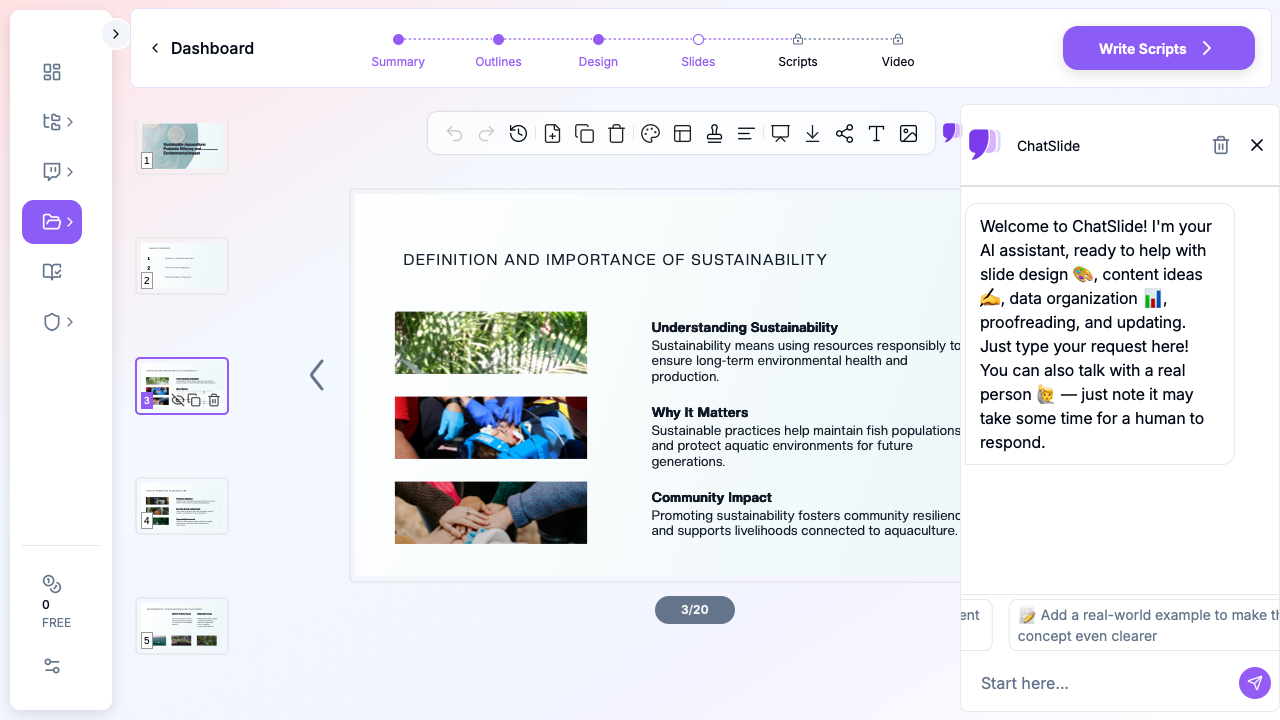

ChatSlide transforms research topics into structured, professional presentations that follow the conventions of scientific communication. Here is how it works for environmental science:
Topic-aware structure generation. When you enter a topic like "Sustainable Aquaculture: Probiotic Efficacy and Environmental Impact," ChatSlide generates an outline that follows scientific presentation conventions: introduction with context, methodology overview, key findings, discussion of implications, and future research directions.
Content depth matching. The AI adjusts content complexity based on your specified audience. A presentation for a peer research conference includes technical terminology and methodological detail. A presentation for community stakeholders emphasizes practical outcomes and visual summaries.
Relevant imagery integration. ChatSlide automatically selects stock images that match your subject matter — aquatic environments, laboratory settings, field research, wildlife — rather than generic corporate graphics.
Consistent professional design. Every slide maintains clean typography, adequate white space, and a visual hierarchy that keeps the audience focused on your data and arguments.
Common Environmental Science Presentation Scenarios
Conference Research Talks
The most common scenario: presenting original research at a scientific conference. Whether it is the Society for Environmental Toxicology and Chemistry annual meeting or a regional ecology symposium, these talks follow a predictable structure that ChatSlide generates automatically.
You provide the research topic and key findings. ChatSlide builds slides covering background literature, research questions, methods, results, and conclusions. You then customize with your actual data figures and specific citations.
Thesis and Dissertation Defenses
Graduate students defending environmental science theses need comprehensive presentations that demonstrate mastery of their research area. These are longer (30-60 minutes) and need to show both breadth of understanding and depth of original contribution.
ChatSlide generates the foundational slide structure — literature review, theoretical framework, methodology, results chapters, and implications — giving students a professional starting point they can build on with their specific content.
Grant Proposal Presentations
Environmental researchers frequently present grant proposals to funding agencies, review panels, and institutional committees. These presentations need to convey scientific merit, feasibility, and broader impacts within strict time limits.
ChatSlide helps structure these pitches by separating the scientific rationale from the project plan and expected outcomes — the format that review panels expect.
Course Lectures in Environmental Programs
Professors teaching environmental science courses create dozens of lecture presentations each semester. Topics range from biogeochemistry to conservation biology, each requiring slides that explain complex processes to undergraduate or graduate students.
ChatSlide accelerates this process by generating initial lecture slides that cover standard curriculum topics, which professors then enrich with their own examples and teaching materials.
Community and Stakeholder Presentations
Environmental impact assessments, conservation project updates, and sustainability reports often need to be presented to non-scientific audiences. These presentations prioritize clarity, visual impact, and actionable conclusions over technical detail.
ChatSlide adjusts the language level and visual density when you specify a general audience, producing slides that communicate findings without jargon.
Research Areas Where ChatSlide Is Used
Environmental science spans a wide range of subdisciplines, and researchers across all of them create presentations regularly:
Aquaculture and fisheries science — sustainable farming practices, probiotic and bioremediator research, water quality management, species-specific cultivation methods.
Climate science — atmospheric modeling, carbon cycle analysis, climate adaptation strategies, renewable energy assessments.
Conservation biology — species population studies, habitat fragmentation analysis, protected area management, biodiversity monitoring.
Environmental engineering — water treatment technologies, pollution remediation, waste management systems, green infrastructure design.
Ecology — community ecology, ecosystem services valuation, invasive species management, restoration ecology.
Marine science — coral reef monitoring, ocean acidification research, marine protected areas, fisheries management.
Tips for Stronger Environmental Science Presentations
Lead with the "so what." Start your presentation with why your research matters. A slide showing declining fish populations or rising water temperatures creates immediate context for the technical details that follow.
Use maps early. Environmental research is inherently spatial. Show your study area on a map in the first few slides so the audience has a geographic anchor for all subsequent data.
Simplify your data slides. Conference presentations are not papers. Show one key trend per graph. If you have five variables, use five slides rather than one crowded figure.
Include a clear recommendations slide. Environmental science is applied science. End with specific, actionable recommendations — not just "more research is needed."
Practice the transition between scales. When moving from molecular-level findings to ecosystem-level implications, explicitly signal the scale shift. Your audience needs a moment to adjust their mental framework.
Get Started with Your Research Presentation
If you have a conference deadline approaching or a thesis defense to prepare for, ChatSlide can generate a professional first draft of your presentation in minutes. Upload your research topic, specify your audience, and get a structured slide deck that follows scientific presentation conventions.
From there, add your own data figures, customize the content, and focus your time on rehearsing your delivery rather than fighting with slide templates.
Try ChatSlide free and build your next environmental science presentation faster.