
Quick Answer: ChatSlide is an AI presentation maker built for clinicians who teach. Describe your topic, upload a protocol or paste a guideline, and it produces a structured exercise oncology deck — prehabilitation, exercise during active treatment, survivorship programming, red flags and referral — in under two minutes. It pulls sources straight from PubMed, Google Scholar and ClinicalTrials.gov with citations, builds real charts from your own outcome data, writes speaker notes, and exports to PowerPoint, PDF or a narrated video. Used by professionals at 750+ universities and by over 260,000 people. Free to start, no card required.
The Exercise Oncology Problem
Exercise oncology is a talk with two audiences in one room. Oncologists and nurses want to know what is safe during chemotherapy, what the evidence actually supports, and when to stop. Physiotherapists and exercise physiologists want the prescription — modality, intensity, frequency, progression, and how to modify it around neutropenia, bone metastases, a stoma, lymphoedema or a port. Patients and caregivers, if they are in the room, want one thing: what can I do this week without hurting myself.
The content is also spread across disciplines. The physiology sits in one literature, the oncology in another, and the practical rehabilitation protocols in a third. Building a single coherent deck usually means pulling from guideline documents, a handful of trials, and your own clinic's protocol, then flattening all of it into slides that still read as one argument.
Generic slide templates have no concept of an exercise prescription table, a treatment-phase timeline, or a red-flag stop rule. So the evening goes into dragging boxes around rather than into the reasoning that makes the talk worth giving.


This guide is about exercise oncology specifically — physical activity before, during and after cancer treatment. For general musculoskeletal and neurological rehabilitation teaching see the physiotherapy presentation guide; for athlete injury and return-to-play see sports medicine; for tumour board, staging and systemic therapy lectures see oncology and haematology.
What Makes ChatSlide Powerful for Exercise Oncology
Three ways in
Start from a topic line ("exercise prescription during adjuvant chemotherapy for breast cancer"), upload a document (your clinic's rehabilitation protocol, a guideline PDF, a lecture script, an existing PowerPoint), or paste raw text. Mixed sources are fine — a protocol PDF plus a paragraph of your own framing produces a better deck than either alone.
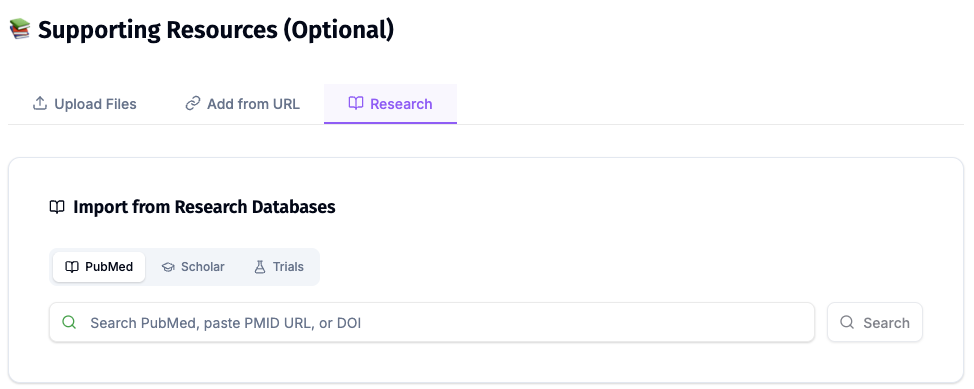
Research tab with citations
Search PubMed, Google Scholar and ClinicalTrials.gov from inside the editor. The AI reads the abstracts and works the findings into your slides with the citation attached, so an evidence slide is sourced rather than asserted.
Real charts from your own numbers
Paste outcome data — six-minute walk distance, grip strength, fatigue scores, adherence rates across a programme — and it renders an actual chart, not a picture of one. Useful when you are presenting your own service's results rather than a trial's.
Speaker notes written with the slides
Each slide comes with notes in your presenting voice. For a mixed clinical and patient audience this is where the nuance goes: the caveat, the contraindication, the sentence you say out loud but do not put on the screen.
Editing that understands slides
Nineteen AI editing tools work at the slide level — shorten a dense block, split one overloaded slide into two, rewrite a clinician-facing slide in patient-facing language, change the tone of a section. Rewriting a professional deck into a patient-education version is a pass over the existing slides, not a rebuild.
Export where you need it
PowerPoint and PDF for the lecture hall, or a narrated video with an AI voice or avatar presenter for a patient-facing resource or an asynchronous module. The same deck serves the CME session and the clinic waiting room.
How ChatSlide Builds Your Exercise Oncology Deck
1. Describe the talk precisely. "Prehabilitation before colorectal cancer surgery: evidence, prescription and implementation, for a mixed surgical and allied health audience" produces a far better deck than "exercise and cancer". Name the population, the treatment phase and the audience.
2. Add your sources. Upload the guideline or protocol, or search the Research tab for the trials you want cited. Anything you upload is read and used; anything you cite arrives with its reference.
3. Review the outline before the slides. The outline is editable first. This is where you set the arc — for exercise oncology, usually: why it matters, the treatment-phase framework, screening and contraindications, the prescription, progression and monitoring, then implementation.
4. Generate, refine, export. Slides arrive with images, layout and speaker notes. Edit the ones that need your clinical judgement, then export.
Use Cases for Cancer Care Teams
Prehabilitation before surgery or systemic therapy. The challenge: explaining a four-week window to a surgical team that has never referred to it. How it helps: upload the prehabilitation protocol and the deck comes back structured around the pathway — referral trigger, assessment, prescription, handover — rather than around the literature. Time saved: an afternoon.
Exercise during active treatment. The challenge: the safety questions dominate, and they are specific — thrombocytopenia, neutropenia, bone lesions, neuropathy, cardiotoxicity, fatigue. How it helps: a screening-and-modification section built as a table, with the stop rules on their own slide instead of buried in a paragraph.
Survivorship and long-term programming. The challenge: moving an audience from "rest and recover" to a maintenance prescription without overclaiming. How it helps: cited evidence slides plus a progression framework the audience can take back to clinic.
Patient and caregiver education. The challenge: the same content, at a different reading level, without a second build. How it helps: rewrite the clinical deck into patient language with the editing tools, then export it as a narrated video for the clinic.
Service in-services and CME. The challenge: short, repeatable teaching for nurses, physiotherapists and medical staff across a cancer centre. How it helps: one deck, several exports, shared templates across the department.
Exercise Oncology Slide Tools Compared (2026)
| ChatSlide | Gamma | Tome | Beautiful.ai | |
|---|---|---|---|---|
PubMed / Scholar / trial search with citations | Yes | No | No | No |
Upload a protocol PDF or existing PPTX as the source | Yes | Partial | Partial | No |
Charts rendered from pasted outcome data | Yes | Limited | Limited | Limited |
Speaker notes generated per slide | Yes | Limited | Limited | No |
Export to narrated video / avatar presenter | Yes | No | No | No |
PowerPoint export | Yes | Yes | Yes | Yes |
Free tier | Yes | Yes | Yes | Trial |
Time Comparison: Manual vs. AI-Assisted
| Task | Manual | With ChatSlide |
|---|---|---|
Finding and reading the sources | 2-3 hours | 20-30 min (Research tab, cited) |
Structuring the talk | 1 hour | 5 min (editable outline) |
Building 25-30 slides | 3-4 hours | Under 2 min to first draft |
Charts from your own outcome data | 1 hour | 5 min (paste the numbers) |
Speaker notes | 1-2 hours | Generated, then edited |
Patient-facing version of the same deck | 2 hours | ~15 min (rewrite pass) |
What a Strong Exercise Oncology Presentation Includes
A treatment-phase spine. Prehabilitation, during-treatment, and survivorship are different prescriptions with different risks. Organising the talk by phase gives the audience a place to put every subsequent slide.
Screening before prescription. Present the screen first: current treatment and its effects, blood counts, bone involvement, cardiac and pulmonary status, neuropathy, falls risk, lymphoedema, surgical restrictions, and the patient's own priorities. A prescription slide that arrives before a screening slide teaches the wrong order.
A prescription that is actually specific. Modality, intensity anchored to something the patient can feel (talk test, rating of perceived exertion), frequency, duration, and progression criteria. "Encourage activity" is not a prescription.
Explicit stop and escalate rules. Fever, new instability, chest pain, syncope, disproportionate breathlessness, sudden severe fatigue, new bone pain. Put them on their own slide. A missed session is cheaper than an avoidable harm.
Baseline function, not diagnosis, as the starting point. Two patients with the same stage can have very different tolerances. Sit-to-stand, gait, balance and symptom response give a usable baseline in a few minutes of clinic time.
Goals in the patient's terms. Returning to work, carrying groceries, walking to the clinic entrance. Tying the prescription to a meaningful goal is what sustains adherence past the talk.
Evidence that is cited and proportionate. Say what the trials support and where the evidence is thinner. An audience of clinicians will trust the whole deck more for one honest limitation slide.
Direct Research Database Access
ChatSlide's Research tab connects to the databases physicians use daily:
- PubMed: Search by keyword, PMID, or DOI. Find the landmark trials, recent publications, and clinical guidelines relevant to your case. The AI reads abstracts and incorporates key findings into your slides with citations.
- Google Scholar: When your topic spans disciplines — say, the intersection of genetics and oncology — Scholar captures the broader academic literature that PubMed alone might miss.
- Clinical Trials (NCT): Presenting on a treatment where pivotal trials are ongoing? Search by NCT number or condition to pull trial design, endpoints, and status into your slides.
Best Practices
Do
- Name the treatment phase in the title of every prescription slide.
- Keep the stop rules on a dedicated slide, in plain language.
- Use one worked patient scenario — generic, not a real patient — to carry the reasoning through the talk.
- Show your own service's outcome data as a chart if you have it; it is more persuasive to a local audience than a trial curve.
- Add the caveat to the speaker notes, not the slide.
Don't
- Don't present a prescription without the screen that precedes it.
- Don't imply a universal dose. The modification is the clinical content.
- Don't use real patient details, images or identifiers in slides or uploads.
- Don't overclaim on outcomes the evidence does not support — survival claims in particular.
Exercise Oncology for Cancer Centres and Departments
Teaching that only lives on one clinician's laptop does not change a pathway. ChatSlide Enterprise adds SSO, centralised team billing, shared brand templates so every in-service across the cancer centre looks like it came from the same service, and team collaboration on a shared deck library. For hospital systems that need a Business Associate Agreement, Enterprise also offers HIPAA-compliant deployment options including private-cloud and on-prem hosting — contact us to discuss terms.
Note on patient data: ChatSlide's standard plans are not a HIPAA-covered service — keep PHI out of slide content and uploads. For hospital systems, group practices, and clinics that need a Business Associate Agreement, our Enterprise plan offers HIPAA-compliant deployment options — contact us to discuss BAA terms, SSO, and on-prem / private-cloud hosting.
Frequently Asked Questions
Can I upload my clinic's rehabilitation protocol instead of typing a topic? Yes. Upload the PDF, Word file or an existing PowerPoint and the deck is built from it. That is usually the better input, because the protocol already contains your service's decisions.
Will it cite real papers? The Research tab searches PubMed, Google Scholar and ClinicalTrials.gov, and citations come from those records. Always read the cited abstract yourself before presenting a claim — the tool finds and summarises sources, it does not replace your appraisal.
Can I produce a patient-facing version of the same talk? Yes. Rewrite the clinical slides into patient language with the editing tools, then export as PDF or as a narrated video with an AI voice or avatar presenter.
How is this different from the physiotherapy guide? That guide covers general rehabilitation teaching — musculoskeletal, spinal, neurological. This one is about cancer-specific programming: prehabilitation, exercise during systemic therapy, and survivorship, where the contraindications and modifications are the hard part.
Can I put my own outcome data on a chart? Yes. Paste the numbers and it renders a real chart you can edit, rather than an image.
Is it free? There is a free tier with no card required. Paid plans add more generations, longer documents and video export.
Can a whole department share templates? Yes, on Enterprise — shared brand templates, SSO and team billing. Contact us for details.
Get Started
Describe your talk, upload your protocol, and have a structured exercise oncology deck to edit in under two minutes.
Make your exercise oncology presentation with ChatSlide — free to start, no card required.