
Why Finance Ethics Training Matters More Than Ever
Financial institutions face growing regulatory scrutiny. From anti-money laundering requirements to ESG disclosure mandates, compliance teams need to deliver clear, actionable training to hundreds of employees — often across multiple offices and time zones.
The challenge? Building these presentations takes days. Compliance officers spend hours translating dense regulatory language into digestible slides, formatting case studies, and ensuring every section meets audit standards. Meanwhile, regulations keep changing, and last quarter's training deck is already outdated.
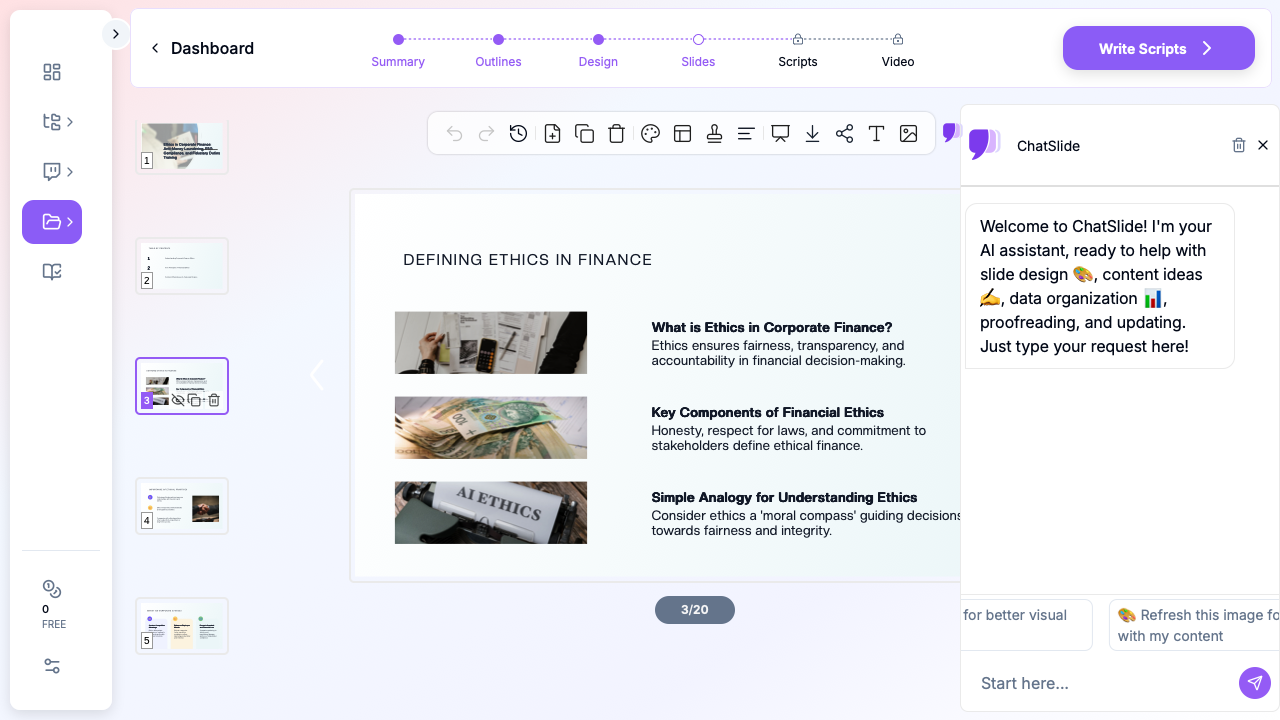

Finance professionals are turning to AI presentation tools to solve this bottleneck. Instead of starting from scratch each quarter, they generate comprehensive training decks in minutes — then customize the content with their institution's specific policies and case studies.
What Makes Effective Finance Ethics Training
Strong ethics training in financial services goes beyond reading regulations aloud. The best programs share several characteristics:
Scenario-Based Learning. Abstract rules don't stick. Effective training presents realistic scenarios: a client asks you to structure transactions to avoid reporting thresholds. A portfolio manager receives material non-public information at a dinner. These concrete situations help employees recognize ethical dilemmas when they encounter them.
Regulatory Context. Employees need to understand not just what the rules are, but why they exist. Training that connects regulations like the Bank Secrecy Act, Dodd-Frank, or MiFID II to real enforcement actions and penalties makes compliance feel urgent rather than bureaucratic.
Clear Decision Frameworks. When faced with an ethical gray area, employees need a structured process: identify the stakeholders, assess the potential harm, consult the relevant policy, escalate when uncertain. Good training slides present this framework visually and reinforce it with examples.
Role-Specific Relevance. A relationship manager's ethical challenges differ from a quantitative analyst's. The most impactful training acknowledges these differences and includes examples that resonate with each audience.
Step-by-Step: Creating Finance Ethics Training with ChatSlide
Define Your Training Scope
Start by identifying which regulatory domains your training needs to cover. Common modules include:
- Anti-Money Laundering (AML) and Know Your Customer (KYC) — Transaction monitoring, suspicious activity reports, customer due diligence
- Insider Trading and Information Barriers — Material non-public information, Chinese walls, restricted lists
- Conflicts of Interest — Personal trading policies, gifts and entertainment, outside business activities
- ESG and Sustainable Finance — Greenwashing risks, disclosure requirements, impact measurement
- Fiduciary Duties — Best execution, suitability, duty of care and loyalty
- Data Privacy and Client Confidentiality — GDPR, CCPA, cross-border data transfers
Generate Your Presentation
Open ChatSlide and enter your training topic. Be specific about the audience and regulatory jurisdiction:
"Anti-money laundering compliance training for retail banking staff covering the Bank Secrecy Act, SAR filing procedures, and red flag indicators for suspicious transactions"
ChatSlide analyzes the subject matter and generates a structured presentation with:
- Clear section headings that follow a logical training progression
- Key regulatory requirements presented in digestible bullet points
- Placeholder sections for case studies and interactive exercises
- Summary slides with key takeaways for each module
Customize with Your Institution's Policies
The AI-generated framework gives you a strong starting point. Now layer in your specifics:
- Replace generic examples with scenarios from your institution's experience (anonymized, of course)
- Add your firm's specific escalation procedures and reporting channels
- Include contact information for your compliance team
- Reference your internal policy document numbers for easy cross-referencing
- Add your institution's code of conduct excerpts where relevant
Add Visual Elements
Finance training benefits enormously from visual aids. ChatSlide's image integration adds relevant stock photography and diagrams, but you may want to supplement with:
- Flowcharts showing decision trees for common ethical dilemmas
- Infographics summarizing key regulatory thresholds (e.g., CTR filing requirements above $10,000)
- Timeline visuals showing the progression of notable enforcement cases
- Charts illustrating the financial impact of compliance failures
Structure for Engagement
The best compliance training avoids the "death by PowerPoint" trap. Structure your deck to maintain attention:
- Hook — Open with a headline-grabbing enforcement case and the penalties involved
- Framework — Introduce the regulatory landscape and your institution's approach
- Deep Dive — Cover each topic area with rules, examples, and scenarios
- Interactive Checkpoints — Include "What would you do?" scenario slides between sections
- Resources — Close with where to go for help, how to report concerns, and upcoming training dates
Key Topics for Financial Services Ethics Training
Anti-Money Laundering
AML training is mandatory for virtually all financial institutions. Your presentation should cover the three pillars: prevention (customer due diligence and transaction monitoring), detection (red flags and pattern recognition), and reporting (SAR procedures and timelines). Include examples of common laundering typologies relevant to your business line — trade-based laundering for commercial banks, layering through shell companies for wealth management.
Insider Trading Prevention
This module needs to be crystal clear about what constitutes material non-public information and the consequences of trading on it. Include your firm's personal trading policies, pre-clearance requirements, and information barrier procedures. Recent SEC enforcement actions provide compelling case studies that make the risks tangible.
ESG Compliance and Greenwashing
As sustainability regulations tighten globally, ESG training has become essential. Cover the EU's Sustainable Finance Disclosure Regulation (SFDR), the SEC's scrutiny of ESG fund labeling, and practical guidance on making defensible sustainability claims. This is a rapidly evolving area — emphasize that marketing materials and client communications about ESG need compliance review.
Conflicts of Interest Management
Every financial professional encounters conflicts of interest. Training should cover the spectrum: from obvious conflicts (trading ahead of client orders) to subtle ones (recommending proprietary products when alternatives might better serve the client). Include your firm's gifts and entertainment policy, outside business activity approval process, and personal relationship disclosure requirements.
Tips for Delivering Ethics Training
Make it annual — or more frequent. Regulations change, enforcement priorities shift, and people forget. Quarterly refreshers on high-risk topics complement annual comprehensive training.
Track completion and comprehension. Don't just record attendance. Include brief assessments to verify understanding. ChatSlide makes it easy to create recap slides that can serve as quiz prompts.
Localize for your jurisdiction. AML requirements differ between the US (FinCEN), EU (AMLD), UK (FCA), and Asia-Pacific markets. Generate separate training decks for each jurisdiction rather than cramming everything into one.
Update after enforcement actions. When a competitor faces a significant fine or settlement, update your training to include lessons learned. Nothing drives compliance home like a peer institution's costly mistake.
Document everything. Regulators want to see not just that training happened, but what it covered and who attended. Keep your slide decks versioned and archived as part of your compliance records.
Get Started
Building comprehensive finance ethics training no longer requires weeks of work. ChatSlide helps compliance teams generate structured, professional training presentations that cover complex regulatory requirements — giving you more time to focus on customization, scenario development, and actual training delivery.
Create your first ethics training deck in minutes at chatslide.ai.