
The Challenge of Teaching Intellectual Property
Intellectual property education spans an unusually wide range of audiences. Law students need deep statutory analysis. Business students need practical IP strategy. Engineers need to understand patent landscapes. Policymakers need to grasp innovation frameworks. And in every case, the material is dense, jurisdiction-dependent, and constantly evolving.
Building IP education presentations means organizing complex legal concepts — patentability criteria, trademark distinctiveness spectrums, copyright fair use doctrine, trade secret protections — into slides that are both accurate and accessible. Most IP educators spend significant time reformatting case law, regulatory frameworks, and comparative analyses into presentation form.
The challenge compounds when teaching emerging IP topics like AI-generated inventions, open-source licensing, or global IP harmonization — areas where the law is still being shaped and static textbook slides quickly become outdated.

What Makes a Strong IP Education Presentation
Framework-First Structure
The most effective IP presentations anchor each topic in a clear framework before diving into specifics. Whether it's the WIPO classification system, the four types of IP protection, or the innovation-to-commercialization pipeline, giving students a mental model first makes the detailed content stick.
Real-World Case Integration
IP law only makes sense through examples. A patent lecture needs landmark cases (Alice Corp. v. CLS Bank for software patents, KSR v. Teleflex for obviousness). A trademark session needs brand disputes students recognize. A copyright module needs fair use analyses of real creative works.
Comparative and Global Perspectives
IP systems vary significantly across jurisdictions. Strong presentations compare approaches — how the USPTO, EPO, and CNIPA handle the same patentability question, or how fair use (US) differs from fair dealing (UK/Australia). This comparative lens is especially important for business and policy audiences.
Visual Organization of Legal Hierarchies
IP concepts are inherently hierarchical and categorical. Patent claims have structures. Trademark registrations follow processes. Copyright has layers of rights. Presentations that visually organize these hierarchies — through numbered lists, process flows, and comparison tables — are far more effective than text-heavy slide decks.
Step-by-Step: Creating Your IP Presentation with ChatSlide
1. Specify Your IP Topic and Audience
The more specific your topic, the more useful the generated content. Instead of "intellectual property overview," try:
- "Patent Filing Process: From Invention Disclosure to Grant"
- "Intellectual Property Rights and Innovation Megatrends in the Digital Economy"
- "Trademark Registration and Brand Protection Strategies for Startups"
- "Creative Commons Licensing for Educators and Content Creators"
Define your audience — law students, MBA students, engineers, entrepreneurs — since the appropriate depth and emphasis varies significantly.
2. Build Your Outline
ChatSlide generates a structured outline that typically follows the logical progression of IP education:
- Foundation concepts and definitions
- Types of IP protection and their scope
- Application and registration processes
- Enforcement and dispute resolution
- Emerging issues and future trends
For coursework presentations, you might add sections on specific case studies or jurisdiction comparisons. For professional training, you might emphasize practical IP strategy and portfolio management.
3. Generate Professional Slides
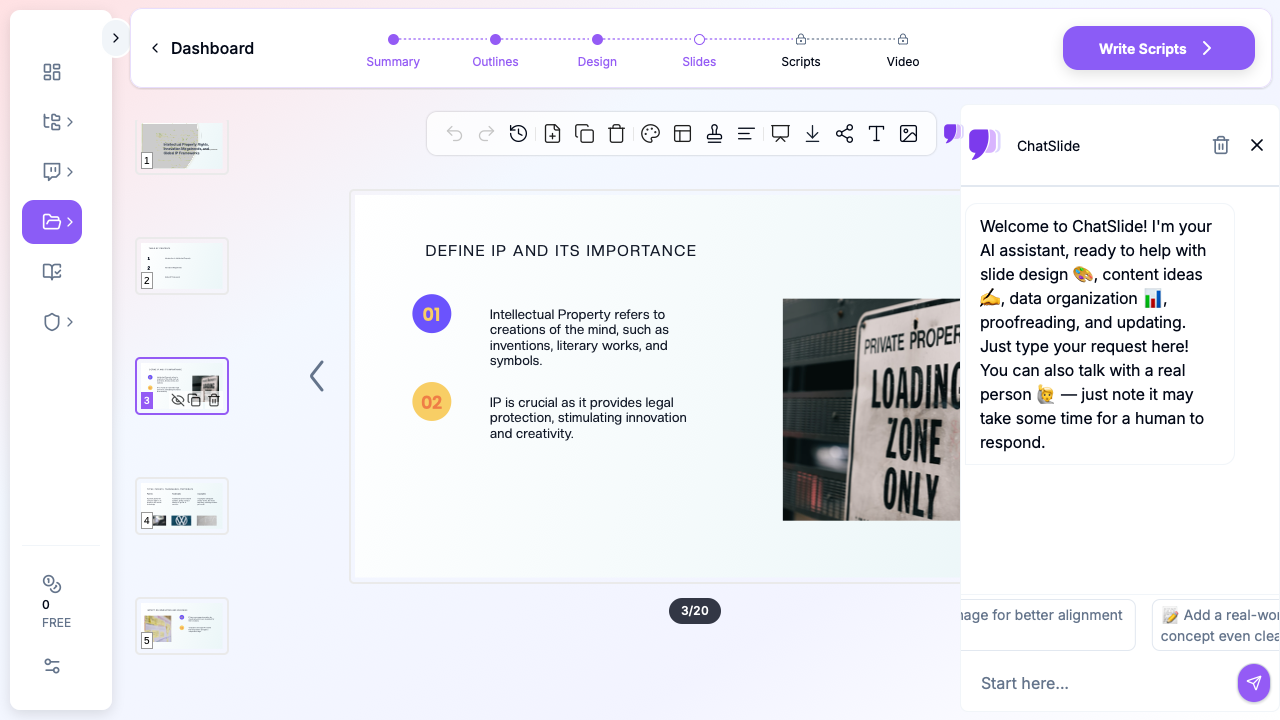
The platform creates slides with structured layouts appropriate for educational content:
- Definition slides with clear, numbered key points
- Process flow slides for filing and registration procedures
- Comparison slides for analyzing different IP types or jurisdictions
- Case study layouts for landmark decisions
4. Customize with Your Expertise
IP education is jurisdiction-specific and rapidly evolving. Use the generated slides as your structural foundation, then:
- Add specific case citations relevant to your curriculum
- Update statutory references for your jurisdiction
- Include recent developments (new patent eligibility guidance, updated trademark classification systems)
- Add institutional branding and course-specific formatting
Common IP Education Presentation Types
University IP Law Courses
Law school IP courses cover the full spectrum: patents, trademarks, copyrights, trade secrets, and their intersections. Presentations need to balance doctrinal analysis with policy discussion and practical application.
Key topics include patentable subject matter, claim construction, infringement analysis, the distinctiveness spectrum for trademarks, the idea-expression dichotomy in copyright, and misappropriation standards for trade secrets.
Business School IP Strategy
MBA and business school IP modules focus on strategic value rather than legal doctrine. Presentations cover:
- IP as competitive advantage and barrier to entry
- IP portfolio management and valuation
- Licensing strategies (exclusive, non-exclusive, cross-licensing)
- IP due diligence in M&A transactions
- Open innovation and collaborative IP models
Professional Development and CLE
Continuing legal education and professional development presentations for practicing attorneys, patent agents, and technology transfer professionals need to be current, practical, and focused on recent developments.
Innovation Policy and Megatrends
Policy-focused IP presentations examine how IP systems interact with broader economic and technological trends:
- AI and inventorship (can AI be an inventor?)
- Standard-essential patents and FRAND commitments
- IP and climate technology transfer
- Digital content and platform liability
- Global IP harmonization efforts
STEM Education IP Modules
Engineering and science programs increasingly include IP education to prepare students for careers where they'll generate patentable inventions. These presentations focus on:
- What makes an invention patentable
- How to read and understand patent claims
- The invention disclosure process
- Researcher obligations and institutional IP policies
Tips for IP Education Presentations
Start with why IP matters. Before diving into legal frameworks, ground your audience in the economic and social rationale for IP protection. Why do we grant temporary monopolies? What happens in systems with weak IP enforcement?
Use the four-category framework early. Patents, trademarks, copyrights, and trade secrets — introduce all four categories upfront, then deep-dive into each. This prevents the common confusion where students conflate different IP types.
Include the limitations. Every IP right has boundaries. Fair use in copyright, patent term limits, genericization in trademarks. Teaching the limitations alongside the rights gives a more complete and honest picture.
Connect to current events. IP disputes make headlines regularly — pharmaceutical patent battles, tech company trademark conflicts, music copyright cases. Referencing recent, recognizable disputes keeps the material engaging.
Address the international dimension. Even in domestic courses, mention how IP rights are territorial and why international treaties (Paris Convention, TRIPS, Madrid Protocol) exist. Students working in global companies will encounter cross-border IP issues early in their careers.
Get Started
Whether you're preparing a law school lecture on patent eligibility, a business school module on IP strategy, or a professional workshop on trademark registration, ChatSlide helps you build structured, professional presentation slides from your topic in minutes.
Focus your expertise on the substantive IP content — the case analysis, jurisdiction-specific details, and strategic insights — while AI handles the slide structure and layout.