
Quick Answer: ChatSlide is the AI presentation maker psychiatrists, registrars and mental health teams use to turn a trial, a guideline or a teaching topic into a ready deck in under two minutes. It is used by teams at 750+ universities and by 280,000+ professionals, imports PDFs, PowerPoints and spreadsheets directly, searches PubMed, Google Scholar and ClinicalTrials.gov from inside the editor, writes speaker notes timed to your teaching slot, and exports to PowerPoint, PDF, Google Slides or a narrated video. Free to start, no card required.
The Psychiatry Presentation Problem
Psychiatry teaching has an altitude problem that most specialties do not. The same hour can hold a consultant who has read the trial, a registrar sitting exams, a nurse who will deliver the intervention on the ward, and sometimes a medical student who has never seen a mental state examination. A deck pitched at one of them loses the rest of the room.
Then there is the evidence itself. Psychiatry's primary literature is heavy on effect sizes that look small, outcome measures that do not obviously map to a patient's life, and trial populations that quietly exclude the people you actually treat. Teaching from it well means showing the methodology, not just the conclusion — the randomisation, the follow-up duration, the exclusion criteria, what the comparator really was. That is slide work, and slide work is the part nobody has time for between clinic and the ward round.
And psychiatry is service-shaped. A talk that does not land back on your own jurisdiction, your own public mental health service, your own prescribing and admission constraints is an interesting talk that changes nothing on Monday.

What Makes ChatSlide Powerful for Psychiatry Talks
The audience field changes the altitude
Write "psychiatrists and psychiatry registrars" into the audience field and the deck drops the diagnostic primer and spends its slides on methodology, prescribing nuance and the practice question. Write "community mental health nurses and allied health" and the same topic comes back at a different level. This is one field, and it is the single most useful control in the tool for a specialty that teaches across grades.
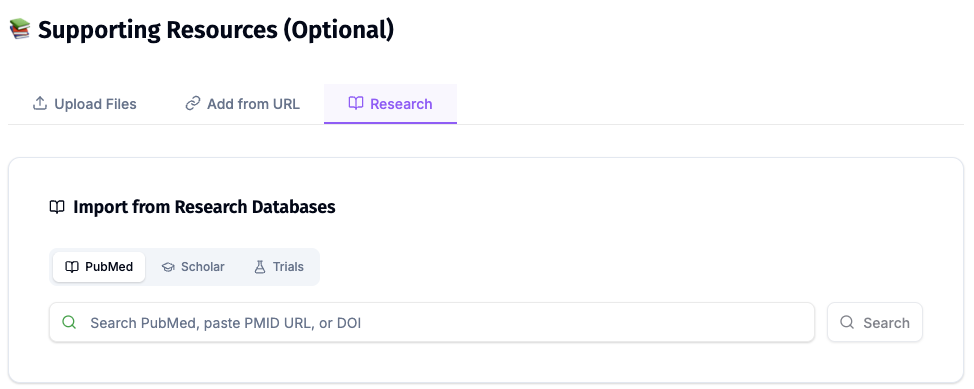
PubMed, Google Scholar and trial registry search inside the editor
Evidence slides are built from a search you run in the Research tab, not from recall. Pull the trial by PMID or DOI, keep the citation attached to the slide, and let the methodology section be built from the abstract you actually read.
Three input modes, including "I already have the deck"
Start from a topic prompt, from uploaded files, or from a link. For psychiatry the file path is usually right: upload the PDF of the paper, last year's teaching deck and your service's clinical guideline together, and the slides are built from those rather than from generic knowledge.
Exact slide count and section order are instructions, not suggestions
Ask for a 30-to-40-minute session with a fixed section order — problem, why this paper, design critique, results, discussion points, implications for our service — and the outline follows it. Review the outline before a single slide is drawn.
Speaker notes written against the clock
Every slide gets notes you can read aloud. For a timed journal club or a departmental CPD slot, that is the difference between reaching your discussion slides and being cut off during the methods.
19 AI editing tools for the pass before you present
Shorten a slide that runs long, rewrite a bullet as a sentence a registrar can repeat, change the tone from conference to ward teaching, regenerate one image without rebuilding the deck.
How ChatSlide Builds Your Psychiatry Deck
- Upload what you already have. The paper, the guideline, a prior lecture, your service's policy document. OCR reads scanned PDFs.
- Set topic, audience and length. Name the grades in the room and give the exact slide count your session allows.
- Review the outline before any slide is drawn. Reorder sections, cut the background block, add a dedicated critique section. Fixing structure here is far cheaper than fixing it later.
- Generate, then refine. Slides, charts, images and speaker notes come back together. Edit in place, then export to PowerPoint, PDF, Google Slides, or generate a narrated video for a training module.
Use Cases for Psychiatry Teams
Journal club for registrars. Challenge: a 30–40 minute slot that has to introduce the problem, justify the article choice, critique the design honestly and end on whether it changes practice. Generate the skeleton from the paper itself, then spend your preparation time on the critique rather than the formatting. Saves roughly 4–6 hours.
Grand rounds or departmental CPD. Challenge: a mixed-seniority audience and a topic that moved since you last taught it. Run the Research tab search, rebuild the evidence section, keep the rest. Saves 3–5 hours.
Exam and viva teaching. Challenge: a weekly registrar teaching slot and no preparation time. Build the session from a review article or a curriculum topic, keep the deck, refresh it next year.
Psychoeducation for patients and families. Challenge: the same content at a completely different reading level. Change the audience field and regenerate — plain language, fewer numbers, more structure.
Service improvement or business case. Challenge: persuading a committee to fund a model of care. Combine the published evidence with your own service's activity data in one deck, with citations visible on the slide.
Multidisciplinary team training. Challenge: nursing, allied health, peer workers and medical staff all need the same update. One project, exported once as slides and once as a narrated video for people who missed the session.
Psychiatry Presentation Tools Compared (2026)
| ChatSlide | Gamma | Tome | Beautiful.ai | |
|---|---|---|---|---|
Import your own PDF / PPTX / spreadsheet | Yes, all three | Limited | Limited | Limited |
PubMed / Google Scholar / trial registry search built in | Yes | No | No | No |
Charts built from your uploaded data | Yes | Partial | No | Template charts |
Audience level controls the altitude | Yes | Approximate | Approximate | Approximate |
Exact slide count and section order respected | Yes | Approximate | Approximate | Approximate |
Timed speaker notes | Yes | Basic | Basic | Basic |
Export to narrated video | Yes | No | No | No |
PowerPoint export that stays editable | Yes | Yes | Limited | Yes |
Interface languages | 30+ | Fewer | Fewer | Fewer |
Time Comparison: Manual vs. AI-Assisted
| Task | Manual | With ChatSlide |
|---|---|---|
Structure a 35-slide teaching session | 2–3 h | 5 min |
Build the methodology and critique section | 2–3 h | 15 min |
Find and format the supporting literature | 2–3 h | 15 min |
Draft speaker notes to the time limit | 1–2 h | 10 min |
Design and image pass | 1–2 h | 10 min |
Total | 8–13 h | ~55 min |
Direct Research Database Access
ChatSlide's Research tab connects to the databases physicians use daily:
- PubMed: Search by keyword, PMID, or DOI. Find the landmark trials, recent publications, and clinical guidelines relevant to your case. The AI reads abstracts and incorporates key findings into your slides with citations.
- Google Scholar: When your topic spans disciplines — say, the intersection of genetics and oncology — Scholar captures the broader academic literature that PubMed alone might miss.
- Clinical Trials (NCT): Presenting on a treatment where pivotal trials are ongoing? Search by NCT number or condition to pull trial design, endpoints, and status into your slides.
What a Strong Psychiatry Presentation Includes
A stated question, on slide two. Not "an update on maintenance treatment" but the question the session answers, phrased so the room knows what they are deciding.
Why this paper, in your words. A sentence of justification does more for a registrar audience than a methods slide. It models how a consultant chooses what to read.
The population before the result. Who was randomised, who was excluded, and how far that is from the patients in your service. In psychiatry this is usually where the talk actually lives.
Design and comparator made explicit. "Drug versus placebo" and "drug versus current standard care" answer different questions, and a room will nod through the difference unless a slide stops them.
Effect sizes expressed in something a clinician feels. Numbers needed to treat, absolute differences, what the scale change means for a person, not only the p value.
Harms given equal slide space to benefits. Weight gain, sedation, sexual dysfunction, akathisia and cognitive effects decide adherence more often than efficacy does.
A slide that lands it back on your own service. Your jurisdiction, your prescribing constraints, your follow-up capacity. This is the slide people remember.
Sources on the slide, not only at the end.
Best Practices
Do:
- Name every grade in the room in the audience field, not just the most senior one.
- Upload the paper itself rather than describing it in the prompt.
- Set the exact slide count your session allows and let the outline absorb the constraint.
- Keep guideline and trial citations visible on the slide.
- Rehearse against the generated speaker notes and cut slides, not words.
Don't:
- Do not let the AI supply a statistic the paper did not report. Check every number against the source before you present it.
- Do not paste patient identifiers, medical record numbers, clinical notes or unredacted case material into a prompt or upload.
- Do not teach a case from a real patient in a way that could identify them — change the details that do not carry the teaching point.
- Do not present a prescribing or admission pathway as universal when your service's policy differs. Say which policy you are describing.
Psychiatry Presentations for Departments and Health Services
Psychiatry teaching rarely belongs to one clinician. Journal club, registrar teaching, CPD and multidisciplinary training are usually shared across a department, and often across several sites of one health service. ChatSlide Enterprise adds SSO, centralized team billing, shared brand templates so every deck leaves the service looking the same, and team collaboration on a single library — contact us to set it up.
Note on patient data: ChatSlide's standard plans are not a HIPAA-covered service — keep PHI out of slide content and uploads. For hospital systems, group practices, and clinics that need a Business Associate Agreement, our Enterprise plan offers HIPAA-compliant deployment options — contact us to discuss BAA terms, SSO, and on-prem / private-cloud hosting.
Frequently Asked Questions
Can it pitch the same topic at registrars and at nurses? Yes. The audience field controls the level. Generate once for each audience from the same uploaded source material rather than rewriting the deck by hand.
Will it respect an exact slide count for a timed teaching slot? Yes. Give it the number and the section order in your prompt, and review the outline before generation to confirm the structure fits the time.
Does it search the psychiatry literature directly? The Research tab searches PubMed, Google Scholar and ClinicalTrials.gov from inside the editor and keeps the citation with the slide.
Can it rebuild last year's teaching deck instead of starting over? Yes. Upload the PPTX and it is used as source material, so the previous session becomes this year's starting point.
How is this different from your journal club and psychotherapy guides? Journal club is the general critical-appraisal format across all specialties; psychotherapy covers therapy modalities and clinical practice for therapists. This page is psychiatry as a medical specialty — grand rounds, registrar and exam teaching, psychopharmacology and service-level CPD. For the general hospital teaching format see medical grand rounds, and for mental health content pitched at nursing audiences see nursing education.
Can I turn the session into a video for people who missed it? Yes. The same project exports as a narrated video, which suits asynchronous CPD better than slides alone.
Is it free? Yes, free to start with no card required. Paid plans add higher limits and more export options.
What languages does it support? The interface runs in 30+ languages, and decks can be generated in the language your audience speaks.
Get Started
Upload the paper, name the grades in the room, set the slide count your session allows, and let ChatSlide build the first full draft while you still have the evening to work on the critique.
Make your psychiatry presentation with ChatSlide → — free to start, no credit card required.