
Quick Answer: ChatSlide is an AI presentation maker for cardio-oncology teams — cardiologists, medical oncologists, and the fellows who cover both services. Describe the talk ("40-slide congress lecture on managing cardiotoxicity risk in cancer patients, ESC style, algorithm-heavy") or upload your existing deck, guideline chapter, or abstract, and it returns a structured, citable lecture in under two minutes. It searches PubMed, Google Scholar, and ClinicalTrials.gov while you build, renders charts from your own surveillance data, writes speaker notes, works in 40+ languages, and exports to PowerPoint, PDF, or narrated video. Used by professionals at 750+ universities and research institutions. Free to start, no credit card.
The Cardio-Oncology Lecture Problem
Cardio-oncology is a teaching problem before it is a clinical one. The central message — do not abandon effective cancer therapy, reduce cardiovascular risk around it — only lands if the audience can follow a decision pathway, and decision pathways are the slowest slides in the world to build.
A congress-grade deck in this field runs 35 to 40 slides and is almost entirely algorithms: baseline risk stratification, surveillance intervals, what an asymptomatic LVEF drop means, when a global longitudinal strain change matters, when to continue therapy anyway. Each one is a flowchart you draw by hand in PowerPoint, nudging arrows for an hour, in an evening you did not have.
Then the same content is asked for three more times at different depths — a cardiology grand rounds, a tumour board slot, an oncology fellows' teaching session — and if you work outside English, frequently in two languages.

What Makes ChatSlide Powerful for Cardio-Oncology
Three ways in
Start from a topic prompt ("40-slide congress lecture on cardiotoxicity risk management in oncology patients, audience of physicians, modern congress style, minimal text, heavy on algorithms and graphs"), from an uploaded document (a guideline chapter, your abstract, a manuscript, a PDF of last year's talk), or from an existing deck you want restructured for a new audience or a shorter slot. The more structure you give — slide count, style, audience, the argument you want the deck to make — the more usable the first draft.
Tell it the slide count and the structure you want
Cardio-oncology talks are usually commissioned with a fixed length and a fixed arc. You can specify both: the number of slides, the order of sections, even what each one should carry. A prompt that says "slide 9: baseline assessment algorithm; slide 10: risk stratification; slide 16: the trial result as a chart" produces an outline that follows it, instead of a generic overview you then have to dismantle.
PubMed, Scholar, and trial registry built in
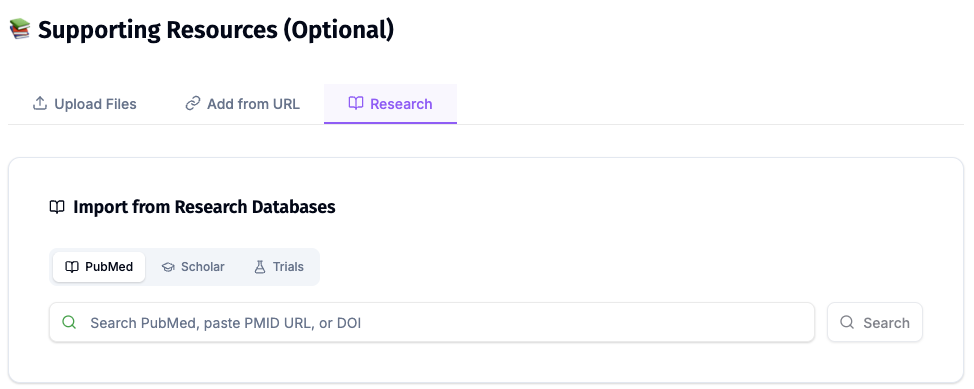
The field moves on trials and guideline updates, and this is the room most likely to ask you for the reference mid-talk. The Research tab searches the literature while you build, so the slide that makes a claim carries the citation that supports it. Searchable by keyword, PMID, DOI, or NCT number.
Real charts from your own numbers
Paste or upload your data — cardiotoxicity incidence by regimen in your cohort, LVEF trajectories, biomarker surveillance yields, how many patients continued therapy after an intervention — and ChatSlide renders a clean chart rather than a bulleted approximation. For a service-line review or a new cardio-oncology clinic business case, your own figures are the argument.
Algorithms and pathways as slides, not as hand-drawn boxes
Describe the pathway in words and the generated slide lays out the decision steps and branches for you. Editing a step later is a text edit, not an afternoon of realigning arrows — which is what makes it realistic to keep a teaching deck current with a guideline that changes.
Speaker notes written with the slide
Each slide can come with notes in your voice. On a deck that is mostly flowcharts, the notes carry the nuance the boxes cannot — why this threshold, why this patient is the exception.
40+ languages, including right-to-left
A large share of cardio-oncology teaching happens in Russian, Spanish, Portuguese, Arabic, or Chinese, and faculty frequently present the same lecture twice. Generate directly in your language, or generate once and produce a second-language version of the same deck.
Export where you need it
PowerPoint for the congress laptop, PDF for the handout, or a narrated video for the trainees and referring oncologists who will not be in the room.
How ChatSlide Builds Your Cardio-Oncology Deck
- Describe the lecture or upload the source. Name the audience, the slide count, the style, and the thesis. "Cardio-oncology congress lecture, physicians, 16:9, modern style, minimal text, algorithm-first" beats "cardiotoxicity talk."
- Let it read your material. Upload a prior deck, a guideline chapter, or a manuscript and it extracts the structure and the evidence rather than starting from nothing. Scanned pages work — text is pulled out with OCR.
- Review and adjust the outline. Reorder sections, add the surveillance algorithm you want, cut the background your audience already has. This is the step worth two minutes of attention; everything downstream follows it.
- Generate, then refine. Slides come back with layout, imagery, charts, and speaker notes. Edit text inline, swap a chart for your own data, regenerate a single slide without touching the rest.
- Export or share. PowerPoint, PDF, narrated video, or a link.
Use Cases for Cardio-Oncology Teams
The congress lecture. A 35 to 40-slide invited talk with a defined thesis and a defined length. The work is the pathway diagrams and the trial figures; those are the parts ChatSlide takes from an evening to a coffee break.
Cardiology grand rounds. The same clinical material, but for an audience that knows heart failure and not oncology drug classes. Regenerate the deck at a different depth instead of rewriting it.
Tumour board and MDT slots. A short, decision-focused set of slides: what the cardiac risk is, what it changes, what it does not. Give it the time limit and the outline comes back sized for the slot.
Fellows' teaching. The surveillance algorithm, the biomarker thresholds, the "when to continue therapy anyway" cases — a recurring didactic that needs updating every time a guideline moves.
Service-line and quality review. Your clinic's own numbers, charted, for a department meeting or a business case for a dedicated cardio-oncology clinic.
Patient and referrer education. The same evidence at plain-language depth, exported as a narrated video for a referring practice.
Direct Research Database Access
ChatSlide's Research tab connects to the databases physicians use daily:
- PubMed: Search by keyword, PMID, or DOI. Find the landmark trials, recent publications, and clinical guidelines relevant to your case. The AI reads abstracts and incorporates key findings into your slides with citations.
- Google Scholar: When your topic spans disciplines — say, the intersection of genetics and oncology — Scholar captures the broader academic literature that PubMed alone might miss.
- Clinical Trials (NCT): Presenting on a treatment where pivotal trials are ongoing? Search by NCT number or condition to pull trial design, endpoints, and status into your slides.
Cardio-Oncology AI Tools Compared (2026)
| Capability | ChatSlide | Gamma | Tome | Beautiful.ai |
|---|---|---|---|---|
PubMed / Scholar / trial-registry search while building | Yes | No | No | No |
Generate from an uploaded guideline chapter or prior deck | Yes | Partial | Partial | No |
Charts rendered from your own surveillance data | Yes | Limited | Limited | Template charts |
Specify slide count and section order in the prompt | Yes | Limited | Limited | No |
Speaker notes generated per slide | Yes | Partial | Partial | No |
40+ output languages incl. right-to-left | Yes | Partial | Partial | Partial |
Narrated video export | Yes | No | No | No |
PowerPoint export that stays editable | Yes | Yes | Limited | Yes |
Time Comparison: Manual vs. AI-Assisted
| Task | By hand | With ChatSlide |
|---|---|---|
Structuring a 40-slide lecture | 1–2 hours | 2 minutes (outline, then edit) |
Drawing 6 decision algorithms | 2–3 hours | Generated, then text edits |
Finding and formatting trial citations | 1–2 hours | Searched inline while building |
Building charts from your own data | 1 hour | Paste the numbers |
Speaker notes | 1 hour | Generated per slide |
A second-language version | A second evening | Regenerate |
What a Strong Cardio-Oncology Presentation Includes
- A thesis, stated early. The best talks in this field argue something — most often that effective oncology therapy should be protected, not stopped, while cardiovascular risk is managed around it. Put it on slide two and return to it at the end.
- Baseline before surveillance. Risk stratification before exposure is what makes everything downstream actionable; a deck that opens at the point of injury has skipped the part the audience can change.
- The limits of a single number. LVEF alone is a late and noisy signal. A strong deck shows what strain imaging and biomarkers add, and where each one stops being informative.
- Agent-class structure. Anthracyclines, HER2-directed therapy, VEGF inhibitors, fluoropyrimidines, checkpoint inhibitors, BTK inhibitors, and CAR-T fail the heart in different ways. Grouping by mechanism is what makes the material memorable.
- Algorithms, not paragraphs. Continue, hold, or stop — with the threshold on the slide.
- Charted trial evidence. A control-versus-intervention bar chart lands harder than the same result in a sentence.
- Long-term follow-up. Survivorship, radiation exposure, and who owns the patient after oncology discharges them.
- Five closing conclusions. A congress audience remembers the last slide.
Best Practices
Do:
- Give the prompt the slide count, the audience, and the argument.
- Upload last year's deck or the guideline chapter instead of starting empty — extraction beats generation.
- Replace generic incidence figures with your own cohort's numbers wherever you have them.
- Keep one algorithm per slide.
- Review the outline before generating; it is the cheapest place to fix structure.
Don't:
- Put patient identifiers, MRNs, or dates of birth into prompts or uploads.
- Upload imaging or report captures with burned-in identifiers — crop them first.
- Present a generated citation you have not opened yourself.
- Pack three decision pathways onto one slide because the slot is short; cut sections instead.
Cardio-Oncology for Departments and Hospital Systems
Cardio-oncology is a shared service by definition — cardiology and oncology, often across more than one site. The Enterprise plan adds SSO, centralized team billing, and shared brand templates so a surveillance pathway deck built once stays consistent wherever it is presented, and HIPAA-compliant deployment options with a BAA for systems that need them. Contact us to discuss terms.
Note on patient data: ChatSlide's standard plans are not a HIPAA-covered service — keep PHI out of slide content and uploads. For hospital systems, group practices, and clinics that need a Business Associate Agreement, our Enterprise plan offers HIPAA-compliant deployment options — contact us to discuss BAA terms, SSO, and on-prem / private-cloud hosting.
Frequently Asked Questions
How is this different from your general cardiology guide? The cardiology presentation guide covers heart failure, prevention, and guideline-directed therapy talks. This page is for the cardio-oncology interface specifically: cancer-therapy-related cardiac dysfunction, surveillance during oncology treatment, and the continue-or-stop decision.
And from the oncology guide? Oncology and hematology is for cancer-treatment lectures and tumour boards. Here the cardiovascular consequence is the subject, not the background.
Is this the same as the immune-related adverse events guide? No. That page covers checkpoint-inhibitor toxicity across every organ system. Myocarditis is one section of it; this page is the full cardiovascular picture across all cancer therapy classes.
Can it build the decision algorithms, or do I still draw them? Describe the pathway in the prompt and it lays the steps out as a slide. You edit the wording; you do not align the boxes.
Will it cite real papers? It searches PubMed, Google Scholar, and ClinicalTrials.gov and attaches what it finds to the claim. Open every citation before you present it — that is your name on the slide.
Can I give it my own cohort data? Yes. Paste or upload the numbers and it charts them rather than describing them.
What about non-English talks? 40+ languages, including Russian, Spanish, Portuguese, Arabic, Chinese, and right-to-left scripts. You can also generate a second-language version of a deck you have already built.
Is it free? Yes, free to start with no credit card. Paid plans add higher limits, more export formats, and team features — see pricing.
Get Started
Describe your next cardio-oncology talk — the audience, the slide count, the argument — or upload the deck you gave last year, and have a structured draft in under two minutes. Make your cardio-oncology presentation with ChatSlide — free, no credit card.