
Quick Answer: ChatSlide is the fastest way for cardiologists, fellows, and cardiac nurses to build a presentation. It reads your trial PDFs, ECGs, echo stills, and ESC/ACC guideline documents, then produces a structured deck with mechanism diagrams, trial-comparison tables, real charts, and speaker notes — with PubMed and ClinicalTrials.gov citations attached. Trusted across 750+ universities and hospital training programs, it builds a 25-slide heart-failure grand rounds or a focused SGLT2-inhibitor lecture in under 2 minutes, and exports to PowerPoint, PDF, or Google Slides. Free to start, no card required.
The Cardiology Deck Problem
Cardiology is one of the most slide-heavy specialties in medicine, and the data underneath it never stops moving. In a single quarter a fellow might present a heart-failure grand rounds built on DAPA-HF, EMPEROR-Reduced, and the 2023 ESC HF update, then a cath-conference case, then a journal club on the latest SGLT2-inhibitor outcomes. Each one pulls from landmark trials, evolving guidelines, ECGs, echo loops, and hemodynamic tracings — and each one is expected to look board-quality.
Built the old way, that means a lost weekend: hunting for a clean Kaplan-Meier curve from DAPA-HF, redrawing the RAAS or natriuretic-peptide cascade in PowerPoint by hand, and retyping NNT numbers out of a supplementary appendix. By the time the deck is half-done, the attending has changed the question they want addressed.
The pivot is to stop assembling slides manually and let the tool do the assembly while you keep the clinical judgement.
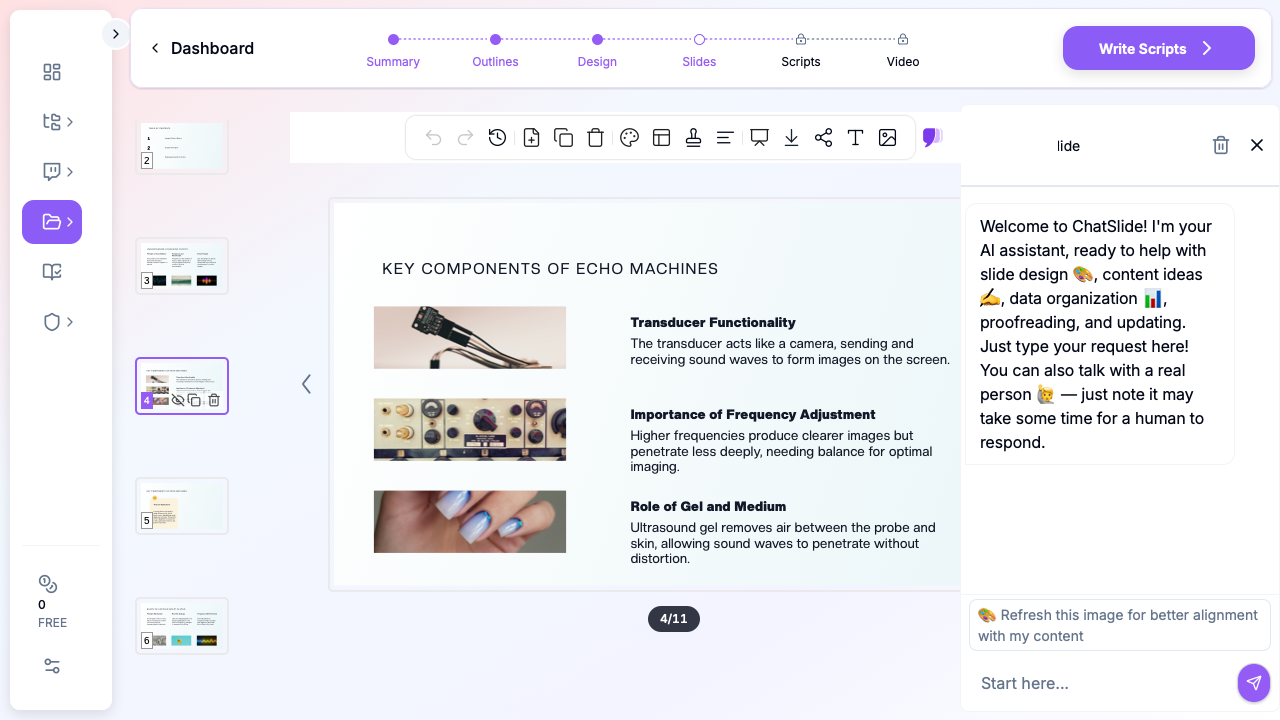
Drop in a topic — "heart failure with reduced ejection fraction: the four pillars of GDMT" or "SGLT2 inhibitors in HFpEF: EMPEROR-Preserved and DELIVER" — and ChatSlide returns a structured deck with a clear arc, mechanism figures, side-by-side trial tables, and presenter-ready talking points.
What Makes ChatSlide Powerful for Cardiology
Reads the trials, not just the topic
Upload the DAPA-HF, EMPEROR-Reduced, PARADIGM-HF, or DELIVER PDFs and ChatSlide extracts the primary endpoints, hazard ratios, and event numbers — then builds them into comparison tables instead of making you retype them. The same works for the ESC/ACC/AHA guideline documents your program expects you to cite.
Real data charts, not clip art
Paste in event rates, EF distributions, or biomarker trends and ChatSlide renders actual charts — Kaplan-Meier-style survival curves, bar comparisons, forest-plot-style summaries — so your outcomes slides carry data, not decoration.
OCR on figures and tables
Screenshot a table from a trial supplement or a figure from a guideline and ChatSlide reads it, pulling the numbers into an editable slide rather than dropping in a blurry image.
Research search built in
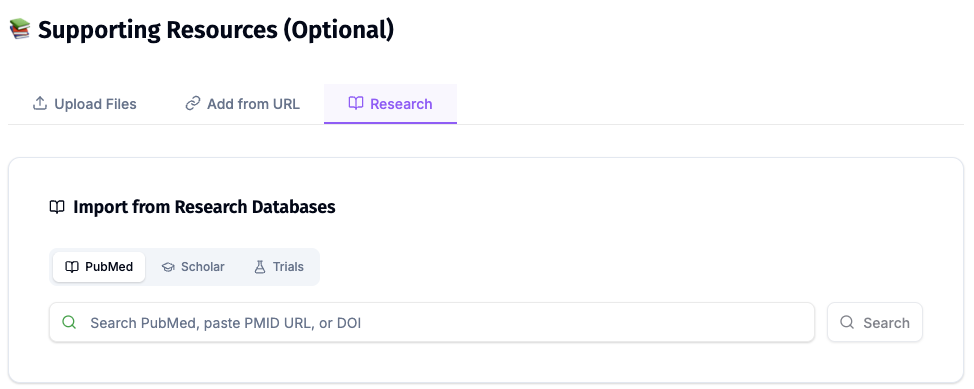
The Research tab queries PubMed, Google Scholar, and ClinicalTrials.gov directly, so the landmark trial or the ongoing study you need is one search away, with the citation attached automatically (details below).
Speaker notes that match the arc
ChatSlide writes presenter notes to the flow of the talk, not the bullet text — useful in cardiology, where the bullets are intentionally sparse and the real teaching ("anchor on the 26% RRR in cardiovascular death here") happens off-slide.
19 AI editing tools
Rewrite for a fellow vs a referring-physician audience, shorten for a 10-minute cath conference, expand a mechanism slide, or restyle the whole deck to your program's template — each edit happens in place, no rebuild.
How ChatSlide Builds Your Cardiology Deck
1. Give it the topic and the audience. "Heart failure grand rounds: the four pillars of GDMT and the SGLT2 evidence" tells ChatSlide the content; naming the room — cardiology fellows, cardiac nurses, or primary-care referrers — calibrates the depth. A talk to nurses gets the pathophysiology foundation; a talk to fellows gets the DELIVER vs EMPEROR-Preserved head-to-head.
2. Bring your sources. Drag in the trial PDFs, the ESC HF guideline, your own ECGs and echo stills, and any teaching files. ChatSlide reads them, extracts results, and surfaces the figures — you review citations before they land.
3. Generate the outline. A 6-section / 3-subpoint outline yields ~25 slides, a reasonable grand-rounds length. For board review, switch to 8–10 shorter sections to cover more ground per minute.
4. Edit and export. Refine at the slide level, then export to PowerPoint, PDF, or Google Slides for your hospital's system.
Use Cases for Cardiology Teams
- Heart failure grand rounds — GDMT pillars, SGLT2 outcomes, device therapy. Challenge: five trials plus a guideline update. How it helps: extracts endpoints into one comparison table. Time saved: a weekend down to an afternoon.
- Cath / case conference — a focused 10-minute deck with the angiogram, the hemodynamics, and the decision point. OCR pulls the cath-report numbers straight in.
- Journal club — one trial, dissected: design, population, endpoints, limitations. The Research tab attaches the citation and finds the accompanying editorial.
- Board / recert review — arrhythmias, valvular disease, prevention, imaging, condensed into high-yield decks with the guideline thresholds front and center.
- Cardiology for departments and referring teams — a shared, brand-templated deck set that a cardiology service can push to primary-care partners so referral criteria and GDMT targets stay consistent across the network.
Cardiology Presentation AI Tools Compared (2026)
| Capability | ChatSlide | Gamma | Beautiful.ai |
|---|---|---|---|
Reads trial PDFs & extracts endpoints | Yes | Limited | No |
PubMed / ClinicalTrials.gov search + citations | Yes | No | No |
Real data charts from pasted numbers | Yes | Partial | Templates only |
OCR on figures / trial tables | Yes | No | No |
Speaker notes matched to talk arc | Yes | Basic | Basic |
PowerPoint / Google Slides export | Yes | Yes | Yes |
Time Comparison: Manual vs. AI-Assisted
| Task | Manual | With ChatSlide |
|---|---|---|
Outline a 25-slide HF grand rounds | 2–3 hrs | 2 min |
Build a 4-trial comparison table | 1–2 hrs | minutes |
Redraw a mechanism / cascade figure | 1 hr | included |
Write speaker notes | 1–2 hrs | auto-generated |
Restyle to program template | 1 hr | one click |
Direct Research Database Access
ChatSlide's Research tab connects to the databases physicians use daily:
- PubMed: Search by keyword, PMID, or DOI. Find the landmark trials, recent publications, and clinical guidelines relevant to your case. The AI reads abstracts and incorporates key findings into your slides with citations.
- Google Scholar: When your topic spans disciplines — say, the intersection of genetics and oncology — Scholar captures the broader academic literature that PubMed alone might miss.
- Clinical Trials (NCT): Presenting on a treatment where pivotal trials are ongoing? Search by NCT number or condition to pull trial design, endpoints, and status into your slides.
What a Strong Cardiology Presentation Includes
Cardiology audiences are demanding and mixed — a fellow, an attending, a cardiac nurse, and a referring internist can share the same room. A board-quality deck has to clear a specific set of bars:
Pathophysiology first. Whether it's the neurohormonal cascade in heart failure, the ischemic cascade in ACS, or remodeling in valvular disease, ground the talk in mechanism before therapy. Lead with the biology and the trial data lands with meaning instead of as a list of acronyms.
Trials presented with the data hierarchy intact. HFrEF therapy rests on PARADIGM-HF (ARNI), DAPA-HF and EMPEROR-Reduced (SGLT2), plus the beta-blocker and MRA foundation; HFpEF now has EMPEROR-Preserved and DELIVER. Show the primary endpoint, the hazard ratio with confidence interval, and the NNT — not a bullet that says "reduces mortality."
Guidelines as thresholds, not prose. The value of the 2023 ESC HF update or the ACC/AHA guidelines is in the numbers: EF cut-points, class-of-recommendation, initiation and titration targets. Put the thresholds on the slide.
Honest comparisons. The most-asked 2026 question is how to sequence the four GDMT pillars and where SGLT2 inhibitors fit across the EF spectrum. A deck that ducks the comparison loses the room; a side-by-side of trial populations and effect sizes wins it.
Imaging and tracings that teach. An annotated ECG, an echo still with the measurement called out, or a cath image with the lesion marked does more than a paragraph. ChatSlide's OCR and image tools let you bring these in cleanly.
Best Practices (Do's and Don'ts)
- Do lead with mechanism, then trials, then guidelines, then the case.
- Do put hazard ratios, confidence intervals, and NNT on outcomes slides.
- Do keep bullets sparse and let the speaker notes carry the teaching.
- Don't paste a full trial table as an image — use OCR so it's legible and editable.
- Don't overload a single slide with four trials; give each its own comparison row.
- Don't put patient-identifiable data on slides (see the privacy note below).
Enterprise for Cardiology Services
For a cardiology division, cath lab, or hospital training program standardizing didactics across fellows and sites, ChatSlide's Enterprise plan adds SSO, centralized/team billing, shared brand templates, and team collaboration so every grand rounds and referral deck matches one house style. Contact us to set it up.
Note on patient data: ChatSlide's standard plans are not a HIPAA-covered service — keep PHI out of slide content and uploads. For hospital systems, group practices, and clinics that need a Business Associate Agreement, our Enterprise plan offers HIPAA-compliant deployment options — contact us to discuss BAA terms, SSO, and on-prem / private-cloud hosting.
Frequently Asked Questions
Can ChatSlide read a clinical trial PDF and build slides from it? Yes. Upload the trial and it extracts endpoints, hazard ratios, and event numbers into editable tables with the citation attached.
Does it cite sources? Yes — the Research tab pulls from PubMed, Google Scholar, and ClinicalTrials.gov and attaches citations automatically. You review them before they land.
Can I present heart failure, arrhythmia, and valvular topics? Any cardiology topic. Name the topic and audience and it builds the structured deck.
Will it make real charts from my numbers? Yes. Paste event rates or biomarker trends and it renders actual data charts, not clip art.
Can I export to PowerPoint or Google Slides? Yes — PowerPoint, PDF, and Google Slides, so it fits your hospital's tooling.
Is it free? Yes, free to start with no card required. Enterprise adds SSO, team billing, shared templates, and HIPAA-compliant deployment options.
Can I keep my program's template? Yes — restyle the whole deck to your house template in one click, or set a shared brand template on Enterprise.
Get Started
Stop losing weekends to slide assembly. Make your next cardiology grand rounds, journal club, or board-review deck with ChatSlide — drop in the trials and guidelines, and get a structured, cited, board-quality deck in minutes. Start free at ChatSlide, no card required.