
Quick Answer: If you teach or present geriatric medicine — comprehensive geriatric assessment, frailty, falls, delirium, polypharmacy, or care coordination for complex older adults — ChatSlide turns a guideline, an assessment protocol, or a one-line topic into a structured teaching deck in minutes. It is used by 260,000+ users across 750+ universities, searches PubMed and clinical trial registries so your slides carry real citations, builds charts from your own cohort data, writes speaker notes for whoever delivers the session, and exports to PowerPoint. Free to start, no card required.
The Geriatrics Slide Problem
Geriatrics is the specialty where a diagnosis list explains the least. Two patients with the same four conditions can sit at opposite ends of the frailty spectrum, and the thing that decides the next six months is function, not pathology. That is genuinely hard to teach, and it is harder to put on slides — because the moment you reduce it to a bulleted problem list, you have taught the exact habit the specialty exists to correct.
So geriatric teaching decks carry an unusual load. A comprehensive geriatric assessment session has to cover physical, cognitive, functional, social, and medication domains without becoming five disconnected lectures. A deprescribing talk has to be specific enough to change prescribing behaviour and cautious enough not to be read as a blanket instruction. A care coordination onboarding deck has to get a nurse and a social worker, sitting in the same room with different training, to work from one shared model of the patient.
And these decks are almost never built by someone with a free afternoon. They are built by a consultant between a ward round and a clinic, by a care coordination programme lead the week before a new cohort starts, by a nurse educator who also runs the rota.

What Makes ChatSlide Powerful for Geriatrics
Three ways in, including the protocol you already use
A geriatrics session rarely starts from nothing. ChatSlide accepts a plain topic ("comprehensive geriatric assessment for new care coordinators"), a pasted outline, or an uploaded document — an assessment protocol, a frailty scoring tool, a local falls pathway, a service specification, a set of handover notes. Upload the protocol your service actually runs on and the deck is built against that document rather than against a textbook version of it.
PubMed and trial registry search inside the editor
Geriatric medicine moves on evidence that is frequently misquoted, and the room usually knows it. The Research tab searches PubMed, Google Scholar, and clinical trial registries from inside the deck, so a claim about an intervention lands on the slide with a citation attached rather than as a half-remembered trial name.
OCR for printed assessment tools and scanned pathways
Services run on paper. A photocopied Clinical Frailty Scale chart, a printed local falls pathway, a scanned medication review proforma. ChatSlide runs OCR on uploaded PDFs and images, so printed material becomes slide content instead of an appendix nobody reads.
Charts built from your own service data
The most convincing slide in a geriatrics service meeting is your own numbers: length of stay by frailty score, readmission rates in the coordinated cohort, the distribution of medication counts before and after a review round. Paste or upload the aggregate data and the chart is built into the slide rather than screenshotted out of a spreadsheet.
An outline you can fix before any slides exist
ChatSlide returns a section-by-section outline first. For a CGA deck that is where you decide whether function comes before diagnoses, whether social circumstances get their own domain or get folded into discharge planning, and whether the medication review sits inside assessment or stands alone. Reordering an outline takes a minute; reordering thirty finished slides does not.
Speaker notes for whoever actually delivers it
Onboarding decks get handed over. The programme lead who wrote it is on leave and a senior nurse is running the session for the new intake. ChatSlide writes speaker notes per slide, which is the difference between a reusable programme resource and a deck only its author can teach from.
Multi-language output for mixed teams and patient-facing versions
Care coordination teams and the families they work with are frequently multilingual. ChatSlide generates and regenerates a deck in other languages, including right-to-left scripts, so the same content can be delivered to a staff cohort in one language and adapted for a family-facing session in another.
19 AI editing tools for the late revision pass
Shorten a bullet, rewrite a clinical slide at family reading level, split an overloaded assessment slide, change the tone, swap an image. Edits are per-slide, so fixing one thing does not mean regenerating the whole deck.
How ChatSlide Builds Your Geriatrics Deck
1. Give it the source. Type the topic, paste your outline, or upload the assessment protocol, pathway, or service specification you work from.
2. Review the outline first. Check the domain sequence before slides exist — this is where a CGA deck stops being a problem list with function appended.
3. Generate the deck with images, charts, and citations. Slides are built with relevant imagery, any charts your aggregate data supports, and references pulled from the research search.
4. Edit and export. Fix individual slides, add speaker notes, and export to PowerPoint, PDF, or a narrated video for staff who missed the live session.
Use Cases in Geriatric Medicine and Elder Care
Comprehensive geriatric assessment teaching. Residents and new nurses need the five domains as one coherent model, not five mini-lectures. Upload your service's assessment proforma and build the teaching deck directly around the tool they will actually hold in their hands. Saves roughly a full evening of slide work.
Frailty scoring and risk stratification. A session on gait speed, grip strength, and the Clinical Frailty Scale lives or dies on worked examples and clear thresholds. Generate the structure, then spend your time on the examples instead of on layout.
Polypharmacy and deprescribing rounds. Deprescribing teaching needs evidence attached to every recommendation. The research search puts the citation on the slide, and the editing tools let you soften a claim without rebuilding the deck.
Care coordination onboarding. Programmes that pair a nurse with a social worker have to onboard two professions into one shared model — eligibility criteria, caseload workflow, documentation rules, escalation paths. Build it once from the programme specification, then hand it to each new cohort with the speaker notes intact.
Falls, delirium, and dementia education for care staff. Care-home and home-care staff need shorter, concrete, less clinical decks than a resident audience. Generate the clinical version first, then use the editing tools to produce the staff-facing version rather than writing a second deck.
Family and patient-facing sessions. Explaining frailty, advance care planning, or a medication review to a family needs different language entirely. Rewrite at reading level from the clinical deck, and see our patient education presentation guide for that workflow.
Geriatrics Presentation Tools Compared (2026)
| ChatSlide | Gamma | Tome | Beautiful.ai | |
|---|---|---|---|---|
PubMed / trial registry search in-editor | Yes | No | No | No |
Citations added to slides | Yes | No | No | No |
OCR on scanned protocols and printed tools | Yes | Partial | No | No |
Charts from your own aggregate data | Yes | Partial | Partial | Yes |
Editable outline before generation | Yes | Partial | Partial | No |
Per-slide speaker notes | Yes | Partial | No | Partial |
Narrated video export for staff who missed the session | Yes | No | No | No |
Multi-language regeneration incl. RTL | Yes | Partial | Partial | No |
Editable PPTX export | Yes | Yes | Partial | Yes |
Free tier | Yes | Yes | Yes | Limited |
Time Comparison: Manual vs. AI-Assisted
| Task | Manual | With ChatSlide |
|---|---|---|
Structuring the CGA domains into a teachable sequence | 1–2 h | 5 min (editable outline) |
Drafting 25–30 slides | 3–4 h | Under 5 min |
Finding and formatting references | 1–2 h | 10 min (research search) |
Charting service or cohort data | 45 min | 5 min |
Writing speaker notes | 1 h | Generated |
Producing a staff-facing simplified version | 2 h | 20 min (editing tools) |
Direct Research Database Access
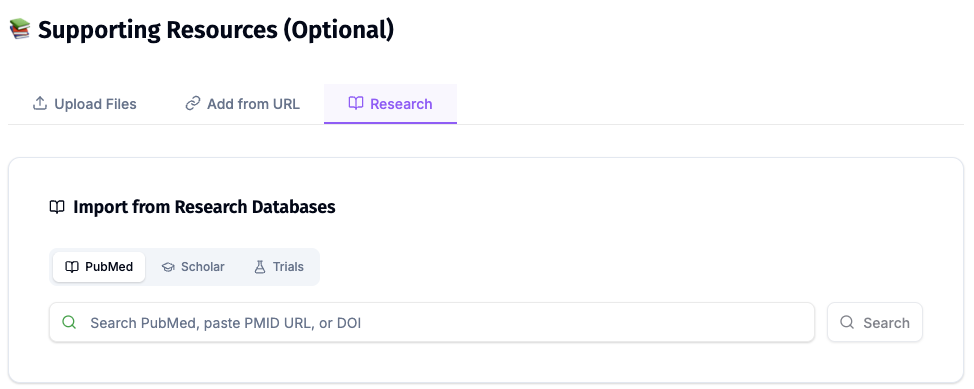
ChatSlide's Research tab connects to the databases physicians use daily:
- PubMed: Search by keyword, PMID, or DOI. Find the landmark trials, recent publications, and clinical guidelines relevant to your case. The AI reads abstracts and incorporates key findings into your slides with citations.
- Google Scholar: When your topic spans disciplines — say, the intersection of genetics and oncology — Scholar captures the broader academic literature that PubMed alone might miss.
- Clinical Trials (NCT): Presenting on a treatment where pivotal trials are ongoing? Search by NCT number or condition to pull trial design, endpoints, and status into your slides.
What a Strong Geriatrics Presentation Includes
Function before diagnosis. If the first substantive slide is a problem list, the deck has already taught the wrong hierarchy. Baseline mobility, cognition, nutrition, continence, and social support belong early, because those are what the plan is actually built on.
All five CGA domains, visibly connected. Physical, cognitive, functional, social, and medication. The connection is the teaching point: a urinary infection that produces delirium, immobility, and a lost placement is one event across four domains, not four problems.
Explicit thresholds and tools. Name the instrument and the cut-off. A four-metre walk taking eight seconds is 0.5 m/s; a Clinical Frailty Scale of 6 means help is needed with outside activities and housekeeping. Vague "assess frailty" slides change nothing.
Medication review as a domain, not a footnote. Anticholinergic burden, falls-risk-increasing drugs, and the drugs whose indication has quietly expired deserve their own section with evidence attached.
Goals of care in the patient's words. A plan that optimises a number the patient does not care about is not a good plan. Include the question you actually ask.
Worked cases, not abstractions. Geriatrics teaching converts when the audience can see a real trajectory. Use anonymised, composite cases — never identifiable patient detail.
What happens next. Who does what by when. An assessment deck without a handover and escalation slide produces a well-assessed patient and no change.
Best Practices
Do:
- Lead with function and baseline, then layer diagnoses onto it.
- Name every instrument and its threshold explicitly.
- Attach a citation to each deprescribing or intervention claim.
- Build the staff-facing simplified version from the clinical deck rather than from scratch.
- Use anonymised, composite cases and aggregate data only.
- Put the escalation and handover path on its own slide.
Don't:
- Reduce a complex older adult to a diagnosis list.
- Present deprescribing as a blanket rule rather than a reasoned, per-patient process.
- Use stock imagery that portrays older adults as uniformly dependent — the specialty's whole point is the range.
- Leave the social domain as a single bullet at the end.
- Paste identifiable patient information into any slide or upload.
Geriatrics Teaching for Services, Programmes, and Care Organisations
Elder care teaching is rarely a one-person activity for long. A national or regional care coordination programme onboarding successive cohorts, a hospital trust standardising frailty teaching across sites, or a care-home group training staff in several languages all need one deck delivered consistently by different people. ChatSlide's Enterprise plan adds SSO, centralised team billing, shared brand templates so every site's slides look like they come from the same organisation, and team collaboration on a shared deck library — contact us to set it up for your programme, trust, or care group. Individual clinicians and educators can keep using the free tier.
Note on patient data: ChatSlide's standard plans are not a HIPAA-covered service — keep PHI out of slide content and uploads. For hospital systems, group practices, and clinics that need a Business Associate Agreement, our Enterprise plan offers HIPAA-compliant deployment options — contact us to discuss BAA terms, SSO, and on-prem / private-cloud hosting.
Frequently Asked Questions
Can I build the deck from our own assessment protocol? Yes. Upload the protocol or proforma and generate against it, so the slides match the tool your service actually uses rather than a generic version of CGA.
Can it pull real references into the slides? Yes. The Research tab searches PubMed, Google Scholar, and clinical trial registries, and citations are added to the slides.
Can I make a care coordination onboarding deck as well as a clinical teaching deck? Yes. The outline step is where you make it operational — eligibility criteria, the nurse–social worker workflow, documentation rules, and escalation paths sequenced deliberately instead of appended to a clinical lecture.
Can I produce the same deck in another language? Yes, including right-to-left languages, which matters for multilingual care teams and family-facing sessions.
Can I chart our service data? Yes. Paste or upload aggregate, anonymised numbers and the chart is generated into the slide.
How is this different from your nursing education guide? That guide covers nursing curriculum and classroom teaching across all specialties; this one covers geriatric clinical content specifically — CGA, frailty scoring, deprescribing, and care coordination. See the nursing education guide for curriculum work, the GP and primary care guide for community-based sessions, and the social work education guide for the psychosocial side of a coordinated team.
Can staff who missed the live session catch up? Yes. The deck can be exported as a narrated video, which works better than circulating slides for an onboarding cohort.
Will the PowerPoint export still be editable? Yes, it exports as a real PPTX with editable text and objects.
Is it free? There is a free tier with no card required. Paid plans add more generations, larger uploads, and additional export options.
Get Started
Geriatrics decks get built by people who have already done a full clinical day, for an audience that will not accept a problem list as a plan. Start from what you already have — the assessment protocol, the frailty tool, the programme specification — and let the structure come out first.
Make your geriatrics slides with ChatSlide — free to start, no card required.