The Challenge: Nursing Leadership Decks Are Built One Module at a Time
Nursing faculty teaching leadership and management content carry a heavier slide-deck load than most clinicians realize. A single semester of an MSN leadership course or a BSN management module asks instructors to produce decks for delegation under the state nurse practice act, therapeutic communication, conflict management between unit nurses and physicians, SBAR shift handoff, charting and documentation, ANA scope-and-standards application, change theory (Lewin, Kotter, Rogers), case management collaboration, and the nurse as a change agent on a quality improvement project. Each topic is its own NCLEX content area, its own AACN Essentials competency, and its own week of class — and the instructor is expected to land every one of them with a deck that holds up against the textbook chapter.
The drift is brutal. Last year's "Delegation" deck was built before the latest NCSBN delegation decision tree update; the "Therapeutic Communication" lecture was forked from a colleague who left, and the citations have aged out. The "Conflict Management" deck still uses Thomas-Kilmann examples drafted for a different cohort. The result is a course that takes weeks to refresh and a Sunday-night rebuild every time the syllabus changes.
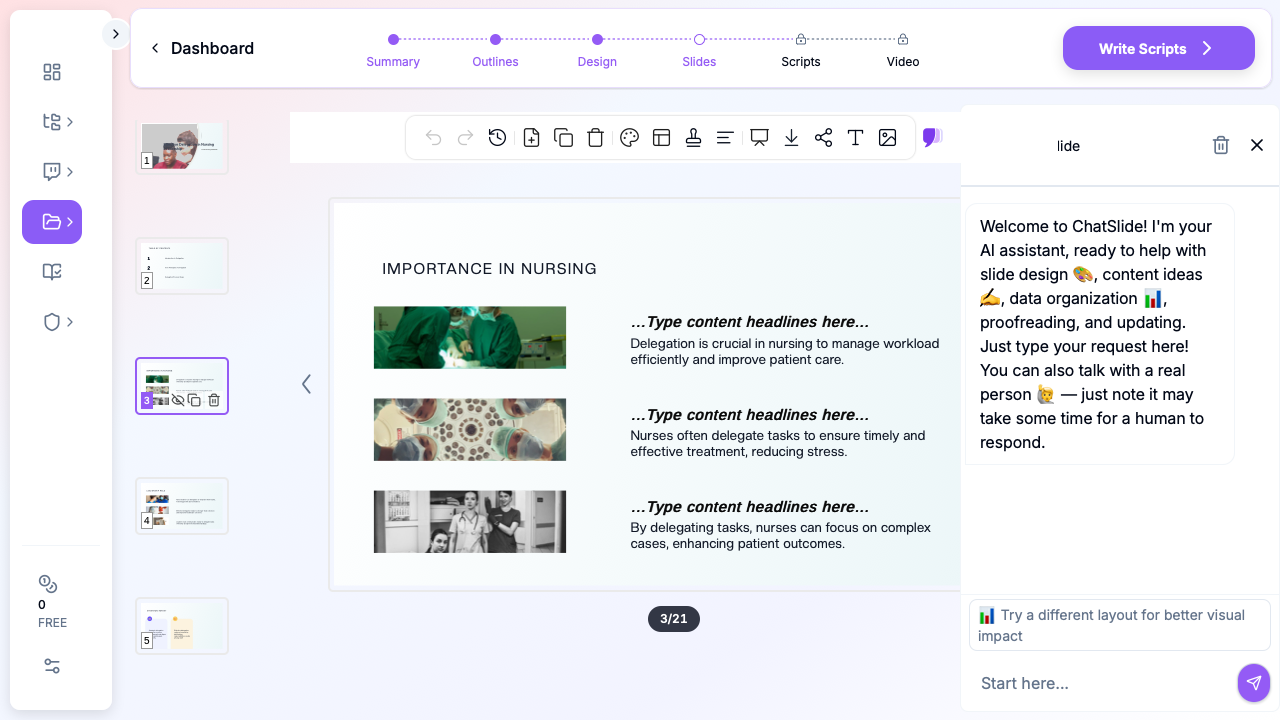

This guide walks through using ChatSlide to draft a complete nursing leadership or management lecture — delegation, therapeutic communication, conflict, SBAR, documentation, change agent, team collaboration — in minutes, and then refining it for a junior-year BSN cohort, an RN-to-BSN bridge course, an MSN leadership seminar, or a unit-based competency in-service.
What Makes a Strong Nursing Leadership Deck
Nursing leadership is taught the way nurses actually practice: in case studies, decision rules, and standardized communication frameworks. A deck that skips those structures and reverts to bullet-point definitions teaches the textbook but not the floor. The structures that consistently work in leadership lectures:
- Open with a unit scenario. A 12-bed med-surg unit, three RNs, two LPNs, one UAP, an unexpected admission and a discharge pending. The lecture's job is to teach the student how to think through that shift — not to define "delegation" in the abstract.
- Anchor in a framework, not a paragraph. The Five Rights of Delegation, ISBAR, SBAR-R, TeamSTEPPS, the NCSBN National Guidelines for Nursing Delegation decision tree, Lewin's three-stage change model, Kotter's eight steps. A single slide that shows the framework with the unit example next to it is worth four slides of prose.
- Show the conversation, not just the principle. Therapeutic communication, conflict de-escalation, and difficult handoff are all scripts. Students remember the language — "I'd like to use SBAR to bring this up" — and they don't remember definitions of empathy. A deck that prints the actual phrasing on the slide gives students something to rehearse.
- Tie every leadership concept to a Quality and Safety competency. QSEN (Quality and Safety Education for Nurses), AACN Essentials, ANA Scope and Standards, Magnet criteria. Connecting a delegation decision to a patient-safety outcome is the move that turns a leadership lecture into a clinical lecture.
- End on the documentation. Nursing leadership content lives or dies on what gets charted afterward. The slide students photograph is the one that shows the actual narrative note format for the situation — incident report, handoff communication, refusal-of-care documentation, restraint event, peer review.
- A second scenario as self-study. Mirror the opening case with a closing case the student answers on their own. Put the answer key in speaker notes so the slide doubles as a study aid before the unit exam.
ChatSlide's *Education|Lecture scenario maps to this structure by default — opening unit scenario, framework, scripted conversation, documentation, second scenario for self-study.
Step-by-Step: Draft a Nursing Leadership Lecture in ChatSlide
1. Pick the scenario and write the audience concretely
Open a new project, choose Education > Lecture. The audience field is the single largest lever on deck quality — write "Third-semester BSN students who have completed Med-Surg I and just started their first leadership rotation on a 30-bed cardiac step-down unit" instead of "nursing students". For a graduate course, write "MSN students in a nurse executive concentration, all of whom are working charge nurses or shift coordinators with three to ten years of bedside experience". For a unit in-service, write "Newly licensed RNs in their first six months on an oncology floor, currently in the residency program and assigned to a preceptor for delegation supervision".
The wider the experience gap inside your audience field, the worse the deck. A leadership lecture pitched at "all nurses" is a leadership lecture that lands with no one.
2. Frame the topic as a decision a nurse has to make
A topic of "Delegation" produces a generic deck. A topic of "Delegation on a med-surg unit when a charge RN must hand off a hypertensive crisis patient's hourly blood pressure checks to an LPN while admitting a new patient with chest pain and supervising a UAP doing AM care" produces a deck with a worked clinical decision baked in. The same applies across the leadership curriculum:
- "Therapeutic communication with a patient diagnosed with stage IV pancreatic cancer one hour after the oncologist's family meeting, when the patient asks the nurse 'Am I dying?' and the family is in the hallway asking the nurse not to tell"
- "Conflict management between two RNs on a 12-hour shift when one believes the other gave an unsafe sliding-scale insulin dose and the patient is currently stable but blood glucose is 312 — what does the nurse say, to whom, and when"
- "SBAR shift report for a post-op day one total knee patient who spiked a temp to 38.4°C overnight, refused PT, and has not voided in eight hours — what goes in each SBAR slot and what gets left out"
- "Documentation of a patient refusing scheduled metoprolol after the nurse explained the rationale — what the chart note has to contain to meet ANA standards, the hospital policy, and a future malpractice review"
- "The nurse as change agent: leading a unit-level QI project to reduce CAUTI rates, framed as a Lewin or Kotter sequence with concrete actions for each phase"
The outline step shows you what you'll get before any slides render — adjust section count to 6 for a fifty-minute class, 8 for a doubled-up leadership seminar, or 4 for a unit competency.
3. Re-architect the deck for the floor moments
The first generation gives you the structure and the prose. Walk through and:
- Promote each framework step into its own slide. The Five Rights of Delegation is five slides, not a list on one slide. SBAR is four slides, one for each letter, with the actual scripted phrasing on each. Students photograph framework slides; they do not photograph bullet lists.
- Build a "what you say" slide for every communication concept. Therapeutic communication isn't a list of techniques — it's a script. Drop in actual sample phrasing: "What I'm hearing you say is...", "It sounds like this has been weighing on you...", "I want to make sure I understand — tell me what part is most worrying right now." Students rehearse the scripts; they don't rehearse adjectives.
- Replace generic clipart with images that look like the unit. The default stock photos of "nurses smiling at clipboards" do not look like a med-surg floor; the editor lets you swap them in two clicks for a unit photograph, a chart screenshot (consent-cleared), or an AI-generated schematic of the handoff workflow.
- Add a documentation slide for every clinical concept. What goes in the chart, what doesn't, what the incident report covers, what the handoff sheet covers. The slide students write down is the one that shows the actual narrative note format.
- Insert a "common errors" slide between the framework and the case. Unsafe delegation under the nurse practice act, communication patterns that escalate conflict, SBAR reports that miss the recommendation, charting that documents the nurse's feelings instead of the patient's findings — the failure modes are what new graduates need to recognize before their first month off orientation.
4. Pull in your standards and the literature you teach from
Upload ANA Nursing: Scope and Standards of Practice and Code of Ethics with Interpretive Statements, the NCSBN National Guidelines for Nursing Delegation, the Joint Commission National Patient Safety Goals, AACN Essentials, your state nurse practice act, and the QSEN competency definitions into the project resources. For change agent content, drop in Diffusion of Innovations (Rogers), Leading Change (Kotter), and the IHI Quality Improvement primer. Ask ChatSlide to extract recommendations and citations into bullets, then drop them onto an "evidence" slide.
For SBAR content, upload your hospital's actual handoff communication policy and the Joint Commission's standards. The resulting deck cites a real policy your students will work under after graduation rather than a generic textbook diagram.
5. Use speaker notes for the floor teaching
Speaker notes are where you put the demonstrations and verbal cues you'll narrate during the lecture: "When delegating to the UAP, stop and ask the UAP to read back the assignment; if the read-back is missing the safety parameter, that's your teaching moment, not the chart audit." ChatSlide preserves notes through PowerPoint and PDF export, so they show in the presenter view at the front of the room and remain in the file students download for review.
For role-play exercises (therapeutic communication, conflict de-escalation), the speaker notes are the facilitator script — what to prompt, what to listen for, how to debrief. Students download the deck for content; faculty use the notes to run the simulation.
6. Export for the LMS and for clinical orientation
Export as PowerPoint for live class (so you can annotate in real time during a delegation walk-through) and PDF for posting to Canvas, Brightspace, ATI, or your school's leadership module. The PowerPoint export keeps the deck editable for next semester's revision and for adjuncts forking your lecture for their own section. For unit in-services, the same deck exports as a self-paced PDF for nurses who can't make the live session.
Direct Research Database Access
ChatSlide's Research tab connects to the databases nursing educators use daily:
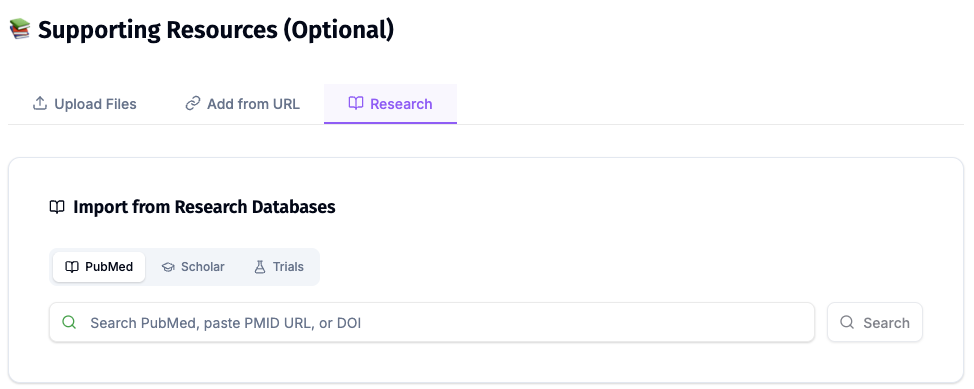
- PubMed: Search by keyword, PMID, or DOI. Find the landmark trials on handoff communication safety, the Cochrane reviews on therapeutic communication and patient outcomes, and the recent quality improvement literature for change agent decks. The AI reads abstracts and incorporates key findings into your slides with citations.
- Google Scholar: When your topic spans disciplines — nursing leadership intersecting with organizational behavior, change theory, or healthcare economics — Scholar captures the management and policy literature that PubMed alone might miss.
- Clinical Trials (NCT): When a leadership lecture references practice-changing trials (e.g., trials that drove the current SBAR adoption, or current QI trials in CLABSI reduction), pull in the trial design and endpoints so the deck cites primary literature rather than secondary summary.
Tips for Nursing Faculty and Nurse Educators
- Build a deck library by competency, not by chapter. One deck per AACN Essentials or QSEN competency (delegation under scope, therapeutic communication, conflict management, SBAR handoff, documentation standards, change agent role, case management collaboration) is more reusable than a single mega-deck for "leadership and management." Each deck is its own teaching unit and revises easily.
- Standardize your deck template across the course. Visual consistency matters when students are reviewing twenty hours of leadership content the week before HESI or NCLEX prep; pick a theme and stay on it across modules.
- Plan didactic and clinical post-conference lectures separately. A board-prep lecture on delegation principles and a post-conference debrief on a real shift delegation question are different decks. Write the audience field for each.
- Show the policy the students will work under. A screenshot of your clinical partner hospital's actual SBAR sheet, delegation checklist, or incident report form is more useful than a stylized textbook diagram. Students recognize the forms in clinical the next morning.
- Lead change-agent lectures with a real QI project. Graduate students need to leave with a project they can scope on Monday — sponsor, baseline data, intervention, measurement — not a survey of every change theory in the literature. Open with the project and let the theory hang off it.
- Save the source PDFs in the project. Next semester's faculty (or future-you) can rebuild the deck without hunting down the standards documents and the hospital policies.
- Tag photos and screenshots by consent status. A clinical-photograph or chart-screenshot library is a teaching asset that lives across decks; tag every image by the consent the patient and the institution gave (school internal, conference, social media) so the deck you build for an in-school lecture doesn't accidentally end up at a national nursing conference with a non-consented image.
Subspecialty and Course Notes
- Pre-licensure BSN leadership courses. Lead with the nurse practice act and the institutional policy, then layer the leadership theory. Students who meet Lewin before they meet the delegation decision tree leave class confused about which to apply first on Monday in clinical.
- RN-to-BSN bridge programs. Working RNs already do leadership; they need the language to name what they do. A deck that opens with their current practice ("when you delegate to a UAP on your unit, you are already applying the Five Rights") lands better than a deck that opens with the textbook definition.
- MSN leadership and nurse executive concentrations. Lead with the system view — Magnet criteria, value-based purchasing, AONL competencies, healthcare finance — and tie every leadership concept to outcome data. A graduate leadership deck without a CMS quality measure on at least one slide is a graduate leadership deck that's still pitched at pre-licensure level.
- Case management courses. A case-management lecture without a discharge planning case is a case-management lecture that students forget by Friday. Open with the patient (CHF, multiple readmissions, home solo) and walk through the team, the resources, the documentation, and the handoff.
- Conflict management workshops. Role-play is non-negotiable. The deck is scaffolding for the simulation, not the simulation itself. Build the conflict scenarios into the deck and run the actual conversations in class.
- Documentation and charting in-services. The single most-screenshotted slide in any documentation in-service is the exact template the unit uses. Build the slide around your institution's template — Epic, Cerner, Meditech — not a generic SOAP outline.
- Change agent and QI seminars. Frame the entire deck around the resident's or staff nurse's actual unit and an actual problem. A generic "leading change in nursing" lecture is forgettable; a "leading change to reduce CAUTI on Unit 4 North between now and Q3" lecture is a syllabus for a thesis.
A Note on Patient Data and HIPAA
ChatSlide's standard plans are not a HIPAA-covered service — keep PHI out of slide content, prompts, and uploads. Pseudonymize patient scenarios, scrub identifiers from any chart screenshots used as examples, and use synthetic case studies for didactic content where possible. For hospital systems, academic medical centers, and nursing programs affiliated with health systems that need a Business Associate Agreement, our Enterprise plan offers HIPAA-compliant deployment options — contact us to discuss BAA terms, SSO, and private-cloud or on-prem hosting.
Get Started
Open ChatSlide, choose Education > Lecture, and paste in the next leadership topic on your syllabus — a delegation scenario, a therapeutic communication script, a conflict between two RNs, a charge-nurse handoff. The first deck is in your hands in minutes; the rest of the afternoon is for the unit-specific examples, the policy screenshots, and the speaker notes that turn an outline into teaching.
For nursing faculty redesigning a leadership course, for graduate program directors building a nurse executive concentration, or for unit educators preparing competency in-services, ChatSlide replaces the per-topic rebuild with a deck-library starting point. Try it at chatslide.ai or app.chatslide.ai.