
Quick Answer: A pharma conference deck follows a 7-section flow: (1) Disease burden + unmet need, (2) Mechanism of action (MoA diagram), (3) Clinical trial design (PICOS), (4) Efficacy data with primary/secondary endpoints, (5) Safety profile & adverse events, (6) Subgroup analyses, (7) Clinical implications + next-step trials. Target 15–20 slides for a 15-minute slot. Manual prep typically takes 20–40 hours per talk. ChatSlide ingests your CSR, NCT trial page, or PubMed paper and produces this exact structure with auto-generated MoA pathways and Kaplan-Meier-style charts.
Why Pharmaceutical Conference Presentations Are Uniquely Challenging
Presenting at a pharmaceutical conference is nothing like giving a standard business talk. You need to communicate complex drug mechanisms, clinical trial data, and therapeutic pathways to an audience that expects precision. A single misrepresented data point or an unclear mechanism diagram can undermine months of research credibility.
Most pharma professionals spend 20 to 40 hours preparing a single conference presentation. Between pulling clinical data, designing mechanism-of-action visuals, structuring the narrative arc from disease burden to treatment outcomes, and rehearsing — the workload is enormous. And that's before you factor in the internal review cycles that pharmaceutical companies require.
The challenge isn't just content creation. It's translating dense scientific material into slides that are visually clear, clinically accurate, and engaging enough to hold attention in a 15-minute conference slot.
What Makes a Strong Pharma Conference Presentation
Before diving into the tools, it's worth understanding what separates memorable pharmaceutical presentations from forgettable ones.
Clear narrative structure. The best pharma talks follow a logical flow: disease burden and unmet need, mechanism of action, clinical evidence, and clinical implications. Your audience should never wonder why they're looking at a particular slide.
Visual clarity over visual complexity. Conference attendees are processing dozens of presentations per day. Clean slides with one key message each outperform dense data dumps. Use visuals to illustrate pathways and mechanisms rather than listing bullet points.
Data that tells a story. Clinical trial results need context. Don't just show p-values and confidence intervals — frame them within the patient journey. What does a 40% reduction in exacerbations mean for a patient with severe asthma? That context is what resonates.
Appropriate depth for the audience. A keynote at a major respiratory conference requires different depth than a workshop for community physicians. Tailor your level of detail to who's in the room.
Building Your Pharma Conference Talk with ChatSlide
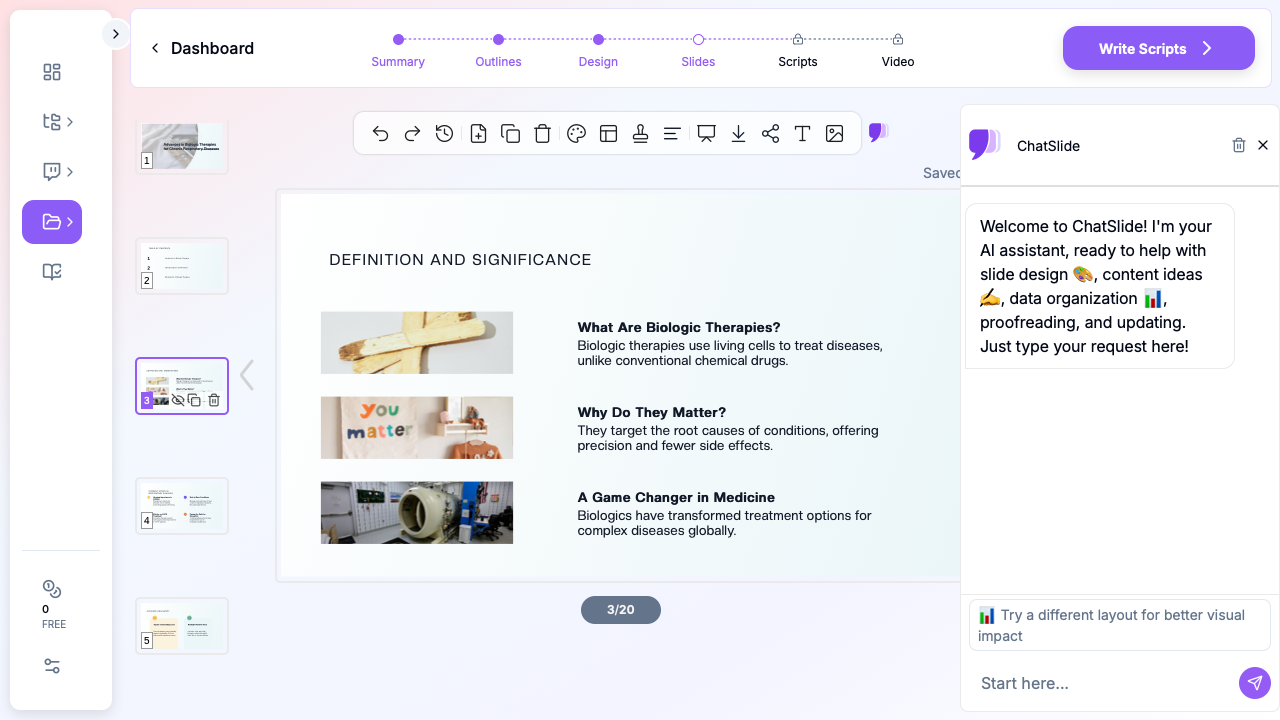
Here's how to create a polished pharmaceutical conference presentation using AI, without sacrificing scientific rigor.
Start with Your Core Message
Open ChatSlide and enter your presentation topic. For a pharmaceutical conference talk, be specific about the therapeutic area and the angle you're taking. Instead of "asthma treatment," try "Advances in Biologic Therapies for Severe Asthma: Clinical Evidence and Treatment Selection."
ChatSlide uses your topic to generate an outline structured around how pharmaceutical presentations actually flow. You'll get sections covering disease background, mechanism of action, clinical data, safety profiles, and practical treatment considerations.
Refine the Outline for Your Conference Format
Conference formats vary significantly. A 10-minute oral presentation needs a tighter structure than a 30-minute symposium talk. Review the generated outline and adjust:
- For oral presentations (10-15 minutes): Keep it to 5-6 sections maximum. Focus on one key clinical message.
- For symposium talks (20-30 minutes): You have room for deeper dives into subgroup analyses and head-to-head comparisons.
- For poster presentations: Structure around the standard IMRaD format (Introduction, Methods, Results, Discussion).
Generate Slides with Clinical Context
Once your outline is set, ChatSlide generates slides with content tailored to your audience and scenario. Select "Conference" as your presentation type to get formatting appropriate for medical meetings.
The AI pulls in relevant context about your therapeutic area, but remember: you are the clinical expert. Review every slide for accuracy. AI-generated content provides a strong starting point, but pharmaceutical presentations demand verification of all clinical claims.
Add Professional Visuals
Use ChatSlide's image integration to add relevant medical imagery. For pharmaceutical presentations, this might include:
- Anatomical illustrations relevant to the disease area
- Treatment landscape diagrams
- Patient journey visualizations
The tool sources professional stock imagery that fits the clinical context. For proprietary data visualizations (trial results, Kaplan-Meier curves), you'll want to add those from your own data sources.
Structuring Different Types of Pharma Presentations
Drug Launch Presentations
When presenting a new therapy at launch, your slides need to build the case from unmet need through to clinical positioning. Structure your talk as:
- Current treatment landscape and gaps
- Mechanism of action of the new therapy
- Pivotal trial results (efficacy and safety)
- How it fits into treatment guidelines
- Patient selection considerations
Medical Science Liaison (MSL) Decks
MSL presentations often need to be more detailed and data-heavy. ChatSlide lets you create comprehensive decks that MSLs can adapt for different healthcare provider audiences. Focus on flexibility — create modular sections that can be expanded or condensed depending on the meeting.
Advisory Board Presentations
Advisory board meetings require presenting complex data for expert discussion. Your slides should pose questions, not just present answers. Use ChatSlide to create a framework, then add discussion prompts and polling questions between data sections.
Direct Research Database Access
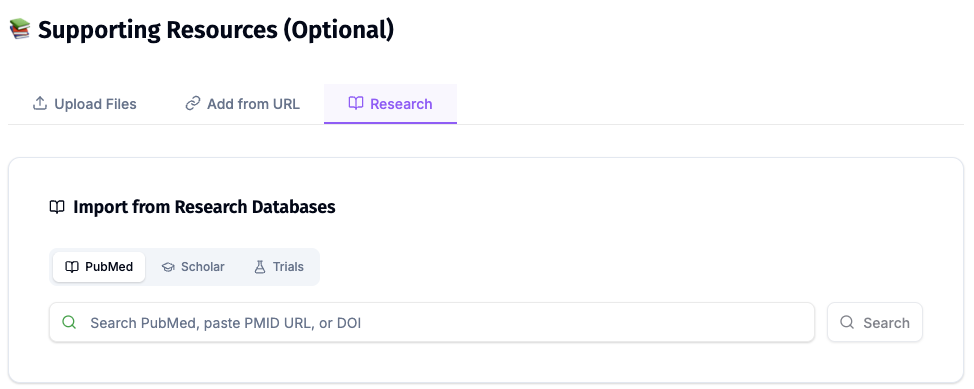
ChatSlide's Research tab connects to the databases physicians use daily:
- PubMed: Search by keyword, PMID, or DOI. Find the landmark trials, recent publications, and clinical guidelines relevant to your case. The AI reads abstracts and incorporates key findings into your slides with citations.
- Google Scholar: When your topic spans disciplines — say, the intersection of genetics and oncology — Scholar captures the broader academic literature that PubMed alone might miss.
- Clinical Trials (NCT): Presenting on a treatment where pivotal trials are ongoing? Search by NCT number or condition to pull trial design, endpoints, and status into your slides.
Tips for Pharmaceutical Conference Presentations
Practice your timing ruthlessly. Conference organizers enforce time limits strictly. If you have 15 minutes, plan for 12 to leave room for questions. ChatSlide's speaker notes feature helps you plan talking points per slide.
Prepare for Q&A. Have backup slides ready with additional data that didn't make it into your main presentation. Subgroup analyses, safety data cuts, and comparator trial details are common question areas.
Consider your compliance requirements. Pharmaceutical presentations often need medical-legal-regulatory (MLR) review. Build in time for this process. Having a clean, well-structured deck from the start makes the review cycle faster.
Use consistent terminology. Stick to the terms used in your product labeling and approved materials. Consistency across slides prevents confusion and compliance issues.
Design for the venue. Conference hall projectors often wash out colors. Use high-contrast text and avoid light-colored text on medium backgrounds. ChatSlide's default themes are designed for readability in presentation settings.
Built-In Research Database Integration
One feature that sets ChatSlide apart for pharmaceutical professionals is its built-in research database access. The Research tab connects directly to PubMed, Google Scholar, and ClinicalTrials.gov (NCT) — so you can search for landmark trials, import published evidence, and pull in clinical trial data without leaving the platform.
For a pharma conference talk, this means you can search PubMed for the pivotal trials behind your therapeutic area, import the key findings, and have the AI incorporate them into your slides with proper citations. Need to reference an ongoing Phase III trial? Search by NCT number directly in ChatSlide.
From Conference Abstract to Finished Slides
Many pharma professionals start with an accepted abstract and need to turn it into a full presentation. ChatSlide handles this workflow well — paste your abstract as the topic description, and the AI expands it into a structured talk that covers all the points your abstract promised.
This is particularly useful when you're presenting at multiple conferences and need to adapt the same core content for different audiences and time slots.
Get Started
Building pharmaceutical conference presentations doesn't have to consume your evenings and weekends. ChatSlide helps you go from clinical concept to polished slides in a fraction of the time, so you can focus on what matters most: delivering insights that advance patient care.
Try ChatSlide at chatslide.ai and create your next conference presentation in minutes. Upload your research papers, clinical data, or abstracts, and let AI handle the slide structure while you focus on the science.
A note on patient data and HIPAA. ChatSlide's standard plans are not a HIPAA-covered service — keep PHI out of slide content, prompts, and uploads. For hospital systems, group practices, and clinics that need a Business Associate Agreement, our Enterprise plan offers HIPAA-compliant deployment options — contact us to discuss BAA terms, SSO, and private-cloud or on-prem hosting.