
Quick Answer: To create a rheumatology lecture with AI, (1) upload your source — a guideline, trial, or case on RA, lupus, or vasculitis; (2) the tool organizes immunology, serology, organ involvement, and treatment algorithms into a teaching deck with citations and charts; (3) export to PowerPoint or PDF with speaker notes. Because biologic and DMARD options shift constantly, use a document-grounded tool like ChatSlide that turns the latest paper into lecture slides in under 2 minutes — free to start.
The Challenge of Teaching Rheumatology
Rheumatology is one of the hardest specialties to present well. A single talk on ANCA-associated vasculitis has to connect immunology, organ-specific manifestations across the lungs and kidneys, serologic testing, biopsy findings, and an induction-and-maintenance treatment algorithm — all while keeping a mixed audience oriented. Rheumatoid arthritis, systemic lupus erythematosus, the spondyloarthropathies, and the systemic vasculitides each carry their own classification criteria, autoantibody profiles, and a treatment landscape that shifts with every new biologic and targeted synthetic DMARD.
The difficulty isn't expertise. Rheumatology fellows, attendings, and immunologists know this material deeply. The problem is translating a disease that touches joints, skin, kidneys, lungs, eyes, and blood vessels into slides that move an audience cleanly from clinical presentation to mechanism to management — without burying the message under a wall of text or a tangle of overlapping syndromes.
Generic presentation templates make this harder. They have no concept of a joint-distribution diagram, an autoantibody panel, a vasculitis classification tree, or a synovial-biopsy image. The result is usually a compromise between immunologic accuracy and visual clarity.

This guide focuses on rheumatology specifically — the inflammatory and autoimmune connective tissue diseases, the systemic vasculitides, and the immunology and serology that drive modern diagnosis. If your talk centers on the renal involvement of lupus or vasculitis, our companion guide on glomerular disease presentations covers the biopsy and biomarker side in more depth.
What Makes a Strong Rheumatology Presentation
The lectures that hold a rheumatology audience share a few traits.
A clear diagnostic framework. Rheumatology teaching works best when it follows the clinical reasoning: pattern of joint or organ involvement, serologic workup, imaging or biopsy, and integration into a specific diagnosis using established classification criteria. This mirrors how clinicians actually think when an undifferentiated patient walks in.
Pattern recognition made visual. So much of rheumatology is pattern: the symmetric small-joint involvement of RA versus the asymmetric large-joint pattern of spondyloarthritis, the malar rash of lupus, the palpable purpura of small-vessel vasculitis. These patterns are far clearer as annotated figures and distribution diagrams than as paragraphs of description.
Autoantibodies in context. Anti-CCP, ANA and its subserologies (anti-dsDNA, anti-Sm, anti-Ro/La), ANCA (anti-PR3 and anti-MPO), and anti-phospholipid antibodies each carry specific diagnostic and prognostic weight. A good slide states explicitly whether an antibody is being used for diagnosis, disease monitoring, or risk stratification.
Mechanism made visual. Cytokine signaling in RA (TNF, IL-6, JAK-STAT), immune-complex deposition in lupus, complement activation, and the granulomatous inflammation of GPA are far clearer as schematics than as text. A good mechanism slide also shows exactly where each therapy intervenes — which is increasingly the whole point, given how targeted modern rheumatology drugs have become.
Current therapeutics. Treatment has changed quickly: bDMARDs and JAK inhibitors in RA, an expanding lupus armamentarium (belimumab, anifrolumab, voclosporin), rituximab and avacopan in ANCA vasculitis, and IL-17 and IL-23 pathway agents in spondyloarthritis and psoriatic disease. Presentations must reflect the most recent evidence and guideline updates, including treat-to-target principles.
Where Rheumatology Presentations Show Up
Fellowship didactics. Core curriculum lectures walking fellows through each major disease — RA, SLE, the vasculitides, the seronegative spondyloarthropathies, crystal arthropathies, and the systemic sclerosis spectrum — with their classification criteria, serologies, and treatment algorithms.
Grand rounds and clinico-pathologic conferences. A complex multi-system case — presentation, labs, autoantibody panel, imaging, biopsy, and management decisions — presented to a mixed audience of rheumatologists, internists, nephrologists, and trainees.
Journal club. Critical appraisal of a pivotal trial in a biologic or targeted synthetic DMARD, where the slides have to carry both the study design and the clinical takeaway.
Board review and CME. High-yield review sessions for the rheumatology boards or continuing-education workshops, where clarity and structure matter more than decoration.
Patient and primary-care education. Talks that translate a chronic autoimmune disease into plain language for patients, or that help primary-care clinicians recognize when to refer.
Step-by-Step: Building a Rheumatology Presentation with ChatSlide
1. Start with your topic or your source material. Begin from a topic prompt — "ANCA-associated vasculitis for fellows" — or upload an existing PowerPoint, a PDF of a guideline, or your notes. ChatSlide reads the material and drafts a structured outline.
2. Refine the outline before generating slides. Reorder sections, sharpen the diagnostic framework, and make sure the arc runs cleanly from presentation to serology to biopsy to management. Fixing structure at the outline stage is far faster than reworking finished slides.
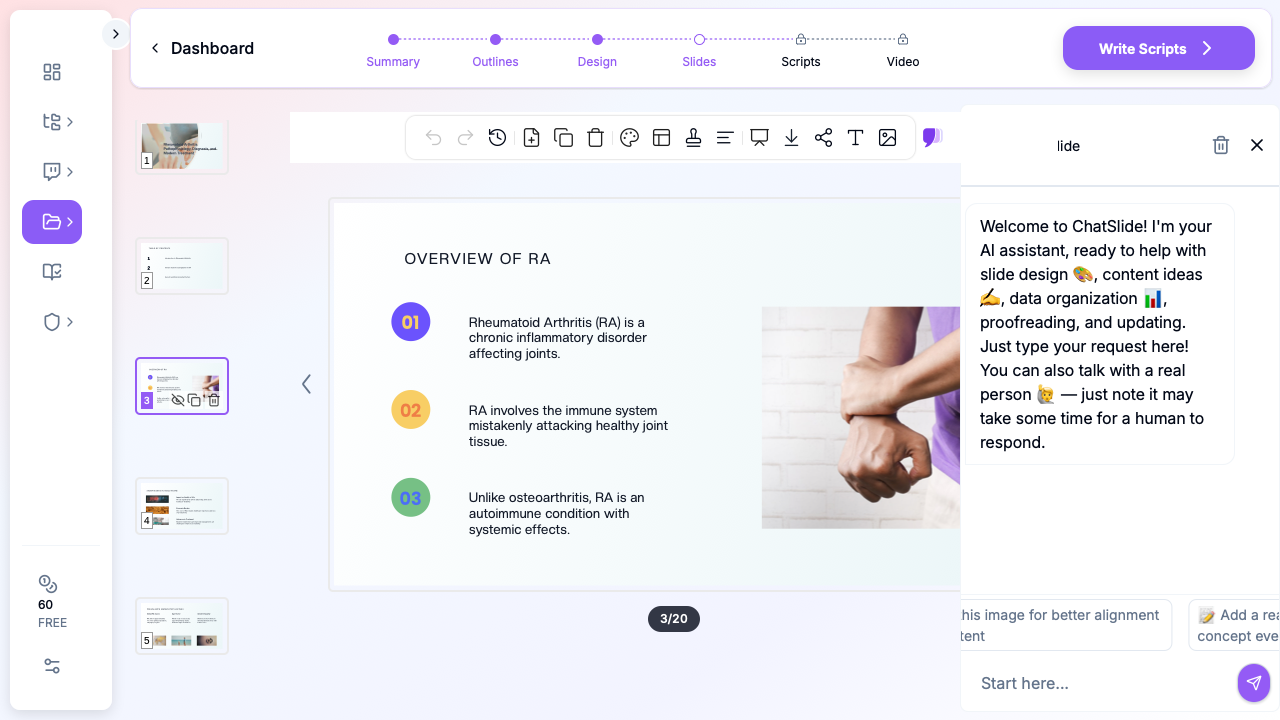
3. Generate slides with relevant medical imagery. ChatSlide builds each slide with a clean layout and pulls in supporting visuals so you're not staring at empty placeholders. Replace any generic image with your own annotated clinical figures, joint diagrams, or biopsy micrographs.
4. Pull in the evidence. Use the Research tab (below) to bring landmark trials and current guidelines directly into your deck with citations.
5. Export to your format. Download as PowerPoint or PDF for grand rounds, fellowship lectures, or a society meeting.
Direct Research Database Access
ChatSlide's Research tab connects to the databases physicians use daily:
- PubMed: Search by keyword, PMID, or DOI. Find the landmark trials, recent publications, and clinical guidelines relevant to your case. The AI reads abstracts and incorporates key findings into your slides with citations.
- Google Scholar: When your topic spans disciplines — say, the intersection of immunology and rheumatology — Scholar captures the broader academic literature that PubMed alone might miss.
- Clinical Trials (NCT): Presenting on a treatment where pivotal trials are ongoing? Search by NCT number or condition to pull trial design, endpoints, and status into your slides.

Tips for Rheumatology Presentations
Lead with the pattern. Anchor each case in its presenting picture — the joint distribution, the rash, the organ involvement — before moving to serology and biopsy. It gives the audience a clinical frame for the immunology that follows.
State the classification criteria. When you invoke ACR/EULAR criteria for RA, SLE, or a vasculitis, show them explicitly and note that they are classification — not diagnostic — criteria. Rheumatology audiences will hold you to that distinction.
Name the autoantibody and its role. When you cite anti-CCP, anti-dsDNA, or anti-MPO, say plainly whether you're using it for diagnosis, monitoring, or prognosis. Consistent framing prevents confusion across a multi-system talk.
Map therapy to mechanism. Modern rheumatology drugs are defined by their targets. A single slide that places each agent on the cytokine or cell-signaling pathway it blocks teaches the treatment landscape far better than a drug list.
Present trial data in context. For pivotal trials, show the clinical question, key design features, and primary outcome on a single slide. Reserve detailed secondary outcomes and subgroup analyses for backup slides.
Prepare for detailed questions. Rheumatology audiences probe immunosuppression dosing, infection risk and screening, tapering strategy, and statistical methodology. Have backup slides ready with supplementary tables and protocol details.
A Note on Patient Data
ChatSlide's standard plans are not a HIPAA-covered service — keep protected health information (PHI) out of slide content and uploads, and anonymize any clinical images or case details. For hospital systems, academic centers, and group practices that need a Business Associate Agreement, our Enterprise plan offers HIPAA-compliant deployment options — contact us to discuss BAA terms, SSO, and on-prem / private-cloud hosting.
Get Started
Rheumatology teaching advances clinical knowledge, sharpens diagnostic reasoning, and trains the next generation of rheumatologists. The hours spent formatting slides are hours away from that work.
With ChatSlide, turn your expertise in rheumatoid arthritis, lupus, the vasculitides, and the rest of the autoimmune spectrum into structured, professional slides in minutes — whether you're delivering fellowship didactics, leading grand rounds, or presenting a trial update at a society meeting.
Start building your rheumatology presentation with ChatSlide.