Quick Answer: ChatSlide is an AI endocrinology presentation maker for endocrinology fellows, internal medicine residents, hospitalists, and medical educators. It turns lecture topics, guideline PDFs, trial abstracts, lab trends, and case notes into structured decks with hormone-axis diagrams, differential tables, lab-interpretation panels, PubMed citations, speaker notes, and PowerPoint or Google Slides export. Trusted across 750+ universities and hospital training programs, ChatSlide can build a thyroid-disorders lecture or an endocrine-emergencies grand rounds in under 2 minutes. Free to start, no card required.
The Endocrinology Deck Problem
Endocrine teaching is hard to slide because it lives on feedback loops. A thyroid lecture is not a list of diseases; it is the HPT axis, the difference between primary and central disease, the way TSH and free T4 move against each other, and the clinical picture that follows. The same is true for the HPA axis in adrenal disease, the anterior pituitary in hypopituitarism, calcium and PTH in bone metabolism, and the lipid pathways behind cardiovascular risk.
The old workflow is slow because the reasoning is layered. You pull a lipid guideline from one source, a thyroid-storm criteria table from another, a case timeline from your own notes, and reference ranges from the lab. Then you rebuild the same slides by hand: axis diagram, lab-pattern grid, treatment algorithm, monitoring plan, and take-home points, for every topic.
ChatSlide keeps the clinical judgment with you, but removes the slide assembly work.
What Makes ChatSlide Powerful for Endocrinology
Turns topics into an axis-first teaching arc
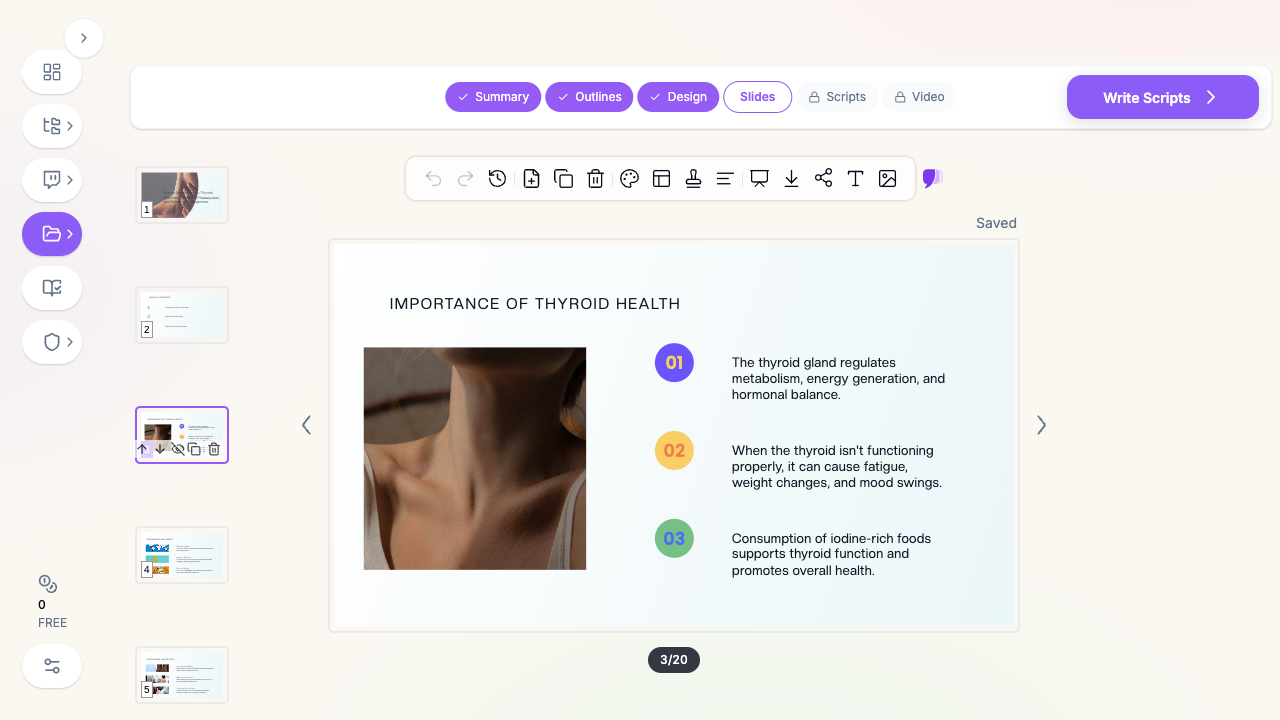
Start with a topic such as "Thyroid emergencies: thyroid storm and myxedema coma for the acute physician" or "Approach to hypopituitarism." ChatSlide builds the deck around endocrine reasoning: the hormone axis, primary versus central disease, the lab pattern, the clinical syndrome, the diagnostic workup, treatment, and monitoring.
Reads guidelines and papers
Upload guideline PDFs, review articles, or society position statements — lipid guidelines, thyroid nodule management, adrenal incidentaloma pathways, osteoporosis treatment thresholds. ChatSlide extracts the recommendations, cutoffs, and treatment thresholds into editable slides. You can keep the deck practical for residents or deepen it for endocrinology fellows and attendings.
Builds lab-interpretation tables
Endocrine talks depend on grids that are easy to scan: TSH and free T4 patterns, the short Synacthen and dexamethasone-suppression interpretations, calcium with PTH, and lipid targets by risk category. ChatSlide helps assemble those comparisons so the pattern is visible instead of buried in paragraph text.
Handles charts and hormone trends
Paste de-identified lab trends — a falling TSH on levothyroxine titration, a cortisol curve, an HbA1c or lipid trajectory — and ChatSlide can turn them into visual slides. This is especially useful for thyroid titration, adrenal insufficiency workups, and lipid-management lectures where the trend carries the teaching point.
OCR for tables and scanned material
If your source is a scanned guideline table, a screenshot of reference ranges, or an old teaching PDF, ChatSlide's OCR can read the text and numbers so you can edit the content rather than paste a blurry image.
Speaker notes for mixed audiences
The same deck can serve different rooms. For residents, the notes can explain why central hypothyroidism cannot be diagnosed on TSH alone. For fellows, they can add the nuance of assay interference or subclinical-disease thresholds. For a primary-care audience, they can keep it to the practical referral and monitoring points.
19 AI editing tools
Shorten a grand rounds to 15 minutes, expand an axis slide, rewrite for medical students, add speaker notes, change the visual style, or turn a dense reference-range table into a cleaner interpretation grid without rebuilding the deck.
How ChatSlide Builds Your Endocrinology Deck
1. Name the topic and audience. A precise prompt works best: "Endocrinology grand rounds on adrenal insufficiency for internal medicine residents" or "Lipid guideline update lecture for primary care."
2. Bring your sources. Upload guideline PDFs, de-identified case notes, PubMed papers, or a reference-range sheet. Keep patient identifiers out of standard-plan uploads, and use aggregate or fictionalized data for teaching cases.
3. Generate the outline. ChatSlide proposes the flow: physiology and axis, disease mechanism, lab interpretation, diagnostic approach, treatment, monitoring, pitfalls, and take-home points. You can edit the sections before generating slides.
4. Generate, review, and export. Review citations and clinical wording, adjust slide depth for the room, then export to PowerPoint, PDF, or Google Slides.
Use Cases for Endocrinology Teams
- Thyroid disorders: Build a lecture that runs from the HPT axis through hypothyroidism, hyperthyroidism, nodules, and thyroid emergencies, with a clean TSH/free-T4 interpretation grid.
- Adrenal and pituitary: Turn adrenal insufficiency, Cushing's, incidentaloma workup, or hypopituitarism into a structured teaching deck with dynamic-testing algorithms.
- Bone and mineral metabolism: Create osteoporosis, hypercalcemia, and PTH-disorder lectures with treatment-threshold tables and monitoring plans.
- Lipids and cardiometabolic risk: Summarize a lipid guideline update into risk categories, LDL targets, and therapy escalation without losing the evidence thread.
- Endocrine emergencies: Build fast, decision-focused decks for thyroid storm, myxedema coma, adrenal crisis, and severe hypercalcemia for acute-care teaching.
- Departments and training programs: Standardize endocrinology didactics, grand rounds, and board-review teaching across sites with shared templates, SSO, centralized billing, and team collaboration.
Endocrinology AI Tools Compared (2026)
| Capability | ChatSlide | Gamma | Beautiful.ai |
|---|---|---|---|
PubMed and ClinicalTrials.gov search | Yes | No | No |
Reads guideline and paper PDFs | Yes | Limited | No |
Builds lab-pattern interpretation tables | Yes | Manual | Manual |
OCR for scanned reference-range tables | Yes | No | No |
Real charts from pasted hormone trends | Yes | Partial | Templates only |
Speaker notes for clinical teaching | Yes | Basic | Basic |
PowerPoint and Google Slides export | Yes | Yes | Yes |
Time Comparison: Manual vs. AI-Assisted
| Task | Manual | With ChatSlide |
|---|---|---|
Outline a 25-slide endocrinology grand rounds | 2-3 hrs | 2 min |
Build a TSH/free-T4 interpretation grid | 45-90 min | minutes |
Summarize a lipid or thyroid guideline | 1-2 hrs | minutes |
Create dynamic-testing algorithm tables | 1-2 hrs | minutes |
Write speaker notes | 1 hr | auto-generated |
Restyle to department template | 30-60 min | one click |
Direct Research Database Access
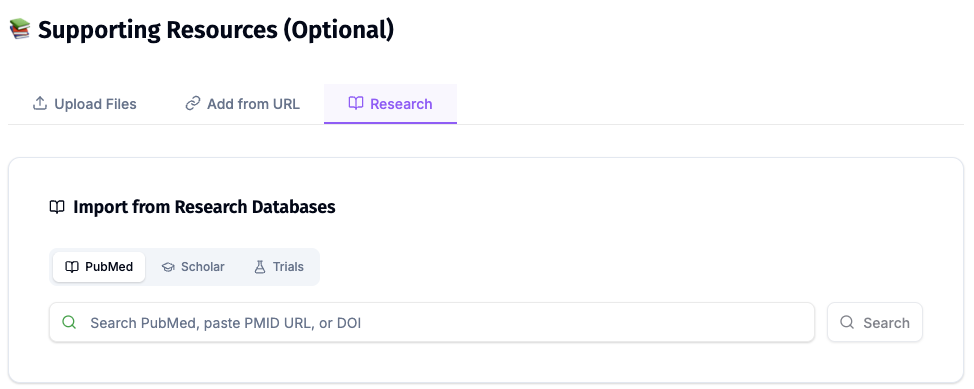
ChatSlide's Research tab connects to the databases physicians use daily:
- PubMed: Search by keyword, PMID, or DOI. Find the landmark trials, recent publications, and clinical guidelines relevant to your case. The AI reads abstracts and incorporates key findings into your slides with citations.
- Google Scholar: When your topic spans disciplines — say, the intersection of genetics and oncology — Scholar captures the broader academic literature that PubMed alone might miss.
- Clinical Trials (NCT): Presenting on a treatment where pivotal trials are ongoing? Search by NCT number or condition to pull trial design, endpoints, and status into your slides.
What a Strong Endocrinology Presentation Includes
The axis first. Start with the feedback loop before the disease list. A thyroid slide that shows the HPT axis makes primary versus central disease obvious; an adrenal slide that shows the HPA axis makes the workup follow naturally.
A lab-pattern grid. Endocrine diagnosis is pattern recognition. Put the paired hormones on one slide — TSH with free T4, cortisol with ACTH, calcium with PTH — so the audience reads the pattern, not a paragraph.
Diagnostics with decision points. Do not list every test. Show what each result changes: when a suppression or stimulation test is needed, when imaging follows biochemistry, and when subclinical findings warrant treatment versus monitoring.
Treatment logic and thresholds. A good therapy slide states the threshold to treat, the first-line agent, the titration plan, and the target. Endocrinology runs on cutoffs, so make them explicit.
A monitoring plan. Levothyroxine titration, steroid replacement in stress, and lipid or bone therapy all depend on follow-up. Show the interval and the parameter, not just the starting dose.
Emergencies made decision-ready. For thyroid storm, myxedema coma, adrenal crisis, and severe hypercalcemia, the highest-value slide is the fast recognition-and-act algorithm. Keep it clean.
Related ChatSlide guides: For diabetes self-management and DSMES teaching, see the diabetes education presentation guide. For weight management, GLP-1 pharmacotherapy, and ABOM board review, see the obesity medicine guide. This guide covers the broader endocrine specialty — thyroid, adrenal, pituitary, bone, lipids, and endocrine emergencies.
Best Practices
- Do open with the hormone axis before the disease list.
- Do pair hormones on the lab-interpretation slide instead of listing them separately.
- Do state treat-versus-monitor thresholds explicitly.
- Do cite guidelines and key trials where recommendations depend on evidence strength.
- Don't paste patient-identifiable labs, notes, or imaging into standard-plan uploads.
- Don't turn a lecture into a wall of reference ranges. Use interpretation grids.
- Don't skip assay caveats and subclinical-disease context that endocrine audiences expect.
Enterprise for Endocrinology Programs
For hospital systems, residency and fellowship programs, and endocrine departments that need consistent education across sites, ChatSlide Enterprise adds SSO, centralized/team billing, shared brand templates, and team collaboration. Contact us to discuss a department or network setup.
Note on patient data: ChatSlide's standard plans are not a HIPAA-covered service — keep PHI out of slide content and uploads. For hospital systems, group practices, and clinics that need a Business Associate Agreement, our Enterprise plan offers HIPAA-compliant deployment options — contact us to discuss BAA terms, SSO, and on-prem / private-cloud hosting.
Frequently Asked Questions
Can ChatSlide make endocrinology grand rounds slides? Yes. Enter the topic, audience, and desired length, then upload guidelines or papers. ChatSlide builds the outline, slides, axis diagrams, lab tables, citations, and speaker notes.
Can it help with thyroid, adrenal, and pituitary lectures? Yes. It is useful for HPT and HPA axis teaching, lab-pattern interpretation grids, dynamic-testing algorithms, and treatment-threshold tables.
Does it handle endocrine emergencies? Yes. It can build fast, decision-focused decks for thyroid storm, myxedema coma, adrenal crisis, and severe hypercalcemia.
Does it cite PubMed sources? Yes. The Research tab searches PubMed, Google Scholar, and ClinicalTrials.gov, and you can also upload papers directly.
Can I use real patient data? Do not put PHI into standard ChatSlide plans. Use de-identified, fictionalized, or aggregate teaching data unless your organization has an Enterprise deployment with appropriate BAA terms.
Can it export to PowerPoint? Yes. You can export to PowerPoint, PDF, or Google Slides and finish the deck in your hospital's required template.
Is it only for physicians? No. Endocrinology fellows, residents, hospitalists, primary-care clinicians, pharmacists, nurses, and medical educators can all use it.
Is it free? Yes. ChatSlide is free to start with no card required. Enterprise is available for teams that need SSO, shared templates, centralized billing, and HIPAA-compliant deployment options.
Get Started
Build your next thyroid lecture, adrenal-insufficiency grand rounds, or endocrine-emergencies teaching deck with ChatSlide. Start with the axis, upload the sources, review the citations, and export a presentation your clinical team can use. Start free at ChatSlide, no card required.