Quick Answer: A manager-facing leave-management training covers 5 modules: (1) FMLA eligibility (12 months, 1,250 hours, 50/75 mile rule) + qualifying reasons, (2) ADA interactive process — request → essential functions → reasonable accommodation → undue hardship analysis, (3) State-specific overlays (CFRA, NYPFL, MA PFML, OR OFLA), (4) Documentation requirements + the certification + recertification cadence, (5) Common manager mistakes — what NOT to say to a leave requester (interactive scenarios). Target 20–25 slides for a 45-min workshop. ChatSlide generates the slides plus per-state cheat-sheets so multi-state employers don't have to duplicate decks.
The Challenge of Leave Management Training
Every HR team faces the same dilemma: leave and accommodation policies are legally complex, but the managers who need to apply them daily are not employment lawyers. A single misstep — an offhand comment about an employee's medical condition, a missed interactive process step, a denied leave that should have been approved — can create serious legal exposure.
The typical approach to training managers on leave policies involves long policy documents that nobody reads, annual compliance sessions that cover too much ground in too little time, or informal guidance that varies depending on which HR business partner a manager happens to ask.
What HR teams need are clear, structured training materials that break down complex policies into actionable guidance. Materials that managers can reference when they get that first accommodation request or need to navigate a tricky intermittent leave situation.
Building those materials from scratch is time-consuming. HR professionals know the content inside and out, but creating a polished, well-organized presentation deck takes hours of formatting work that pulls them away from the advisory work where they add the most value.
What Strong Leave Management Training Covers
Effective leave and accommodation training goes beyond reading policy language aloud. The best programs share several characteristics.
Scenario-based learning. Managers remember how to handle a leave request when they have walked through realistic scenarios: an employee requesting intermittent FMLA for a chronic condition, a new hire asking for a schedule accommodation, a team member returning from extended leave who needs a modified role temporarily.
Clear decision frameworks. When a manager receives a leave or accommodation request, they need to know exactly what to do first, second, and third. Flowcharts and step-by-step guides reduce errors and ensure consistency.
Manager do's and don'ts. What questions can a manager ask? What should they never say? What needs to be documented? These practical guardrails prevent the most common compliance mistakes.
Integration with company-specific processes. Generic FMLA training is a starting point, but managers also need to know how your organization's specific processes work: which forms to use, who to contact in HR, how to handle coverage during an absence, and what the return-to-work process looks like.
Creating Leave Management Slides with ChatSlide
Here is how AI transforms the process of building these training materials.
Define Your Training Scope
Start by describing your training topic in ChatSlide. Be specific about what aspect of leave management you are covering. Some effective approaches:
- "Manager training on handling FMLA leave requests and the interactive accommodation process"
- "HR onboarding: Overview of company leave policies including PTO, FMLA, ADA accommodations, and state-specific requirements"
- "Supervisor refresher: Recognizing accommodation triggers and responding appropriately"
The more specific your topic, the more targeted and useful the AI-generated content will be.
Review and Refine the Outline
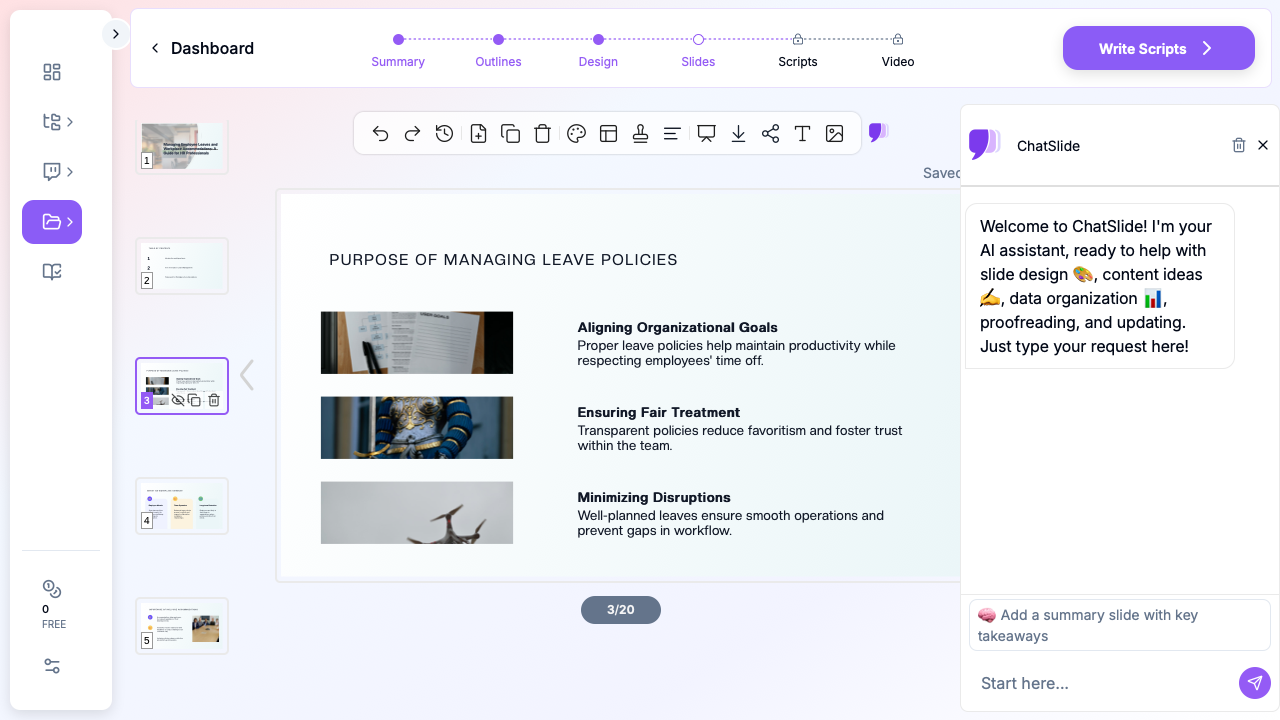
ChatSlide generates a structured outline covering the key components of leave management training. A typical outline might include:
- Purpose and importance of consistent leave management
- Overview of key leave types (FMLA, ADA, state leaves, company PTO)
- Manager responsibilities when receiving a leave request
- The interactive process for workplace accommodations
- Documentation requirements and common pitfalls
- Return-to-work procedures and ongoing management
Review the outline and adjust it to match your training goals. If your audience already understands FMLA basics and needs deeper training on accommodations specifically, remove or condense the introductory sections and expand the interactive process content.
Generate Your Slide Deck
Once the outline is finalized, ChatSlide creates a complete presentation with professional formatting, relevant imagery, and clearly organized content. Each slide covers one concept, keeping the information digestible for a non-HR audience.
Customize with Your Policies
The AI provides the framework, but the most effective training connects general principles to your organization's specific policies and processes. Enhance the generated deck by adding:
- Your company's specific leave request forms and where to find them
- Contact information for your leave administration team or third-party administrator
- State-specific leave requirements that apply to your locations
- Real examples of accommodation solutions that have worked at your organization (anonymized, of course)
- Links to your HRIS or leave management system with screenshots of key workflows
Key Topics for HR Leave Training Presentations
FMLA Fundamentals for Managers. Cover eligibility criteria, qualifying reasons, the 12-month entitlement calculation, intermittent leave rules, and what managers can and cannot ask when an employee requests FMLA.
ADA Interactive Process. Walk through the four-step interactive process: receiving a request, gathering information, identifying possible accommodations, and implementing the chosen accommodation. Include examples of reasonable accommodations across different job types.
State and Local Leave Laws. Many states have leave requirements that go beyond federal law. Create separate modules for each state where you have employees, covering paid family leave, paid sick leave, and state disability programs.
Return-to-Work Management. Cover fitness-for-duty certifications, modified duty programs, how to handle requests for extended leave beyond FMLA exhaustion, and the transition back to full duties.
Leave Abuse and Attendance Management. Train managers on how to address suspected leave abuse without retaliating against protected leave usage. Cover documentation standards and when to involve HR.
Manager Communication Guide. Provide scripts and templates for common conversations: receiving an initial leave request, checking in during a leave (appropriately), discussing return-to-work plans, and addressing team workload during an absence.
Tips for HR Training Presentations
Lead with the "why." Managers are more likely to follow proper procedures when they understand the business and legal reasons behind them. Start with real consequences of mishandled leave situations — not to scare, but to establish why this training matters.
Use decision trees. When an employee says "I need to take time off for a medical procedure," what should the manager do? A visual decision tree is more useful than a paragraph of policy language.
Include practice scenarios. After covering each topic, present a realistic scenario and ask managers what they would do. This active engagement helps cement the learning far better than passive listening.
Keep slides visually clean. HR policies are text-heavy by nature. Fight the urge to put entire policy paragraphs on slides. Use bullet points for key principles and provide the detailed policy document as a separate reference.
Plan for updates. Leave laws change. Build your training deck in a way that makes it easy to update specific sections when regulations change or your company's policies evolve.
Get Started
Your managers need clear, actionable guidance on leave management — not another dense policy manual. With ChatSlide, you can turn your HR expertise into professional training presentations that help managers handle leave and accommodation situations confidently and consistently.
Visit ChatSlide to build your HR training deck today.