
Quick Answer: ChatSlide is the AI presentation maker infection preventionists use to build an infection prevention and control (IPC) deck — hand hygiene in-service, a CLABSI or CAUTI bundle refresher, an annual competency, an Infection Prevention Week talk — in under two minutes. Upload your policy document, bundle checklist or surveillance spreadsheet and the slides are built from those files, with charts plotted from your own rate data. It is used by teams at 750+ universities and by 280,000+ professionals, searches PubMed, Google Scholar and ClinicalTrials.gov from inside the editor, respects an exact slide count, and exports to PowerPoint, PDF, Google Slides or a narrated video. Free to start, no card required.
The Infection Control Training Problem
IPC education is relentless and repetitive. The same hand hygiene message has to reach night shift, agency staff, environmental services, the new residents in July and the unit that just failed an audit — and it has to land differently each time. Meanwhile the real work is surveillance, outbreak response and rounding, and the slides get built after hours.
The content is also awkwardly shaped. A bundle is a checklist, not a narrative. A surveillance report is a spreadsheet of rates per 1,000 device days that means nothing to a ward without a chart. A policy is twelve pages of "shall" statements that have to become six slides a charge nurse can deliver in a huddle. Each format needs translating, and translating is what eats the evening.
Then there is the calendar. International Infection Prevention Week falls in October every year, annual competencies come due, accreditation surveys arrive, and each one wants a deck that is recognisably this year's rather than last year's with the dates changed.

What Makes ChatSlide Powerful for IPC Decks
Your policy, bundle or audit tool is the source
Upload the document — the central line insertion checklist, the isolation policy, the environmental cleaning SOP — and the deck is built from that file rather than from generic infection control knowledge. The practice on the slide is then your organisation's practice, which is the only version that matters at the bedside.
Charts built from your own surveillance numbers
Upload the spreadsheet and the compliance trend or device-infection rate is plotted from your figures. ChatSlide does not invent the data behind a chart; it plots what you give it. For IPC that distinction is the whole credibility of the talk, because a unit will argue with a rate they do not recognise.
The audience field sets the altitude
Write "environmental services staff" and the deck comes back as what to clean, in what order, with what dwell time. Write "infection prevention committee" and the same material comes back as rates, trends and interventions. One field, one regeneration, same source material.
Exact slide count is an instruction, not a suggestion
"Six slides for a 10-minute huddle" is honoured as given — which is the usual shape of IPC teaching, where the slot is short and fixed. Review the outline before a single slide is drawn.
OCR reads scanned policies and paper audit forms
Much IPC documentation is a scan of a signed policy or a photographed audit tool. OCR reads it, so the content comes through as text you can build on instead of an image you have to crop onto a slide.
PubMed, Google Scholar and trial registry search inside the editor
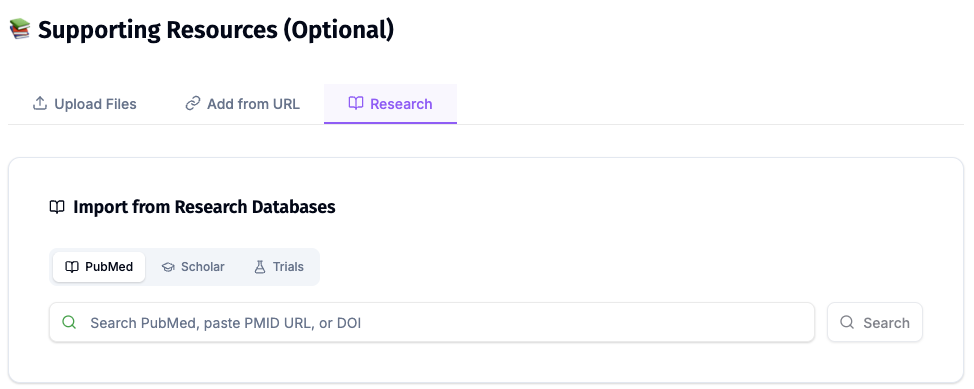
When staff ask why the practice changed — why chlorhexidine bathing, why the dwell time, why daily line necessity review — the answer is a study. Pull it by PMID or DOI from the Research tab and keep the citation attached to the slide.
Speaker notes written against the clock
Each slide gets notes you can read aloud, which is what lets a deck be handed to a unit educator who did not write it and still be delivered in the ten minutes available.
How ChatSlide Builds Your Infection Control Deck
- Upload what you already have. Policy PDF, bundle checklist, last quarter's surveillance export, the audit tool, your previous year's deck — any combination.
- Say who it is for and how long you have. "Twelve slides, 15-minute in-service, med-surg nursing staff, focus on hand hygiene moments and glove misuse" is a usable instruction.
- Review the outline first. Confirm the sequence matches how you actually teach it before slides are generated.
- Generate, then verify. Slides, charts and speaker notes come back together. Check every rate, threshold and policy statement against your source documents, edit in place, then export to PowerPoint, PDF, Google Slides or a narrated video.
Use Cases for Infection Prevention Presentations
Hand hygiene in-service. Challenge: the same five moments, delivered for the fourth time this year, to staff who have heard it. Rebuild it around this unit's own observation data rather than the generic message. Saves 2–4 hours.
CLABSI, CAUTI or SSI bundle refresher. Challenge: a checklist has to become teaching without losing a single element. Upload the bundle and keep the elements intact as the deck's spine. Saves 3–5 hours.
Quarterly surveillance report to committee. Challenge: rates per 1,000 device days, trended, with the interventions that moved them. Upload the export and let the charts come from your numbers.
International Infection Prevention Week. Challenge: a themed talk every October, visible to the whole organisation, wanted in a week. Build one project and export short versions for huddles, screens and email.
Annual competency and orientation. Challenge: standard-precautions content that must be identical for everyone and refreshed every year. Keep one project and regenerate it rather than editing last year's file.
Outbreak and transmission-based precautions briefing. Challenge: a cluster is identified on Friday and the ward needs a briefing deck before the weekend. Start from the organism, the precautions and your own case line list.
IPC for environmental services and support staff. Challenge: the same transmission principles, pitched for non-clinical staff and often in a second language. Change the audience field, generate in the language the team speaks.
Infection Control Presentation Tools Compared (2026)
| ChatSlide | Gamma | Tome | Beautiful.ai | |
|---|---|---|---|---|
Build the deck from an uploaded policy or bundle document | Yes | Limited | Limited | Limited |
OCR for scanned policies and paper audit tools | Yes | No | No | No |
Charts built from your own surveillance spreadsheet | Yes | Partial | No | Template charts |
PubMed / Google Scholar / trial registry search built in | Yes | No | No | No |
Exact slide count respected | Yes | Approximate | Approximate | Approximate |
Audience level controls the altitude | Yes | Approximate | Approximate | Approximate |
Timed speaker notes for a hand-off educator | Yes | Basic | Basic | Basic |
Export to narrated video for asynchronous staff | Yes | No | No | No |
PowerPoint export that stays editable | Yes | Yes | Limited | Yes |
Interface languages | 30+ | Fewer | Fewer | Fewer |
Time Comparison: Manual vs. AI-Assisted
| Task | Manual | With ChatSlide |
|---|---|---|
Turn a policy or bundle document into a teaching sequence | 2–3 h | 15 min |
Chart the quarter's surveillance data | 1–2 h | 10 min |
Rebuild the same content for a second audience | 2–3 h | 5 min |
Find and format the supporting evidence | 1–2 h | 15 min |
Draft speaker notes to a 10-minute slot | 1 h | 10 min |
Total | 7–11 h | ~55 min |
Direct Research Database Access
ChatSlide's Research tab connects to the databases physicians use daily:
- PubMed: Search by keyword, PMID, or DOI. Find the landmark trials, recent publications, and clinical guidelines relevant to your case. The AI reads abstracts and incorporates key findings into your slides with citations.
- Google Scholar: When your topic spans disciplines — say, the intersection of genetics and oncology — Scholar captures the broader academic literature that PubMed alone might miss.
- Clinical Trials (NCT): Presenting on a treatment where pivotal trials are ongoing? Search by NCT number or condition to pull trial design, endpoints, and status into your slides.
What a Strong IPC Presentation Includes
One behaviour, not ten. A deck that asks a unit to change everything changes nothing. Name the single observable behaviour this session is about.
The unit's own data, early. Staff engage with their own numbers and argue with everyone else's. Put the local figure on slide two.
The bundle shown as a bundle. Elements listed, in order, with nothing dropped to make the layout work. The completeness is the intervention.
Observation framed without blame. Aggregate findings, patterns rather than names, and a fix the unit can own. Audit data presented as an accusation stops being collected honestly.
The reason behind the practice. One study, named, for the element people resist most. "Because policy" ends the discussion without changing the behaviour.
A barrier slide. Empty dispensers, gloves in the wrong size, a sink behind a door. Most non-compliance is a supply and layout problem wearing a training costume.
A measurable follow-up. What will be re-observed, by whom, and when the unit will see the result.
The date and the policy version on the slide. IPC guidance changes; an undated competency deck is wrong eventually.
Best Practices
Do:
- Upload the actual policy, bundle or audit tool rather than describing it in the prompt.
- Put your own surveillance numbers in the chart, and say which period and denominator they cover.
- Set the slide count to the slot you really have — most IPC teaching is 10 to 15 minutes, not an hour.
- Regenerate the same project for each audience instead of maintaining separate decks per staff group.
- Verify every rate, threshold, dwell time and precaution category on the slide against your source before delivering it.
Don't:
- Do not let the AI supply a contact time, dilution, dwell time or isolation duration that your policy did not state. Check every one.
- Do not present a national or society recommendation as your organisation's policy when the two differ. Say which you are describing.
- Do not put patient identifiers, medical record numbers or a named case line list into a prompt or upload when illustrating an outbreak.
- Do not name individual staff or units in observation findings used for teaching.
- Do not reuse last year's competency deck with only the date changed — guidance and your own rates have both moved.
IPC Education Across a Health System
Infection prevention is organisation-wide by definition: the same competency has to reach every unit, every site and every staff group, and look like it came from one department. ChatSlide Enterprise adds SSO, centralized team billing, shared brand templates, and team collaboration on a single deck library so the hand hygiene deck used at one hospital is the one used at all of them — contact us to set it up.
Note on patient data: ChatSlide's standard plans are not a HIPAA-covered service — keep PHI out of slide content and uploads. For hospital systems, group practices, and clinics that need a Business Associate Agreement, our Enterprise plan offers HIPAA-compliant deployment options — contact us to discuss BAA terms, SSO, and on-prem / private-cloud hosting.
Frequently Asked Questions
Can it build the deck from our own policy instead of generic infection control content? Yes, and for IPC it should. Upload the policy, bundle or SOP and the slides are generated from that file, so the practice taught is the practice your organisation actually requires.
Can it chart our surveillance data? Yes. Upload the spreadsheet and the trend or rate chart is plotted from your figures. It does not generate or estimate rates — the numbers are the ones you provide.
Can it handle a scanned policy or a photographed audit form? Yes. OCR reads scanned and image-rendered files, so the content comes through as text rather than as a cropped screenshot.
Can I make a short version for a huddle and a longer one for a committee? Yes. Keep one project, change the slide count and audience, and regenerate. The source documents stay the same.
Does it check my infection rates or dwell times for accuracy? No. It builds slides from what you upload, and you remain the verifier. Read every number, contact time and precaution category against your source before you teach it.
How is this different from your infectious disease and public health guides? Infectious disease is clinical ID content — grand rounds, bacteremia cases, antimicrobial stewardship therapeutics. Public health is population-level health promotion. This page is the IPC practitioner's job: hand hygiene, device bundles, precautions, surveillance reporting and competency training inside a facility. For the teaching craft itself see nursing education, and for the general clinical deck see the medical presentation guide.
Can staff who miss the session watch it later? Yes. The same project exports as a narrated video, which fits night shift and agency staff better than a slide file nobody opens.
Is it free? Yes, free to start with no card required. Paid plans add higher limits and more export options.
What languages does it support? The interface runs in 30+ languages, and decks can be generated in the language your staff speak — useful for environmental services and support teams.
Get Started
Upload your policy and this quarter's surveillance export, say which unit is in the room and how many minutes you have, and let ChatSlide build the first full draft while you still have time to check it against the source.
Make your infection control presentation with ChatSlide → — free to start, no credit card required.