
Quick Answer: ChatSlide is an AI presentation maker built for nuclear medicine physicians, residents, and medical physicists. Describe your topic — PSMA theranostics, FDG PET interpretation, dosimetry workflows, a radiation-safety in-service — or upload a paper, protocol, or existing deck, and it generates a structured, citable slide deck in under two minutes. It pulls sources directly from PubMed, Google Scholar, and ClinicalTrials.gov, builds real charts from your own numbers, writes speaker notes, works in 40+ languages, and exports to PowerPoint, PDF, or narrated video. Used by professionals at 750+ universities and research institutions. Free to start, no credit card.
The Nuclear Medicine Presentation Problem
Nuclear medicine talks carry an unusual load. A single slide may need a tracer, an indication, an administered activity, a dosimetry constraint, and the trial that established all four — each of which has to be exactly right, because the audience includes people who will quote it back at you. Building that deck by hand means moving between a PubMed tab, a protocol binder, a PACS screenshot, and PowerPoint for an entire evening.
The field also moves faster than the slide library. A deck assembled around ¹⁸F-FDG and conventional SPECT a few years ago now needs ⁶⁸Ga-DOTATATE, PSMA PET, ¹⁷⁷Lu radioligand therapy, and voxel-based dosimetry to feel current. Every update means rebuilding, not editing.
And the same material gets presented to different rooms. A referring-oncologist talk, a resident teaching session, a hospital board pitch for a new theranostics service, and a radiation-safety in-service are four decks drawn from one body of knowledge — with four different depths, four different vocabularies, and sometimes four different languages.

What Makes ChatSlide Powerful for Nuclear Medicine
Three ways in
Start from a topic prompt ("PSMA PET/CT in biochemical recurrence: acquisition, interpretation pitfalls, and theranostic eligibility, for nuclear medicine residents"), from an uploaded document (a guideline PDF, a departmental protocol, a manuscript draft, a conference abstract), or from an existing deck you want restructured and modernised. The more clinical context you give — tracer, indication, audience, time limit — the more usable the first draft.
PubMed, Scholar, and trial registry built in
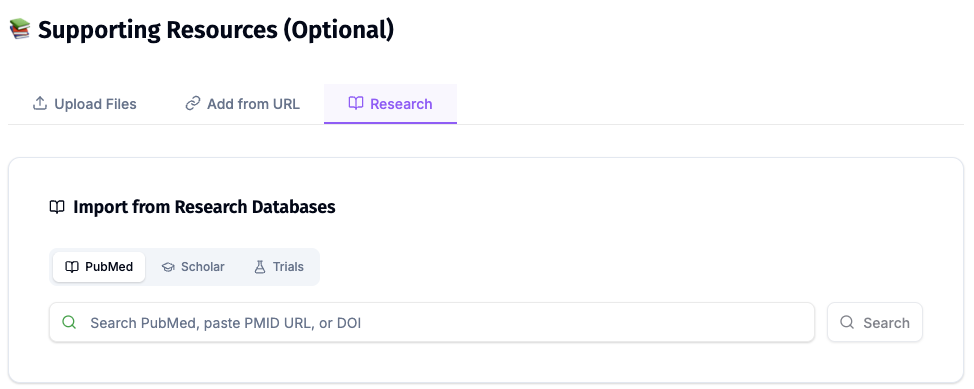
The Research tab searches the literature while you build, not in a separate browser session. Pull the pivotal trial for a radioligand therapy, the current procedure guideline, or the ongoing study your audience will ask about, and the generated slides carry the citation with the claim.
Real charts from your own numbers
Paste or upload your data — detection rates by PSA stratum, SUV distributions, lesion-level response, departmental scan volumes, absorbed-dose ranges by organ — and ChatSlide renders a clean chart rather than a bulleted approximation. For a service-line business case, your own throughput and turnaround figures are the argument.
Your images, placed properly
Upload de-identified PET/CT fusion captures, maximum-intensity projections, SPECT/CT slices, time-activity curves, or equipment photographs, and they are laid out at a size an auditorium can actually read. Keep identifiers out of what you upload.
Speaker notes written with the slide
Each slide can come with notes in your voice, which matters when you are narrating a parametric map or walking a referring physician through why a positive finding does not automatically mean eligibility.
40+ languages, including right-to-left
Nuclear medicine is a global specialty and a lot of its teaching happens outside English. Generate in Spanish, Arabic, Hebrew, Turkish, Chinese, Portuguese, or French, or generate once and produce a second language version of the same deck.
Export where you need it
PowerPoint for the conference laptop, PDF for the handout, or a narrated video for asynchronous teaching and for the referrers who will never attend your session live.
How ChatSlide Builds Your Nuclear Medicine Deck
- Describe the talk or upload the source. Name the tracer, the indication, the audience, and the time slot. "25 slides on PET/CT in paraneoplastic syndromes for nuclear medicine physicians at a national conference" produces a markedly better outline than "PET/CT."
- Review and reshape the outline. You get a section structure before any slide is rendered. Reorder, cut, or deepen — this is where a 45-minute lecture and a 10-minute case presentation diverge.
- Add evidence and data. Search PubMed, Scholar, or ClinicalTrials.gov from the Research tab; drop in your own tables for charts; upload your imaging captures.
- Generate, edit, export. Slides render in about two minutes. Refine any slide with the editing tools, then export to PPTX, PDF, or video.
Direct Research Database Access
ChatSlide's Research tab connects to the databases physicians use daily:
- PubMed: Search by keyword, PMID, or DOI. Find the landmark trials, recent publications, and clinical guidelines relevant to your case. The AI reads abstracts and incorporates key findings into your slides with citations.
- Google Scholar: When your topic spans disciplines — say, the intersection of genetics and oncology — Scholar captures the broader academic literature that PubMed alone might miss.
- Clinical Trials (NCT): Presenting on a treatment where pivotal trials are ongoing? Search by NCT number or condition to pull trial design, endpoints, and status into your slides.
Use Cases in Nuclear Medicine
Conference lecture on a tracer or indication. A 25-slide talk on PET/CT in paraneoplastic syndromes, or on somatostatin-receptor imaging in neuroendocrine tumours, for an audience of specialists. The hard part is the evidence scaffold, and that is what the Research tab supplies. Typical saving: a full evening.
Theranostics service business case. Convincing a hospital director, an oncology department, or a national programme to fund a radioligand therapy service means pairing the clinical rationale with throughput, staffing, shielding, and referral projections. Charts from your own planning numbers do more work here than any amount of prose. Typical saving: half a day.
Resident and fellow teaching. Interpretation pitfalls — physiologic PSMA uptake in ganglia and urinary activity, FDG in brown fat and post-treatment inflammation, attenuation-correction artefacts — are a recurring curriculum. Build the session once, then regenerate variants as guidance changes.
Referring-physician education. The same content at a different altitude: what the scan answers, when to order it, what the report means for the next decision. A narrated video version reaches the referrers who cannot attend.
Radiation safety and technologist in-service. Handling, administered activity, patient release criteria, contamination response, and documentation — mandatory, repeated, and tedious to rebuild each cycle.
Departments and training programmes. Teams running a shared curriculum across several sites can work from one set of brand-consistent templates instead of a folder of divergent decks. See the Enterprise note below.
Nuclear Medicine Presentation Tools Compared (2026)
| ChatSlide | Gamma | Tome | Beautiful.ai | |
|---|---|---|---|---|
PubMed / Scholar / trial-registry search | Yes, built in | No | No | No |
Citations attached to generated claims | Yes | No | No | No |
Charts from your own data | Yes | Limited | Limited | Yes |
Upload imaging captures and documents | Yes | Partial | Partial | Partial |
Generate from an existing deck | Yes | Limited | No | No |
Speaker notes generated | Yes | Partial | No | No |
Narrated video export | Yes | No | No | No |
Languages | 40+ | Limited | Limited | Limited |
PowerPoint export | Yes | Yes | Yes | Yes |
Free tier | Yes | Yes | Limited | Limited |
Time Comparison: Manual vs. AI-Assisted
| Task | Manual | With ChatSlide |
|---|---|---|
Literature search and reference collection | 2–3 hours | 20–30 minutes |
Outline and narrative structure | 1 hour | 5–10 minutes |
Drafting 25 slides | 3–4 hours | ~2 minutes to first draft |
Charts from your data | 1 hour | 10 minutes |
Speaker notes | 1–2 hours | Generated, then edited |
Second-language version | Rebuild from scratch | Regenerate |
What a Strong Nuclear Medicine Presentation Includes
State the clinical question before the tracer. The reason a study was ordered determines which tracer, which protocol, and which pitfalls matter. Decks that open with physics and arrive at the patient late lose the room.
Pair diagnostic and therapeutic agents explicitly. Theranostics only makes sense as a pair: somatostatin-receptor imaging selecting patients for ¹⁷⁷Lu-DOTATATE, PSMA PET selecting for ¹⁷⁷Lu-PSMA-617. Show the pairing as a decision, not a list.
Give acquisition parameters that make results comparable. Uptake time, injected activity, patient preparation, field of view, and reconstruction belong on a slide whenever you show quantitative results. Without them, a change in SUV is not interpretable.
Teach the false positives. Physiologic uptake, inflammation, fractures, benign structures, and treatment effect generate more misreads than subtle true positives. Name them with images.
Be precise about eligibility versus imaging positivity. Target-positive disease is necessary, not sufficient. Organ function, prior therapy, disease distribution, and discordant lesions all sit between a positive scan and a treatment decision.
Treat dosimetry as a clinical variable. Absorbed dose to tumour and to kidney and marrow varies substantially across patients at the same administered activity. If you present dosimetry, present the uncertainty with it.
Close with what changes on Monday. Referral pathway, protocol change, reporting template, follow-up interval. A specialty audience wants the operational consequence.
Best Practices
Do:
- Name the tracer, indication, audience, and time limit in your prompt
- Pull citations from the Research tab as you build, so claims and sources stay attached
- Use your own departmental data for the charts that carry an argument
- Upload de-identified imaging rather than describing findings in text
- Generate speaker notes, then rewrite them in your own voice
- Verify every dose, activity, and guideline figure against the primary source before presenting
Don't:
- Put patient identifiers in prompts, uploads, or slide content
- Present a quantitative comparison without the acquisition parameters behind it
- Let an AI-generated numeric claim reach an audience unverified — you are the clinical authority in the room, not the tool
- Reuse a tracer-era deck without checking current guidance
For Departments and Programmes
Nuclear medicine departments, hospital systems, and national training programmes can standardise on shared brand templates, centralised team billing, SSO, and collaborative editing so a curriculum stays consistent across sites. For organisations that need a Business Associate Agreement or private deployment, contact us.
Note on patient data: ChatSlide's standard plans are not a HIPAA-covered service — keep PHI out of slide content and uploads. For hospital systems, group practices, and clinics that need a Business Associate Agreement, our Enterprise plan offers HIPAA-compliant deployment options — contact us to discuss BAA terms, SSO, and on-prem / private-cloud hosting.
Frequently Asked Questions
Can ChatSlide make a nuclear medicine presentation from a PDF of a guideline or paper? Yes. Upload the document and it extracts the structure and key content into a deck. This is the fastest route for journal clubs and guideline-update sessions.
Does it cite the sources it uses? Slides built from Research-tab results carry their citations. Always verify figures against the primary source before presenting — the tool assembles evidence, it does not replace your review of it.
How is this different from your radiology guides? Medical imaging and radiology covers cross-sectional and radiographic teaching broadly, and oncologic imaging covers cancer staging, response assessment, and tumour boards. This guide is for nuclear medicine as a specialty — radiopharmaceuticals, theranostic pairing, radioligand therapy, and dosimetry. Radiation oncology is external-beam and brachytherapy, a different discipline.
Can I upload PET/CT images? Yes, as de-identified image files. Remove patient identifiers before uploading; follow your institution's policy for teaching use.
Can it build the deck in a language other than English? Yes — 40+ languages, including right-to-left scripts. You can also generate a second-language version of a deck you already built.
Can it make a narrated video instead of slides? Yes. Export as a narrated video for asynchronous teaching, referring-physician education, or sharing with colleagues who miss the live session.
Is it free? There is a free tier with no credit card required. Paid plans add capacity and advanced features — see pricing.
Is it suitable for a conference talk, not just teaching? Yes. Conference decks are the most common use among specialist physicians on paid plans. Give the time limit in your prompt so the slide count matches the slot.
Get Started
Describe your talk — the tracer, the indication, the audience, the time slot — or upload the paper you are presenting, and have a structured, cited draft in about two minutes. Then spend your evening on the clinical reasoning rather than on slide layout.
Make your nuclear medicine presentation with ChatSlide — free to start, no credit card required.
Related: oncologic imaging presentations · medical imaging and radiology presentations · oncology and hematology presentations