Quick Answer: ChatSlide is the AI presentation maker anesthesiologists, cardiac anesthesia fellows, anesthesia residents and nurse anesthesia (CRNA) educators use to build a cardiac anesthesia lecture (anesthesia for CABG and off-pump CABG, valve surgery, aortic dissection and aneurysm repair, or cardiopulmonary bypass and separation) in under two minutes. Upload your department's protocol, your syllabus or the review article you teach from, and the slides are built from those files. It is used by teams at 750+ universities and by 290,000+ professionals, searches PubMed, Google Scholar and ClinicalTrials.gov from inside the editor, respects an exact slide count, and exports to PowerPoint, PDF, Google Slides or a narrated video. Free to start, no card required.
The Cardiac Anesthesia Lecture Problem
Cardiac anesthesia is taught procedure by procedure, and every procedure has its own physiology. Coronary bypass is about myocardial oxygen supply and demand. Aortic stenosis punishes tachycardia and hypotension; mitral regurgitation tolerates them differently. Off-pump surgery moves the heart while you are trying to keep it perfused. Aortic dissection repair brings in circulatory arrest and cerebral perfusion strategies that most trainees have only read about.
So a teaching program rarely needs one deck. It needs a series: anatomy and the cardiac cycle, preoperative risk, then one session per operation, each with hemodynamic goals, induction, monitoring, the bypass run and separation. Building that series by hand means rewriting the same structure eight times and still finding the evidence for every recommendation.
And the audience changes the altitude. A first-year anesthesia resident needs the pressure-volume loop explained. A CRNA program needs the case flow and the drugs in the order they are used. A fellows' conference wants the trial behind each choice.

What Makes ChatSlide Powerful for Cardiac Anesthesia Decks
Your protocol, syllabus and review articles are the source
Upload the departmental cardiac anesthesia protocol, the course syllabus, the textbook chapter you assign or a review article. The deck is built from those files rather than a generic overview, so the drugs, targets and monitoring follow what your institution actually teaches.
One lecture per procedure, same structure every time
Ask for the same section order for each session (hemodynamic goals, induction, maintenance, bypass, separation, postoperative handover) and each deck in the series comes back in that shape. CABG, off-pump CABG, aortic valve, mitral valve and aortic surgery stay consistent, which makes the series easier to teach and to study from.
The audience field sets the altitude
Write "nurse anesthesia students, first cardiac rotation" and the deck explains the physiology behind each goal. Write "cardiac anesthesia fellows, journal-based conference" and it leads with the evidence and the controversies. One field, one regeneration, same source material.
Exact slide count and time slot respected
"Twenty slides for a 45-minute lecture: coronary anatomy, determinants of myocardial oxygen supply and demand, risk stratification, induction, off-pump positioning, separation from bypass, take-home points" is followed as written. Review and reorder the outline before a single slide is drawn.
PubMed, Google Scholar and trial registry search inside the editor
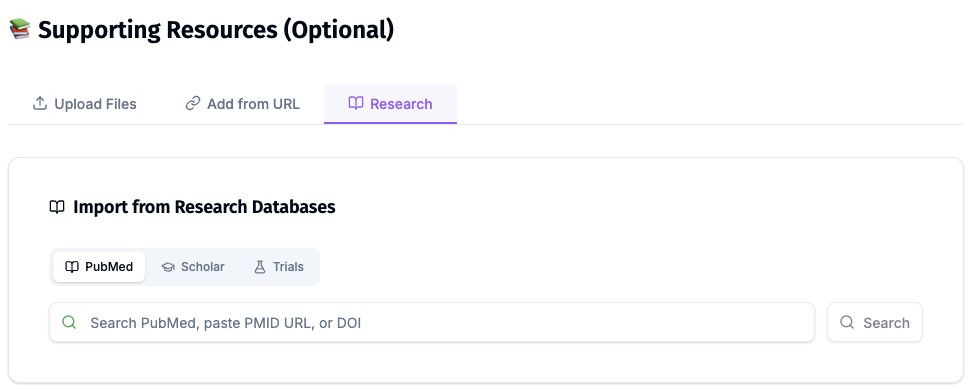
Pull the guideline, the systematic review or the trial by keyword, PMID, DOI or NCT number from the Research tab and keep each citation on the slide that makes the claim.
Diagrams, tables and speaker notes
Hemodynamic goal tables, classification slides and step-by-step case flows come back as structured layouts, not paragraphs. Each slide gets speaker notes timed to your slot, and a finished deck exports as a narrated video for asynchronous teaching.
How ChatSlide Builds Your Cardiac Anesthesia Deck
- Upload what you already have. The protocol, the syllabus, a chapter or a review, in any combination.
- Say who it is for and how long you have. "45-minute lecture for anesthesia residents on anesthetic management for aortic valve replacement, including hemodynamic goals, induction and separation from bypass" is a usable instruction.
- Review the outline first. Check that every learning objective has a section before slides are generated.
- Generate, then verify. Slides, images and speaker notes come back together. Check every drug, dose, target and citation against your sources, then export to PowerPoint, PDF, Google Slides or a narrated video.
Use Cases for Cardiac Anesthesia Presentations
Anesthesia for CABG. Challenge: teach the balance of myocardial oxygen supply and demand, induction in patients with coronary disease, monitoring for ischemia and preparation for bypass. Build the goals table from your protocol.
Off-pump CABG. Challenge: hemodynamic instability while the heart is positioned and stabilized. A slide per target vessel and a clear plan for what to do when pressure falls keeps the session practical.
Valve surgery. Challenge: aortic stenosis, aortic regurgitation, mitral stenosis and mitral regurgitation each have different preload, rate, rhythm and afterload goals. Ask for one comparison table, then one section per lesion.
Aortic dissection and aneurysm repair. Challenge: classification systems, deep hypothermic circulatory arrest and cerebral perfusion strategies in one session. Put the classification on its own slide and the perfusion strategy on another so neither gets buried.
Cardiopulmonary bypass and separation. Challenge: the bypass run, rewarming and weaning involve the surgeon, perfusionist and anesthesia team at once. Present it as a checklist with who does what at each step.
Foundations session. Challenge: coronary anatomy, the cardiac cycle and pressure-volume loops before any procedure is taught. Build it as the first deck of the series and refer back to it.
Preoperative risk assessment. Challenge: risk scores, echocardiographic findings and comorbidities turned into an anesthetic plan. Use a de-identified or illustrative case to show the reasoning.
Cardiac Anesthesia Presentation Tools Compared (2026)
| ChatSlide | Gamma | Tome | Beautiful.ai | |
|---|---|---|---|---|
Build the deck from an uploaded protocol, syllabus or review | Yes | Limited | Limited | Limited |
PubMed / Google Scholar / trial registry search built in | Yes | No | No | No |
OCR for scanned protocols and handouts | Yes | No | No | No |
Exact slide count and section order respected | Yes | Yes | Approximate | Approximate |
Audience level controls the altitude | Yes | Approximate | Approximate | Approximate |
Speaker notes for every slide | Yes | Basic | Basic | Basic |
Export to narrated video for asynchronous teaching | Yes | No | No | No |
PowerPoint export that stays editable | Yes | Yes | Limited | Yes |
Interface languages | 30+ | Fewer | Fewer | Fewer |
Time Comparison: Manual vs. AI-Assisted
| Task | Manual | With ChatSlide |
|---|---|---|
Turn learning objectives into a slide sequence | 1–2 h | 10 min |
Build hemodynamic goal tables and case-flow slides | 2–3 h | 15 min |
Find, read and cite the evidence for each recommendation | 2–4 h | 20 min |
Source diagrams and images for each section | 1–2 h | 10 min |
Draft speaker notes to the time slot | 1–2 h | 10 min |
Total per lecture | 7–13 h | ~65 min |
Direct Research Database Access
ChatSlide's Research tab connects to the databases physicians use daily:
- PubMed: Search by keyword, PMID, or DOI. Find the landmark trials, recent publications, and clinical guidelines relevant to your case. The AI reads abstracts and incorporates key findings into your slides with citations.
- Google Scholar: When your topic spans disciplines — say, the intersection of genetics and oncology — Scholar captures the broader academic literature that PubMed alone might miss.
- Clinical Trials (NCT): Presenting on a treatment where pivotal trials are ongoing? Search by NCT number or condition to pull trial design, endpoints, and status into your slides.
What a Strong Cardiac Anesthesia Lecture Includes
Physiology first, then the plan. State the hemodynamic goals for the lesion or procedure (rate, rhythm, preload, afterload, contractility) and explain why, before listing any drug. Trainees remember the reason longer than the recipe.
A goals table per lesion. For valve lectures, one table that compares the lesions side by side, then one section per lesion. It is the slide trainees photograph.
The case in the order it happens. Preoperative assessment, lines and monitoring, induction, pre-bypass period, bypass, separation, transport and handover. Follow the sequence your team actually uses.
Monitoring and imaging tied to decisions. What each monitor or echocardiographic view is used for, and what you do when it changes.
Team communication. The points where the anesthesia team, surgeon and perfusionist must agree, such as going on bypass, cooling and rewarming, and weaning, shown as explicit handoffs.
Complications and rescue. What goes wrong in this procedure, how you recognize it and the first steps, drawn from your protocol.
References. Every drug, dose, target and threshold traceable to a guideline, protocol or study the learner can look up.
Best Practices
Do:
- Upload your institution's protocol so the deck matches local practice.
- Keep one section order across the whole lecture series.
- Teach the physiology behind every hemodynamic goal.
- Use de-identified or illustrative cases for risk and case-based slides.
- Verify every drug, dose, target and citation against your sources before teaching.
Don't:
- Do not let the AI supply a dose, target or threshold your source did not state. Check every one.
- Do not put identifiable patient details, echo images with identifiers or record numbers into a prompt or upload.
- Do not present one institution's protocol as the only correct approach; name where practice varies.
- Do not reuse last year's deck without checking for guideline updates.
Cardiac Anesthesia Teaching Across a Department
Anesthesia departments, residency programs and nurse anesthesia programs teach the same cardiac curriculum to every new cohort, often from slides that drift apart between faculty. ChatSlide Enterprise adds SSO, centralized team billing, shared brand templates, and team collaboration on a single deck library, so the valve lecture given by one attending is the one given by the next — contact us to set it up.
Note on patient data: ChatSlide's standard plans are not a HIPAA-covered service — keep PHI out of slide content and uploads. For hospital systems, group practices, and clinics that need a Business Associate Agreement, our Enterprise plan offers HIPAA-compliant deployment options — contact us to discuss BAA terms, SSO, and on-prem / private-cloud hosting.
Frequently Asked Questions
Can it build a whole cardiac anesthesia lecture series? Yes. Create one deck per session (foundations, CABG, off-pump CABG, valves, aortic surgery, bypass and separation) and give each the same section order so the series stays consistent.
Can it make a hemodynamic goals table for valve lesions? Yes. Ask for a comparison table in the outline and it is built as a table slide. Check every entry against your textbook or protocol before teaching.
Does it check drug doses or hemodynamic targets? No. It builds slides from what you upload and the sources you choose, and you remain the verifier. Check every drug, dose and target before presenting.
Is it suitable for nurse anesthesia (CRNA) programs? Yes. Set the audience to your learners' level and upload the course objectives so each one gets its own section.
Can I present a real case? Only as a de-identified case. Remove names, dates, record numbers and any detail that could identify the patient before anything goes into a prompt or upload.
How is this different from your anesthesiology and cardiac surgery guides? Anesthesiology covers anesthesia presentations in general. Cardiac surgery covers the surgical and perfusion side: operative series, bypass protocols and outcomes. This page is the anesthetic management of cardiac procedures, taught as a lecture series. For imaging see the echocardiography guide, for the medical side of heart disease see the cardiology guide, and for evidence sessions see the journal club guide.
Is it free? Yes, free to start with no card required. Paid plans add higher limits and more export options.
What languages does it support? The interface runs in 30+ languages, and decks can be generated in the language your audience speaks.
Get Started
Upload your protocol or syllabus, name the procedure, the audience and the time slot, and let ChatSlide build the first full draft while you keep the time to check every drug and target against your sources.
Make your cardiac anesthesia presentation with ChatSlide →: free to start, no credit card required.