
Quick Answer: ChatSlide is the AI presentation maker cardiac surgeons, cardiac anesthesiologists and perfusionists use to turn an operative series, a bypass protocol or a conference abstract into a conference-ready deck in under two minutes. It is used by teams at 750+ universities and by 280,000+ professionals, imports PDFs, PowerPoints and spreadsheets directly, searches PubMed and ClinicalTrials.gov from inside the editor, builds charts from your own numbers rather than inventing them, writes speaker notes timed to your talk slot, and exports to PowerPoint, PDF, Google Slides or a narrated video. Free to start, no card required.
The Cardiac Surgery Presentation Problem
A cardiac surgery talk is three audiences in one room. The surgeon wants the operative decision. The anesthesiologist wants the hemodynamic and coagulation consequence. The perfusionist wants the circuit, the flow and the priming volume. A deck that satisfies one of them bores the other two, and a ten-minute conference slot gives you no room to satisfy them in sequence.
The content problem is worse than the audience problem. Cardiopulmonary bypass strategy is the part of the field where guidance moves fastest and where your own series is the most valuable thing you own. The EACTS / EACTA / EBCP bypass guidance, the minimally invasive extracorporeal circulation literature, your institution's transfusion thresholds and your own case numbers all have to land on the same slide without a single invented figure, because the person who will challenge the number is sitting in the second row.
So most of the work is not thinking. It is reformatting: pulling numbers out of a spreadsheet, rebuilding a bar chart, retyping a protocol from a prior deck, cutting three slides to fit eleven minutes.

What Makes ChatSlide Powerful for Cardiac Surgery Talks
Three input modes, including "I already have the deck"
Start from a topic prompt, from uploaded files, or from a link. For a cardiac surgery talk the file path is usually the right one: upload last year's bypass lecture, the EACTS guideline PDF, your outcomes spreadsheet, and a draft abstract together, and the deck is built from those instead of from generic knowledge. A prior PowerPoint can be rebuilt rather than retyped.
Your own numbers become real charts
Upload a CSV or spreadsheet of your series — case volume by year, transfusion rate, ventilation hours, cross-clamp times — and ChatSlide builds charts from those actual values. It does not fabricate a plausible-looking curve. This matters more in cardiac surgery than almost anywhere else, because a surgeon presenting their own 450-case experience is presenting the thing nobody else in the room can check except by asking you.
PubMed, Google Scholar and trial registry search inside the editor
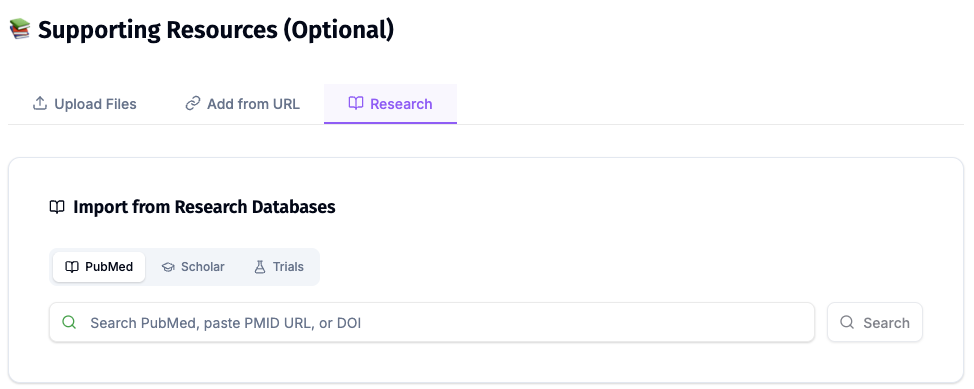
Evidence slides are built from a search you run in the Research tab, not from recall. Pull the trial, keep the citation, drop it on the slide.
Audience and slide count are instructions, not suggestions
Tell it the audience is "cardiac surgeons, cardiac anesthesiologists and perfusionists" and the altitude shifts: less anatomy primer, more circuit and physiology. Ask for exactly 40 slides and a defined section order and you get that structure, which is what a programme committee's time limit actually requires.
Speaker notes written against the clock
Every slide gets notes you can read. For a ten-minute conference slot that is the difference between finishing and being cut off mid-algorithm.
19 AI editing tools for the pass before you submit
Shorten a slide that runs long, rewrite a bullet as a sentence, change the tone from teaching to conference, regenerate one image without touching the rest of the deck.
How ChatSlide Builds Your Cardiac Surgery Deck
- Upload what you already have. Guideline PDFs, a prior lecture, your outcomes spreadsheet, the abstract. OCR reads scanned documents and figures.
- Set topic, audience and length. Name all three specialties in the audience field and give the exact slide count your session allows.
- Review the outline before any slide is drawn. Reorder sections, cut the background block, add a dedicated circuit slide. Fixing structure here is far cheaper than fixing it later.
- Generate, then refine. Slides, charts, images and speaker notes come back together. Edit in place, then export to PowerPoint, PDF, Google Slides, or generate a narrated video version for a training module.
Use Cases for Cardiac Surgery Teams
Conference abstract to ten-minute talk. Challenge: an accepted abstract and a brutal time limit. ChatSlide turns the abstract plus your figures into a fixed-length deck with timed notes. Saves roughly 4–6 hours.
Cardiopulmonary bypass protocol for the perfusion team. Challenge: a protocol document nobody reads. Upload the SOP and generate a teaching deck with the circuit decisions laid out step by step, then export it as a narrated video for asynchronous training. Saves 3–5 hours.
Morbidity and mortality review. Challenge: a case that needs an honest, structured walk-through under time pressure. Build the timeline, the decision points and the literature comparison from your own notes and a Research-tab search. Saves 2–4 hours.
Resident and fellow didactics. Challenge: a weekly teaching slot and no preparation time. Generate the session from a textbook chapter or a review article, keep the deck, and regenerate the images next year rather than rebuilding it.
Device or technique evaluation for the department. Challenge: persuading a committee to fund a change in bypass strategy. Combine the published evidence with your own cost and outcome data in one deck, with the citations visible on the slide.
Cardiac Surgery Presentation Tools Compared (2026)
| ChatSlide | Gamma | Tome | Beautiful.ai | |
|---|---|---|---|---|
Import your own operative PDF / PPTX / spreadsheet | Yes, all three | Limited | Limited | Limited |
PubMed / Google Scholar / trial registry search built in | Yes | No | No | No |
Charts built from your uploaded data | Yes | Partial | No | Template charts |
Exact slide count and section order respected | Yes | Approximate | Approximate | Approximate |
Timed speaker notes | Yes | Basic | Basic | Basic |
Export to narrated video | Yes | No | No | No |
PowerPoint export that stays editable | Yes | Yes | Limited | Yes |
Interface languages | 30+ | Fewer | Fewer | Fewer |
Time Comparison: Manual vs. AI-Assisted
| Task | Manual | With ChatSlide |
|---|---|---|
Structure a 40-slide conference talk | 2–3 h | 5 min |
Rebuild charts from your outcomes data | 1.5–2 h | 5 min |
Find and format the supporting literature | 2–3 h | 15 min |
Draft speaker notes to the time limit | 1–2 h | 10 min |
Design and image pass | 1.5–2 h | 10 min |
Total | 8–12 h | ~45 min |
Direct Research Database Access
ChatSlide's Research tab connects to the databases physicians use daily:
- PubMed: Search by keyword, PMID, or DOI. Find the landmark trials, recent publications, and clinical guidelines relevant to your case. The AI reads abstracts and incorporates key findings into your slides with citations.
- Google Scholar: When your topic spans disciplines — say, the intersection of genetics and oncology — Scholar captures the broader academic literature that PubMed alone might miss.
- Clinical Trials (NCT): Presenting on a treatment where pivotal trials are ongoing? Search by NCT number or condition to pull trial design, endpoints, and status into your slides.
What a Strong Cardiac Surgery Presentation Includes
A stated main idea, on slide two. Not "an overview of bypass strategy" but the claim you are defending, for example that a perfusion strategy is a physiological plan rather than a smaller circuit.
The patient and the indication before the technique. The room cannot judge a cannulation or flow decision without knowing who was on the table.
One slide per decision point, not per topic. Conversion from antegrade to retrograde, the choice to prepare a calcified lesion before stenting, the point at which you separate from bypass. The decision is the content.
Separation of your data from the literature. Label each clearly. If your own series has no number for an outcome, say the literature figure is literature, and say it on the slide.
Circuit and physiology made visible. Flow, pressure, temperature, hematocrit and oxygen delivery belong in a diagram or a trend, not a paragraph.
Sources on the slide, not only at the end. Conference audiences check as you speak.
A closing set of conclusions a listener can repeat. Five lines, each one a decision someone could take back to their own theatre on Monday.
Best Practices
Do:
- Name all three specialties in the audience field if all three are in the room.
- Upload your own data rather than describing it in the prompt.
- Set the exact slide count your session allows and let the outline absorb the constraint.
- Keep guideline citations visible on the slide.
- Rehearse against the generated speaker notes and cut slides, not words.
Don't:
- Do not let the AI supply a number your series did not produce. If you have no figure, present the literature figure and label it as such.
- Do not paste patient identifiers, medical record numbers, operative report headers or unredacted imaging into a prompt or upload.
- Do not use a real patient's photograph or any detail that could identify them in a teaching deck.
- Do not present a flow or pressure target as universal when your institution's protocol differs — say which protocol you are describing.
Cardiac Surgery Presentations for Departments and Hospital Systems
Cardiac surgery slides rarely belong to one person. A division's conference decks, perfusion SOP training and fellow didactics are usually shared across a surgical service, an anesthesia department and a perfusion team, often across several sites. ChatSlide Enterprise adds SSO, centralized team billing, shared brand templates so every deck leaves the institution looking the same, and team collaboration on a single library — contact us to set it up.
Note on patient data: ChatSlide's standard plans are not a HIPAA-covered service — keep PHI out of slide content and uploads. For hospital systems, group practices, and clinics that need a Business Associate Agreement, our Enterprise plan offers HIPAA-compliant deployment options — contact us to discuss BAA terms, SSO, and on-prem / private-cloud hosting.
Frequently Asked Questions
Can I upload my own outcomes spreadsheet and get real charts? Yes. Upload a CSV or spreadsheet and ChatSlide builds the chart from those values. It does not invent data points to fill a chart.
Will it respect an exact slide count for a timed conference slot? Yes. Give it the number and the section order in your prompt, and review the outline before generation to confirm the structure fits the time limit.
Can it rebuild a prior PowerPoint instead of starting over? Yes. Upload the PPTX and it is used as source material, so last year's lecture becomes this year's starting point rather than a retyping job.
Does it search the cardiac surgery literature directly? The Research tab searches PubMed, Google Scholar and ClinicalTrials.gov from inside the editor, and keeps the citation with the slide.
How is this different from your cardiology guides? Cardiology covers heart failure and general cardiology teaching; interventional cardiology covers cath lab and PCI case talks; cardio-oncology covers cardiotoxicity in cancer patients. This page is the surgical and perfusion side — operative technique, bypass strategy, circuit management and the cardiac surgery conference talk. For perioperative coagulation and airway teaching, see anesthesiology; for non-cardiac operative talks, see general surgery.
Can I turn the deck into a training video for the perfusion team? Yes. The same project exports as a narrated video, which is usually a better fit than slides for asynchronous SOP training.
Is it free? Yes, free to start with no card required. Paid plans add higher limits and more export options.
What languages does it support? The interface runs in 30+ languages, and decks can be generated in the language your audience speaks.
Get Started
Upload your abstract, your guideline PDF and your outcomes spreadsheet, name your audience, set the slide count your session allows, and let ChatSlide build the first full draft while you still have the evening to rehearse it.
Make your cardiac surgery presentation with ChatSlide → — free to start, no credit card required.