Quick Answer: A strong cultural competency training deck moves through 5 parts: (1) Why it matters — health disparities and outcome data that frame the case, (2) Core concepts — cultural humility, implicit bias, and the CLAS standards, (3) Communication skills — working with interpreters, the teach-back method, and respecting health beliefs, (4) Population-specific considerations presented as composites rather than stereotypes, and (5) Application — case scenarios and a commitment to practice change. Aim for 20–35 slides for a one- to two-hour in-service. ChatSlide turns your training outline or a policy PDF into the framework slides, communication scenarios, and discussion prompts.
The Challenge of Cultural Competency Presentations
Cultural competency and culturally responsive care have become standard requirements across healthcare — nursing in-services, behavioral health continuing education, residency didactics, social work training, and hospital-wide DEI initiatives all touch the same material. A clinical educator, staff development coordinator, or behavioral health trainer regularly finds themselves building a deck that has to satisfy a licensing board or accreditation requirement while still being genuinely useful to a room full of busy clinicians.
The preparation problem is unusually delicate. Unlike a procedure lecture, this content is about people's identities, beliefs, and lived experiences — which means the line between teaching cultural awareness and reinforcing stereotypes is thin. A slide that reduces a community to a bulleted list of "traits" does more harm than good. A presentation that stays so abstract it never names a real communication barrier leaves attendees with nothing to apply on Monday morning. The trainer has to land somewhere in between: specific enough to be practical, humble enough to avoid essentializing.

There is also the evidence problem. Cultural competency is sometimes dismissed as a "soft" topic, so credible presentations have to anchor themselves in real data — health disparities research, patient-experience outcomes, and validated frameworks like the National CLAS Standards. Pulling that evidence together, then translating it into slides that hold a clinical audience's attention for an hour, is exactly the kind of work that eats an evening of someone's week. AI presentation tools, used carefully, can take over the structural and visual scaffolding so the educator's energy goes into the discussion facilitation that only a person can do.
What Makes a Strong Cultural Competency Presentation
Presentations for healthcare audiences on this topic have conventions that differ from corporate diversity training or a general education talk. Getting them right is what separates a deck that earns engagement from one that gets eye-rolls.
Cultural humility over cultural "mastery." The field has largely moved away from the idea that a clinician can "become competent" in a fixed list of cultures. The stronger framing — cultural humility — treats every patient encounter as an opportunity to learn, centers the patient as the expert on their own life, and acknowledges the clinician's own biases and power. Decks that open with this framing signal current, credible thinking.
Anchored in health-equity data. A presentation that asserts disparities exist without showing them feels like opinion. One that displays real outcome gaps — in maternal mortality, pain management, behavioral health access, or chronic disease control — makes the stakes concrete. The point is not to assign blame but to motivate the skills that follow.
The CLAS standards as a backbone. The U.S. Department of Health and Human Services' National Standards for Culturally and Linguistically Appropriate Services (CLAS) give the topic a recognized structure: a principal standard plus themes around governance, communication and language assistance, and engagement/accountability. Building a section around CLAS gives the deck institutional legitimacy and a checklist attendees can actually use.
Composites, never stereotypes. Population-specific content — working with refugee and immigrant patients, LGBTQ+ patients, patients with limited English proficiency, veterans, older adults — should be framed as "considerations to ask about," not "facts about a group." The strongest slides model curiosity ("ask how the patient prefers to make decisions") rather than prescription ("this group always defers to elders").
Concrete communication skills. This is where decks earn their keep. Working with a medical interpreter (and why a family member is not an interpreter), the teach-back method, the LEARN and ETHNIC mnemonics, and how to ask about health beliefs without judgment are all teachable, demonstrable skills. A slide with a short scripted dialogue beats a slide of adjectives every time.
Reflection and application built in. The best trainings aren't lectures; they scaffold reflection. Implicit-bias self-assessment, small-group case discussion, and a closing "one change I will make" commitment turn a passive hour into something that shifts practice.
Step-by-Step: Creating Cultural Competency Slides with ChatSlide
Here is how a clinical educator can go from a blank page to a polished training deck.
1. Start from what you already have. If you have a training outline, a policy document, your organization's DEI plan, or a set of articles on health disparities, upload them. ChatSlide reads the source and pulls the structure and key points into a draft rather than making you start from scratch. If you're starting fresh, a one-line topic prompt — "cultural competency and culturally responsive care for outpatient behavioral health staff, 90-minute in-service" — is enough to generate a full outline.
2. Shape the outline before generating slides. ChatSlide produces an editable outline first. This is the moment to enforce the five-part arc — why it matters, core concepts, CLAS, population considerations, application — and to make sure population-specific sections are framed as questions to ask, not traits to assume. Reorder, rename, and trim here; it's far faster than fixing finished slides.
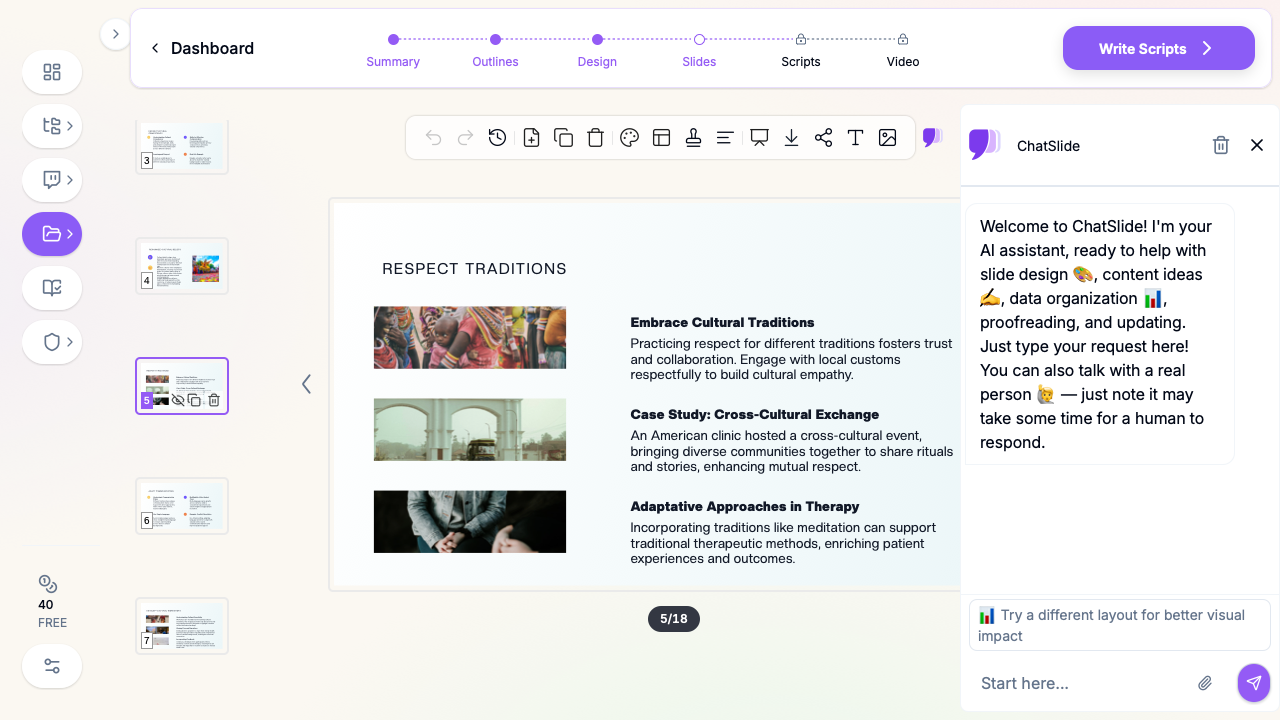
3. Generate slides with a consistent, calm design. Once the outline is right, generate the deck. Cultural competency content benefits from a restrained, professional template — readable type, generous spacing, and imagery that depicts real, diverse people respectfully rather than clip-art "diversity." ChatSlide applies a coherent theme across every slide so the deck looks intentional.
4. Let the AI add supporting visuals. Rather than leaving slides as walls of text, ChatSlide can populate them with relevant images and simple visual layouts — the difference between a slide that's read and one that's skimmed. Photographs of clinical communication, interpreter-mediated visits, and community settings keep the human subject matter human.
5. Layer in your evidence. Use the Research tab (below) to pull disparities data and framework citations directly into the deck, then add your own institution's numbers where you have them. Local data — your clinic's interpreter-request volume, your patient-experience scores by language — turns a generic training into one that obviously applies to the people in the room.
6. Add the interactive scaffolding. Insert reflection slides, a case-scenario slide or two, and a closing commitment slide. ChatSlide can draft discussion prompts and short composite scenarios you then edit for accuracy and tone.
Direct Research Database Access
ChatSlide's Research tab connects to the databases physicians use daily:
- PubMed: Search by keyword, PMID, or DOI. Find the landmark trials, recent publications, and clinical guidelines relevant to your case. The AI reads abstracts and incorporates key findings into your slides with citations.
- Google Scholar: When your topic spans disciplines — say, the intersection of genetics and oncology — Scholar captures the broader academic literature that PubMed alone might miss.
- Clinical Trials (NCT): Presenting on a treatment where pivotal trials are ongoing? Search by NCT number or condition to pull trial design, endpoints, and status into your slides.
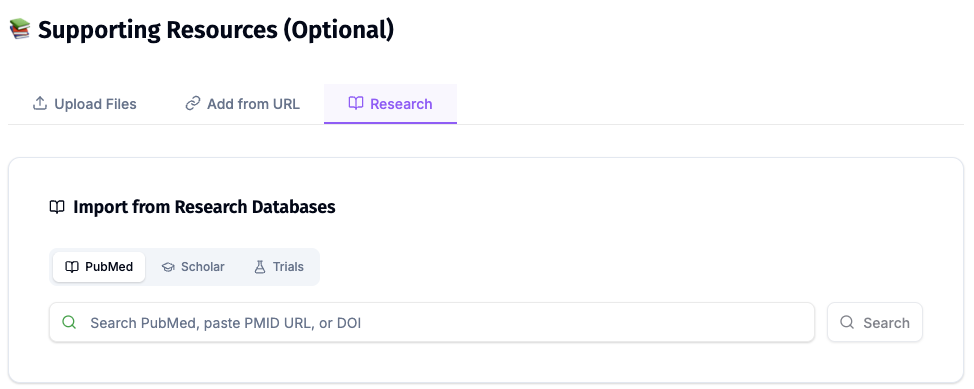
For cultural competency work specifically, the Research tab is how you ground claims about disparities and intervention effectiveness in citable literature — health-equity studies, validated cultural-humility training evaluations, and interpreter-use outcome research — rather than relying on assertion.
Tips for Cultural Competency Presentations
Lead with curiosity, not a checklist. Frame the whole deck around questions clinicians can ask their patients. The single most useful slide in many trainings is a short list of open-ended questions ("What concerns you most about this?" "Who do you involve in health decisions?" "Is there anything about your background that would help me care for you better?").
Show the interpreter skill, don't just mention it. A slide that walks through the mechanics — position yourself facing the patient, speak in short segments, address the patient directly in the first person, never use a child as interpreter — is more memorable than a slide that says "use professional interpreters."
Use composite scenarios. A two- or three-slide worked scenario that follows one composite patient through a culturally responsive encounter teaches reasoning that bullet points can't. Build the scenario from typical, non-identifiable details.
Acknowledge the limits. Credible trainers name what cultural competency can't fix — structural barriers, insurance, access — so the session doesn't oversell individual skill as the whole solution.
Close with a commitment. End on a slide that asks each attendee to name one concrete change they'll make. It converts a presentation into behavior change and gives you something to follow up on.
A note on patient data and HIPAA. ChatSlide's standard plans are not a HIPAA-covered service — keep PHI out of slide content, prompts, and uploads, and build any case examples from composite, non-identifiable details. For hospital systems, group practices, and clinics that need a Business Associate Agreement, our Enterprise plan offers HIPAA-compliant deployment options — contact us to discuss BAA terms, SSO, and private-cloud or on-prem hosting.
Get Started
Cultural competency training is too important to lose to a week of PowerPoint formatting. The clinical educator's value is in the facilitation, the local data, and the discussion — not in dragging text boxes. ChatSlide handles the structural and visual scaffolding so you can build a credible, engaging, evidence-grounded deck in an afternoon and spend your prep time on what actually changes practice.
Upload your training outline or policy document, shape the outline around the five-part arc, and generate a culturally responsive care presentation your colleagues will actually use. Try ChatSlide free and turn your next in-service into something that sticks.